Septorhinoplasty combines two procedures in one operation: septoplasty, which straightens the wall inside the nose (the septum), and rhinoplasty (a nose job), which reshapes the outside of the nose. It is planned for people who have a deviated septum that makes breathing difficult and who also want to change how their nose looks; both problems are dealt with under one anaesthetic and in one recovery period. In everyday speech, “deviated septum surgery” or surgery for a “bent nasal bone” usually means straightening the septum alone; septorhinoplasty adds a change to the outer shape of the nose.
 The results of any surgical or interventional procedure vary from person to person. You are advised to get your physician’s detailed opinion before the procedure.
What Is Septorhinoplasty?
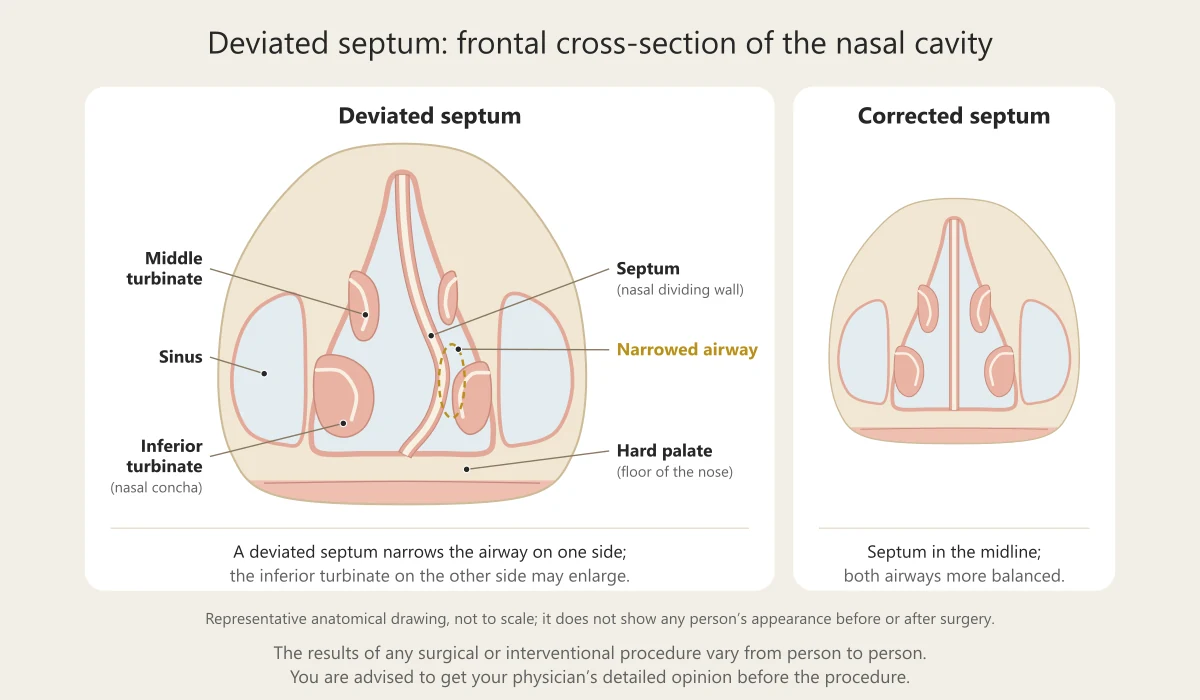
The septum is the central wall that divides the nasal cavity into a right and a left airway; both of its surfaces are covered with a thin lining (mucosa). Its front part is made of cartilage and its back part of thin bone; its upper edge, which runs along the bridge, and its front edge, near the tip, also form the main support of the nose. In most people the septum is not exactly in the middle; when the deviation becomes marked, the airway on one or both sides narrows. On the side walls of the nasal cavity are the turbinates, which warm and humidify the air you breathe in.
In the septoplasty part of the operation, the aim is to bring the crooked septum back to the midline so that the two airways are more evenly balanced. In the rhinoplasty part, the bridge, the bony framework and the tip are shaped to suit the proportions of the face. What people call a “bent nasal bone” is most often in the cartilage part of the septum, and sometimes in the bony part further back.
Why Are Both Done in the Same Operation?
The septum matters for both the inside and the outside of the nose. A deviation at its front edge or along the bridge can also push the nose to one side; correcting the outer curve without straightening the septum is often not enough. If the two procedures are done at different times, you have two anaesthetics and go through two recovery periods; done in the same operation, the airway and the shape of the nose are planned together.
Inner and Outer Deviation
“Nasal deviation” can mean two different things. An inner deviation (deviated septum) may not be visible from the outside and may show itself through breathing problems. An outer deviation is when the nose shifts to one side of the midline of the face, either in a straight line or in a C or S shape; it is often linked to an old injury and frequently occurs together with a deviated septum. In septorhinoplasty, both are assessed together and treated in the same operation.
Symptoms of a Deviated Septum
A mild deviation of the septum often causes no symptoms and needs no treatment. When the deviation noticeably obstructs airflow, the following symptoms can occur:
- Blocked nose: usually worse on one side, although both sides can be affected. A blockage that persists after a cold has cleared, and is usually felt on the same side, suggests a structural cause.
- Mouth breathing and a dry mouth: sleeping with your mouth open, especially at night, and waking with a dry mouth and throat.
- Snoring and noisy breathing: a narrowed nasal passage can contribute to snoring during sleep; some people always sleep on the same side to breathe more easily.
- Recurrent sinus problems: if the deviation narrows the area where the sinuses drain into the nose, drainage can become harder and bouts of sinusitis more frequent.
- Nosebleeds and crusting: air striking the protruding surface of the deviation dries out the inside of the nose; crusting and repeated nosebleeds can occur in this area.
- Other complaints: shortness of breath that gets worse with exertion, a feeling of pressure in the face or headaches, and in some people a reduced sense of smell.
None of these symptoms is specific to a deviated septum. A blocked nose can also be caused by allergic rhinitis, enlarged turbinates, the sides of the nostrils collapsing inwards as you breathe in, polyps or long-term use of decongestant nasal sprays; often more than one cause is involved. The operation is therefore planned only after the structure causing the blockage has been identified.
What Causes a Deviated Septum?
The most common cause is the septum growing towards one side as the nose and face develop; such deviations often cannot be traced back to any particular event. Blows to the nose, for example from a fall, a sports injury or a road accident, can also bend or break the septum; a knock in childhood that went unnoticed can cause a deviation that becomes more obvious as the nose grows. Pressure on the nose during birth is also counted among the causes.
How Is the Cause of a Blocked Nose Found?
The assessment starts with your symptoms: you are asked how long the blockage has lasted, which side it affects, how it changes at night and during exercise, and about any previous injuries to the nose, earlier nose operations, allergies and the nasal sprays you use. Then the outside and the inside of the nose are examined:
- Examination inside the nose: with a light shone through the nostrils, the front part of the septum, the turbinates and the lining of the nose are examined. Repeating the examination after a spray that temporarily shrinks the swollen lining helps to tell how much of the blockage comes from a fixed structure and how much from swelling.
- Nostril walls and the internal valve: the surgeon checks whether the sides of the nostrils, and the narrow passage just beneath the bridge (the internal nasal valve), collapse inwards when you breathe in. Narrowing here can make breathing difficult regardless of the septum and may need to be addressed in the rhinoplasty part of the operation.
- Endoscopy: if needed, a thin camera is used to view the back of the nose, the bony part of the septum and the area where the sinuses drain into the nose.
- Imaging: a CT scan may be requested if sinus disease is suspected or the deviation looks complex. Not every patient needs imaging to diagnose a deviated septum.
For the cosmetic planning, skin thickness, cartilage support and facial proportions are assessed, and photographs are taken from standard angles. If a problem such as an allergy or chronic rhinitis is found, its treatment is arranged before surgery. Symptoms such as a blockage on one side that keeps getting worse, bloody or foul-smelling discharge, or swelling or numbness of the face may point to a different cause; in that case, an ear, nose and throat (ENT) assessment is requested before the operation is planned.
Who Is Septorhinoplasty For?
This operation is usually considered for people with:
- A blocked nose that the examination shows to be caused by a deviated septum, and that affects daily life, sleep or sport.
- Alongside it, a concern about the appearance of the nose, such as a hump, a crooked or twisted nose, or a drooping or wide tip.
- A nose whose bone and cartilage have finished developing.
- General health that allows surgery and anaesthesia, and realistic expectations.
If you are happy with how your nose looks and only have trouble breathing, septoplasty on its own may be enough. If there is an active infection in the nose or sinuses, surgery is postponed until it has cleared; if you have become dependent on decongestant nasal sprays, this is dealt with first. Smoking and substances taken by sniffing can impair healing of the septum and increase the risk of a hole forming in it, so they should be discussed openly at the examination.
Septoplasty vs Septorhinoplasty: What Is the Difference?
Both operations straighten the septum; the difference is whether the outer structure of the nose is changed as well.
| Feature | Septoplasty | Septorhinoplasty |
|---|---|---|
| Aim | To open the airway | To open the airway and change the outer shape of the nose |
| What it corrects | Deviation of the cartilage and bone of the septum | The septum, plus the bony framework, the bridge, the tip and, where needed, the internal valve area |
| Outer appearance of the nose | Not intended to change | Changes to the extent planned |
| Incisions | Inside the nose; no scar on the outside | Inside the nose only with the closed technique; the open technique adds a small incision on the columella |
| Recovery | Usually no external splint and no bruising around the eyes; getting back to daily life usually takes less time | External splint; swelling and bruising around the eyes if the bony framework has been reshaped; the final shape of the nose emerges over months |
| Who performs it | Septoplasty on its own is mostly performed by ear, nose and throat (ENT) specialists | Plastic, reconstructive and aesthetic surgeons; ENT specialists |
Because septoplasty alone does not touch the bridge or the tip, a nose that looks crooked from the outside because of the deviated septum may still look crooked afterwards. If enlarged turbinates (the inferior turbinates) narrow the airway further, they can be reduced in the same operation when needed.
How Is Septorhinoplasty Performed?
The operation is performed under general anaesthesia in a fully equipped hospital licensed by the Ministry of Health. How long it takes depends on what needs to be done, but it is usually 2–4 hours; it can take longer when many cartilage grafts are needed or the nose has been operated on before. Patients usually stay in hospital for one night.
Open or Closed Technique
With both techniques, the septum is reached from inside the nose. In suitable noses, where the deviation is in the back part of the septum and only limited changes to the outer shape are planned, the closed rhinoplasty technique, with all incisions inside the nose, can be used. Where the deviation runs along the bridge or lies at the front edge of the septum near the tip, where the nose looks clearly crooked from the outside, or where many grafts are needed, the open technique allows the structures to be corrected under direct vision. The choice of technique is made at the examination.
Straightening the Septum
The lining that covers the septum is carefully lifted on both sides; the crooked sections of cartilage and bone are straightened or repositioned, or the parts that narrow the airway are removed. Throughout, the L-shaped strut of cartilage that runs along the bridge and down towards the tip is preserved; weakening this support can make the bridge sag or the tip drop. If the deviation lies within this supporting strut, the cartilage is fixed in the midline with stitches or reinforced with thin strips of cartilage; with some severe deviations, most of the septum may need to be taken out, straightened and put back. If the front edge of the septum has slipped off the bony ridge on the floor of the nose, it is brought back to the midline and secured.
The Bony Framework, Bridge and Tip
If the outer deviation comes from the bony framework, the nasal bones are freed with controlled cuts and moved to the midline; where needed, this stage uses the piezo rhinoplasty method, in which the bone cuts are made with a device that works by ultrasonic vibration. When a hump is removed or the bridge is narrowed, thin strips of cartilage (spreader grafts) can be placed on either side of the septum to keep the internal nasal valve open; these grafts also help a crooked bridge to stay straight. The tip and the sides of the nostrils are shaped to the planned form with stitches and, if needed, cartilage support.
The Septum as a Source of Grafts
Straight pieces of the septal cartilage removed during the correction are, where suitable, used as grafts to support the tip, smooth the bridge or keep the internal valve open. In a first operation, the cartilage needed can often be taken from the septum. How planning changes in a nose that has been operated on before is explained on the revision rhinoplasty page.
At the End of the Operation: Splint and Silicone Packs
A protective splint is placed over the bridge. If the septum has been straightened, soft silicone packs with a thin air channel in the middle may be placed inside the nose to hold the septum in its new position; they also help to prevent bands of scar tissue (adhesions) from forming inside the nose. The splint and packs are usually removed at the check-up 5–7 days after surgery.
Recovery: When Does Breathing Get Easier?
Recovery follows the general course of rhinoplasty; because the septum, and the turbinates if needed, are operated on as well, the swelling and blocked feeling inside the nose can last a little longer than after an operation that changes only the outer shape. The table below gives a general picture of breathing and daily life; your personal schedule is given to you when you are discharged.
| Period | Breathing | Appearance and daily life |
|---|---|---|
| First days | The nose is blocked; you breathe mostly through your mouth, which becomes dry. Slight bloody oozing is expected for the first 2–3 days. | Swelling and bruising are at their most noticeable on days 2–3; you rest with your head raised. |
| Days 5–7 | Once the packs are out, breathing usually becomes noticeably easier; a mild blockage continues because of swelling inside the nose. | The splint is removed; the nose may be taped for a while. |
| Weeks 2–4 | Crusting and, at times, blockage on one or both sides are normal. | Most people with desk jobs return to work between days 10 and 14; light exercise usually starts in weeks 3–4, once your surgeon agrees. |
| Months 1–3 | As the swelling inside goes down, breathing gets steadily easier; most of the improvement is usually felt during this period. | Intensive exercise such as running and weight training is usually resumed step by step after weeks 4–6; resting glasses on the bridge and contact sports are usually put off for 2–3 months. |
| Months 6–12 | If a blockage persists even though healing is complete, its cause is investigated at an examination. | The final shape of the nose usually becomes clear during this period; with thick skin it can take 12–18 months. |
Because the lining of the nose can stay swollen for weeks after surgery, and crusts can narrow the airway in places, the final state of the airway is judged only once the swelling inside has settled. During this time, you care for the inside of your nose with the saline sprays your surgeon recommends, and you do not blow your nose in the first weeks. Day-by-day care, sleeping position, sport and glasses are covered in detail in the rhinoplasty recovery guide.
The operation aims to remove a structural narrowing of the airway; it does not cure complaints that come from the lining of the nose, such as allergic rhinitis, and in these cases treatment may need to continue after surgery. How much breathing improves, and how the nose finally looks, vary from person to person.
Risks and Possible Complications
Like any surgical procedure, this operation on the septum and the framework of the nose carries risks. Careful planning reduces them but cannot remove them entirely:
- Bleeding: slight oozing in the first days is expected; rarely, bleeding may need packing or another intervention.
- A collection of blood or pus in the septum (septal haematoma, abscess): uncommon. Pain, a feeling of pressure or fever together with increasing blockage can be signs of it; because it can impair the blood supply to the septal cartilage, it must be drained without delay.
- A hole in the septum (perforation): this can rarely develop when the lining on both sides of the septum is damaged at opposite points.
- Blockage that persists or comes back: breathing may improve less than expected because of a deviation that remains in the septum or becomes noticeable again over time, weakness of the nostril walls or the internal valve, or enlarged turbinates.
- Adhesions inside the nose: bands of tissue can form between the septum and the side wall during healing and make breathing harder.
- Irregularities and asymmetry: irregularities on the bridge or asymmetry of the tip can occur. If the supporting structures weaken, the bridge may rarely sag or the tip drop.
- Changes in smell and sensation: a change in the sense of smell; numbness of the nasal tip, upper lip and front teeth, which is usually temporary.
- Infection and anaesthetic risks: uncommon; risks related to anaesthesia are reviewed at the assessment before surgery.
- Need for a further correction (revision): some patients may need a second procedure for breathing or appearance; this decision is made once the nose has reached its final shape.
Not following the aftercare advice can also make some of these risks more likely. The risks that apply to you are discussed at the examination, based on the structure of your nose and your medical history.
What Determines the Cost of Septorhinoplasty?
There is no single fee; it is set once the scope of the operation has been clarified at the examination. The main factors are:
- The scope of the operation: will only the septum and the bridge be treated, or the bony framework, the tip and the sides of the nostrils as well?
- Where the deviation is and how severe it is, and whether a nose that looks clearly crooked from the outside needs to be straightened.
- Whether the turbinates are treated in the same operation.
- Whether cartilage grafts are needed, and where the cartilage will be taken from.
- Open or closed technique, and whether piezo is used to shape the bone.
- Whether it is a first operation or a nose that has been operated on before.
- Anaesthesia, length of surgery, hospital stay, tests and follow-up visits.
What makes up the fee, and what a written quote should include, are explained in detail on the rhinoplasty cost page.
Is the Operation Covered by SGK or Insurance?
For patients insured under the Turkish social security system (SGK): procedures that only change appearance are not covered, so SGK does not pay for the cosmetic part of the operation. Whether the functional part, which opens the airway, is covered depends on the medical need documented at the examination and on whether the institution where the operation is performed has an agreement with SGK; how this part is covered, and whether an additional fee is charged on top, also vary from one institution to another. For an operation planned through the practice, whether the functional part can be considered under SGK or private insurance is discussed at the examination, depending on the hospital where it will take place. With private health insurance, cover depends on the terms of your policy and on approval before surgery. Before fixing a date for surgery, confirm the current conditions with SGK, your insurer and the hospital.
Travelling to Istanbul, Turkey, for Septorhinoplasty
Before you travel, you can send photos on WhatsApp for a preliminary assessment and receive the proposed plan in writing. The examination and the operation plan are then made in person in Istanbul, the operation takes place in a fully equipped hospital licensed by the Ministry of Health, and your surgeon decides when you are fit to fly home; as for rhinoplasty in general, a stay of about 6–7 nights is typical. Once you are home, follow-up continues with photo reviews on WhatsApp, and your medical records are given to you in English. To plan your visit, contact the practice.
Frequently Asked Questions about Deviated Septum Surgery
What is the difference between septorhinoplasty and rhinoplasty?
Rhinoplasty is the name of the operation that changes the outward appearance of the nose. Septorhinoplasty adds the correction of a deviated septum that makes breathing difficult, so the operation has both a cosmetic and a functional goal. Which one you need depends on whether the examination inside your nose finds a deviation that causes blockage. If only the outer shape of a nose with a deviated septum is changed, the breathing problem may persist, and narrowing the bridge can make the blockage worse.
Can a deviated septum be fixed with medication or a nasal spray?
No; medicines and sprays do not change the shape of the septum. Sprays that reduce swelling of the nasal lining, or allergy treatment, can ease the swelling that accompanies the deviation and so relieve the symptoms to some extent; once treatment stops, however, the symptoms often come back. The way to remove a narrowing caused by the septum itself is surgery. Your doctor decides which spray to use and for how long.
Can a deviated septum cause snoring?
It can: when the nasal passage is narrowed, you breathe through your mouth during sleep, which can make snoring worse; once the deviation is corrected, snoring that comes from the nose may lessen. Snoring is often also linked to structures outside the nose, however, such as the soft palate, the uvula, the base of the tongue or the tonsils, so surgery does not stop snoring in every patient. If someone notices that your breathing stops during sleep, or you are excessively sleepy during the day, a separate assessment for sleep apnoea is needed.
At what age can deviated septum surgery be done?
For an operation that also changes the outer shape of the nose, the bone and cartilage of the nose need to have finished developing; this is usually the case at around 17–18 for women and around 18 for men. In teenagers who are still growing, if a deviation makes breathing seriously difficult, only a limited, conservative correction of the septum may be considered separately, so as not to affect the development of the nose. Patients under 18 need the consent of a parent or legal guardian.
Can the deviation come back after surgery?
In most patients, the corrected septum and bones heal in their new position. Even so, the deviation can partly return because of the cartilage’s tendency to spring back to its old shape (cartilage memory), tissue reactions during healing, or a later blow to the nose. In severely crooked noses in particular, a slight deviation can remain; this possibility is discussed before surgery.
Will my sense of smell change after surgery?
In the first weeks, a reduced sense of smell is common because of swelling inside the nose, crusts and any packs; as the swelling goes down, the sense of smell usually returns to how it was. Rarely, there can be a lasting reduction or change in smell. If you already have a problem with your sense of smell before surgery, mention it at the examination; some causes are unrelated to the septum and are assessed separately.
What happens if a hole (perforation) forms in the septum?
A hole in the septum is a rare complication of septal surgery. Small holes towards the back usually cause no symptoms; holes at the front can cause crusting, nosebleeds or a whistling sound when you breathe. Symptoms can often be eased with care that keeps the inside of the nose moist; if necessary, the hole can be closed surgically or covered with a silicone button. Which option is suitable depends on the size and position of the hole.
Can I have septorhinoplasty if I have had nose surgery before?
Yes, but the planning is different. In a nose that has already had septoplasty, part of the septal cartilage may have been removed; ear or rib cartilage may then be needed for grafts. After the previous operation, it is usual to wait at least 12 months for healing to be complete and for the scar tissue to mature. Because of the scar tissue, the operation can take longer, and the nose takes longer to reach its final shape.
Consultation and Appointments
At the first consultation at the practice in Istanbul, the inside and the outside of your nose are assessed together, and your priorities for breathing and appearance are discussed. It makes the assessment easier if you bring any reports from previous nose operations, the results of earlier CT scans or endoscopies, and a list of the medicines and nasal sprays you use. Asking the following questions at the consultation can help to clarify the plan that suits you:
- Is my blockage caused by the septum, the turbinates or the sides of my nostrils, and do I need any tests before surgery?
- Would septoplasty alone be enough for me, or does the outer structure of my nose also need to be treated?
- Is the open or the closed technique planned, will grafts be needed, and if so, where will they come from?
- Will packs be placed inside my nose, and when can I go back to work and sport?
- What change in my breathing is it realistic to expect?
- Which documents are needed for SGK or insurance cover of the functional part, and what does the fee include?
Results vary from person to person; the purpose of the examination is to establish whether this operation is the right option for you. Op. Dr. Ayberk Akçay is a plastic, reconstructive and aesthetic surgeon, a Fellow of the European Board of Plastic, Reconstructive and Aesthetic Surgery (EBOPRAS) and a full member of the Turkish Society of Plastic, Reconstructive and Aesthetic Surgeons; his practice is in Teşvikiye, Şişli, Istanbul. To book an examination, get in touch through the contact page.