
A droopy eyelid, known medically as ptosis (or blepharoptosis), is when the edge of the upper eyelid sits lower than it should. As the eyelid margin comes closer to the pupil, the eyes look tired or sleepy, and as the droop increases, the upper part of the field of vision narrows. The problem is not excess skin: in most cases it lies in the muscle that lifts the eyelid or in its tendon, which is why it cannot be corrected by removing skin alone. Below you will find the causes of ptosis, how it differs from sagging eyelid skin and from a drooping brow, the surgical options, recovery and the risks.
What is a droopy eyelid (ptosis)?
The main structures that open the upper eyelid are the muscle that lifts it (the levator) and the thin tendon (aponeurosis) that attaches this muscle to the firm plate of tissue along the eyelid margin (the tarsus). When you look straight ahead, the edge of the upper eyelid normally covers the top of the coloured part of the eye (the iris) slightly, while the pupil stays fully uncovered. When the muscle or its tendon slackens or weakens, or when the nerve signal that drives the muscle decreases, the eyelid margin drops.
Ptosis can affect one eye or both. When it is mild, it is often noticed as a difference between the two eyes or as a tired look; when it is advanced, the eyelid covers part of the pupil and affects vision. In everyday language, “droopy eyelid” is also used for excess skin hanging over the eyelid, but in medicine ptosis means only a drop of the eyelid margin itself.
What are the symptoms?
- The edge of one or both upper eyelids coming closer to the pupil; eyes that look narrowed or sleepy
- A difference between the two eyes in eyelid height or in the eyelid crease
- Narrowing of the upper field of vision; difficulty with tasks such as reading or driving
- Unconsciously raising the eyebrows, tilting the head back or lifting the chin in order to see
- Deepening horizontal lines on the forehead; a tight forehead and tired eyes at the end of the day
Droopy eyelid (ptosis), sagging eyelid skin or a drooping brow?
Three different conditions can look like a “droopy eyelid” in the mirror, and they are treated differently: ptosis, in which the eyelid margin itself drops; sagging eyelid skin (dermatochalasis), in which the margin stays in place but excess skin folds over it; and a drooping brow, in which the descending brow pushes the eyelid skin down over the eye. The diagram compares a normal eyelid with ptosis and with sagging eyelid skin, and the table summarises all three conditions; which one you have, or which combination, is determined at the consultation.
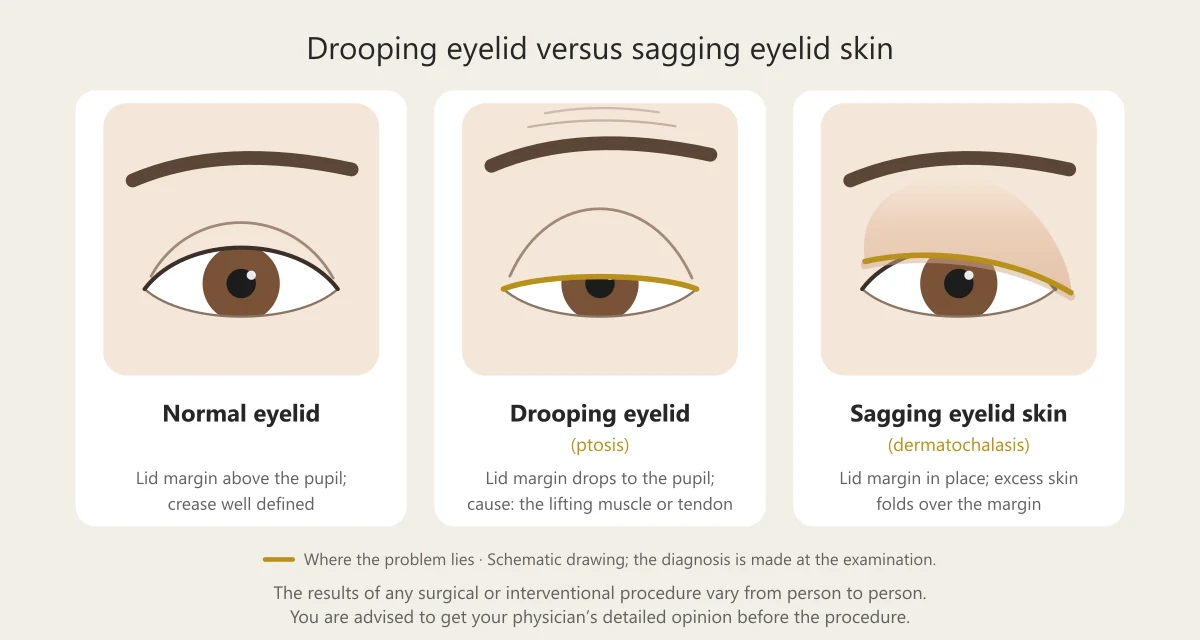 The results of any surgical or interventional procedure vary from person to person. You are advised to get your physician’s detailed opinion before the procedure.
| Feature | Droopy eyelid (ptosis) | Sagging eyelid skin (dermatochalasis) | Drooping brow |
|---|---|---|---|
| Source of the problem | The muscle that lifts the eyelid, or its tendon | Excess skin of the upper eyelid, sometimes fat | Descent of the brow and forehead tissues |
| Eyelid margin | Lower than it should be; may come close to the pupil or cover part of it | Usually in place; extra skin folds over the margin | Usually in place; the brow pushes the eyelid skin down |
| Common clue | A difference in height between the two eyes; raising the brows or tilting the head back in order to see | Loss of the eyelid crease; a fold of skin at the outer corner | The heaviness of the eyelid lessens when the brows are gently lifted with the fingertips |
| Is removing skin alone enough? | No; the muscle or tendon needs to be repaired | Yes, if the problem is only the skin | No; the brow may drop even further |
| Treatment | Ptosis surgery | Upper eyelid surgery (blepharoplasty) | Brow lift or temporal lift |
These conditions often occur together; especially in older age, ptosis may be accompanied by excess skin and a drooping brow. How excess skin is corrected is explained on the eyelid surgery (blepharoplasty) page, and how the position of the brow is assessed on the brow lift page.
What causes a droopy eyelid?
Ptosis can be present from birth or develop later in life. Which technique is suitable depends largely on this distinction and on how well the muscle that lifts the eyelid works.
Congenital ptosis (present from birth)
In congenital ptosis, the muscle that lifts the eyelid has not developed fully in the womb: the muscle tissue is less elastic and cannot lift the eyelid enough. It is usually noticed from birth, can affect one or both eyes and can affect the development of vision in childhood.
Acquired ptosis (developing later in life)
- Age-related (aponeurotic) ptosis: This is the type commonly seen in adults. Over the years, the tendon of the muscle that lifts the eyelid thins, stretches or comes away from its attachment to the eyelid, while the muscle itself usually keeps working.
- Long-term contact lens wear (especially hard lenses): Stretching the eyelid again and again while putting lenses in and taking them out over many years can contribute to the tendon slackening, which is why ptosis may start earlier in lens wearers.
- Eye operations and injuries: The eyelid may droop after eye operations such as cataract surgery, or after a blow to the area around the eye.
- Conditions that weigh the eyelid down: A swelling, cyst or lump in the eyelid can pull it down.
- Nerve and muscle disorders: Damage to the nerve that drives the eyelid-lifting muscle, or muscle and nerve disorders such as myasthenia gravis, can cause ptosis. In these cases the priority is to diagnose and treat the underlying condition.
When does a droopy eyelid need urgent assessment?
Ptosis usually develops slowly over the years. In the following situations, however, the droop may be a sign of a condition affecting the nerves or muscles that needs to be diagnosed quickly:
- A droop that starts suddenly, over hours or days
- Double vision or restricted eye movements together with the droop
- A marked difference in size between the two pupils
- Headache, eye pain or neck pain accompanying the droop
- A droop that varies markedly during the day, getting worse with tiredness and improving with rest
- Difficulty swallowing, speaking or breathing; weakness in the face, arms or legs
If you have any of these signs, see an ophthalmologist or a neurologist without delay; if the droop started suddenly, or comes with double vision, a difference between the pupils, a severe headache, or difficulty swallowing or breathing, go to an emergency department. In such a case the priority is to find the cause of the droop; cosmetic or surgical planning is discussed only once this assessment is complete.
Droopy eyelids in children
In children, ptosis is mostly congenital, and it is not only a matter of appearance. Vision continues to develop in the first years of life; if the drooping eyelid covers the pupil, or presses on the eye and causes a refractive error (astigmatism), a lazy eye (amblyopia) can develop in that eye. This is why ptosis noticed in infancy or childhood should be assessed early by a paediatric ophthalmologist.
A child who tilts their head back or raises their chin or eyebrows to look at things may be trying to see from under the drooping eyelid. The timing of surgery depends on how much vision is affected: if the eyelid covers the pupil or there is a risk of lazy eye, surgery may be considered at an early age; if the development of vision is not at risk, the child is monitored with regular eye examinations and surgery can be planned for a later age. If the muscle is very weak, a brow suspension is usually preferred in children. The decision, and the monitoring of vision afterwards, are planned together with a paediatric ophthalmologist; if there is a lazy eye, treatments such as patching or glasses continue after surgery.
What is assessed at the consultation?
The surgical plan is based on a few simple measurements; the examination looks at:
- Your history: When the droop started, whether it affects one or both sides and whether it changes during the day; contact lens wear, previous eye operations, injuries and the medicines you take. Old photos help to show when the droop began.
- Eyelid height: With the eye looking straight ahead, the distance from the eyelid margin to the centre of the pupil is measured and the two eyes are compared; this shows how much the eyelid needs to be raised.
- Muscle strength: The brow is held gently in place to stop the forehead muscle from helping, and the distance the eyelid margin travels as you look down and then up is measured. This shows how well the muscle works and is the main finding that determines the technique.
- Eyelid crease, skin and brow: The position of the eyelid crease, any excess skin and fat, the position of the brow and how much the forehead muscle is used in order to see.
- Eye surface: Dry eye and whether the eyelids meet fully when the eye closes; this matters because the eye may not close completely for a while after surgery.
- Pupils and eye movements: These are checked so that a nerve or muscle cause is not missed.
If needed, an eye drop is put in to see how much the eyelid rises; this gives an idea of whether the approach from inside the eyelid is suitable. When vision is affected, a visual field test may be requested. Because the brain sends an equal signal to the muscles that lift both upper eyelids, raising the drooping eyelid can make the other eyelid come down a little; this is why both eyes are assessed together even when the droop seems to affect one side only. Sometimes the eyelid that looks low is actually normal and the real change is that the other eyelid is pulled up (for example in thyroid disease); this distinction is also made at the consultation.
Surgery is usually planned for people whose droop narrows their vision or causes a marked difference between the eyes or a tired look, and whose general health allows surgery. Uncontrolled high blood pressure, diabetes or thyroid disease, or severe dry eye, is assessed first. Medicines and herbal supplements that can increase bleeding are stopped under your doctor’s supervision, and you will be asked to stop smoking and drinking alcohol at least 2 weeks before surgery.
How is ptosis surgery performed?
The aim is to raise the eyelid margin to a height that clears your vision and is balanced with the other eye. The technique is chosen at the consultation according to the amount of droop, the strength of the muscle and the cause. The operation is performed in a fully equipped hospital licensed by the Turkish Ministry of Health; adults usually have local anaesthesia with light sedation, children have general anaesthesia, and most patients go home the same day. The main approaches, used in suitable cases, are:
Muscle repair through the eyelid crease
This is a commonly used approach for age-related ptosis when the muscle is strong. The tendon is reached through an incision in the natural crease of the upper eyelid; the stretched or detached tendon is brought forward and stitched back onto the eyelid plate, and if the muscle is weaker, it can be shortened to lift the eyelid further. Under local anaesthesia you may be asked to open and close your eyes, so that the height and curve of the eyelid can be adjusted during the operation, aiming for balance between the two eyes. The incision lies in the eyelid crease and is largely hidden when the eye is open.
Approach from inside the eyelid (conjunctival approach)
In suitable patients with mild ptosis and good muscle strength, the eyelid is turned over and the surgery is done through the thin membrane on its inner surface (the conjunctiva); the eyelid is raised by shortening a small second muscle that contributes to its height (Müller’s muscle). No cut is made in the skin. If the droop is marked, or the eyelid crease also needs adjusting, repair through the eyelid crease is preferred.
Brow suspension (frontalis sling)
If the muscle that lifts the eyelid works very little or not at all, repairing it will not raise the eyelid enough; this is mostly seen in congenital ptosis and sometimes in nerve or muscle disorders. In a brow suspension, the eyelid is connected to the forehead muscle with a thin sling material or with a strip of the person’s own tissue (usually taken from the thigh through a small incision); the sling is passed through small incisions made in the eyelid and above the brow. This way, when the brow rises, the eyelid rises with it. The eyelids may not meet fully when the eye closes, especially in the early period, while the eyelid staying slightly raised when you look down often persists with this technique. This is why protecting the surface of the eye and regular check-ups are important.
In the same session as cosmetic eyelid surgery
If there is also excess skin on the upper eyelid, the ptosis repair and the skin removal (upper blepharoplasty) can be done through the same incision in the same session, so that the eyelid margin and the eyelid skin are treated together with one operation and one recovery period. If the whole brow has dropped, a brow lift can also be added to the plan; if only its outer end has dropped, a temporal lift. In people who have long been raising their brows in order to see, the brows may come down a little once the eyelid is lifted; this is why the plan for the skin and the brows is made together with the ptosis repair.
Recovery after ptosis surgery
Recovery follows a course similar to that of cosmetic eyelid surgery; timings vary with the person and the technique:
- First 48 hours: Swelling, bruising, tightness and slight oozing are possible; cold compresses and sleeping with your head raised reduce the swelling. The eye may not close fully in the first days; the prescribed drops and ointments protect its surface.
- First week: Swelling and bruising start to go down; stitches are usually removed within the first week or dissolve on their own.
- Days 7–10: Most people with desk jobs return to work.
- Week 2: Swelling and bruising have usually reduced markedly; most people get back to social life during this week, and light eye make-up can be started once the incisions have healed.
- Weeks 4–6: Strenuous exercise and heavy lifting can usually be resumed during this period, with your doctor’s approval.
- Months 3–6: The remaining swelling resolves, and the eyelid height, the crease and the scar approach their final appearance.
In the first weeks, swelling can make the eyelid look higher or lower than it will finally be, and there may be temporary differences between the two eyes; the result is judged once the swelling has gone down. Contact lenses are not worn for at least the first two weeks; when you can wear them again is decided at a check-up. Avoid rubbing your eyes, keep away from dusty environments and wear sunglasses; because of the sedation, you should not drive on the day of surgery. If you notice severe or worsening pain, rapidly increasing swelling or reduced vision, contact your doctor without delay.
Risks and possible complications
Like any operation, ptosis surgery carries risks. The height of the eyelid has to be adjusted to the millimetre and every tissue heals differently, so the result cannot always be predicted exactly and varies from person to person:
- Under-correction: The eyelid may stay lower than planned or drop a little again over time.
- Over-correction: The eyelid may be raised more than needed; the eye may look wider open and be harder to close.
- Asymmetry: A difference between the two eyes may remain in eyelid height, in the curve of the eyelid margin or in the crease. After surgery on one side, a mild droop of the other eyelid may become more noticeable.
- Dry eye and difficulty closing the eye: In the early period the eye may not close fully, and there may be dryness, a gritty feeling and watering. This is mostly temporary and is managed with drops and ointment; if it lasts, additional measures may be needed to protect the clear front surface of the eye (the cornea). It may last longer in people who had dry eyes before surgery.
- Bleeding and infection: These are uncommon and may need further treatment. With a brow suspension, infection related to the sling material, or the material becoming visible, can rarely occur.
- Scarring: In most patients the incision scar in the eyelid crease fades and becomes inconspicuous; in some it may remain more noticeable.
- Risks of anaesthesia: The risks of sedation or general anaesthesia are discussed separately before surgery.
- Bleeding behind the eye: This is very rare; because it can affect vision, it needs emergency treatment.
An additional procedure (revision) may be needed to adjust the eyelid height or the balance between the two eyes; this is more likely in congenital ptosis and when the muscle is weak. The risks, together with the precautions to be taken in light of your health, are discussed in detail at your consultation.
Travelling to Istanbul, Turkey, for ptosis surgery
Before you travel, you can send photos of your eyes on WhatsApp for a preliminary assessment, and you receive the plan in writing; to get started, contact the practice. The examination and the operation plan are made in person in Istanbul, the operation takes place in a fully equipped hospital licensed by the Turkish Ministry of Health, and your surgeon decides when you are fit to fly home. The length of your stay depends on the procedure and is confirmed in your written plan before you book flights. After you return home, follow-up continues with photo reviews on WhatsApp, and your medical records are given to you in English.
Frequently Asked Questions about Droopy Eyelids (Ptosis)
Is ptosis surgery difficult, and how long does it take?
In adults the operation is mostly done under local anaesthesia with light sedation, so apart from the brief sting of the numbing injection you usually feel no pain during the procedure; the tightness and mild ache of the following days usually ease with simple painkillers and cold compresses. How long it takes depends on whether one or both eyelids are operated on, on the technique and on whether cosmetic eyelid surgery is added; it usually takes between 1 and 2 hours.
How long is the recovery after ptosis surgery?
Most people return to desk work within 7–10 days and to social life during the second week; swelling and bruising usually reduce markedly within 1–2 weeks. Strenuous exercise usually has to wait 4–6 weeks. The height and crease of the eyelid become clear over 3–6 months as the swelling resolves; timings vary with the person and the technique.
Will there be a scar after ptosis surgery?
Every incision in the skin leaves a scar. With repair through the eyelid crease, the scar lies in the natural fold of the eyelid; it may look pink for the first few weeks and fades within 3–6 months in most patients. The approach from inside the eyelid involves no cut in the skin, while a brow suspension involves small incisions in the eyelid and above the brow, and also on the thigh if your own tissue is used. How the scar finally looks depends on your skin; protecting it from the sun and not smoking support healing.
Can exercises, creams or tape fix a droopy eyelid?
No. Exercises, creams, massage and herbal remedies do not repair a stretched or detached tendon, nor do they strengthen a muscle that did not develop fully before birth, so age-related or congenital ptosis does not improve this way. Tape applied to the eyelid lifts it only while it is in place. If the droop is caused by a nerve or muscle disorder, treatment is planned for that condition.
Can botulinum toxin (anti-wrinkle injections) cause a droopy eyelid, and does it go away?
Botulinum toxin injected into the forehead or between the brows can, rarely, spread to the muscle that lifts the eyelid and cause a temporary droop. This droop usually resolves on its own as the effect of the drug wears off and does not need surgery. If it happens, see the doctor who gave the injections. Botulinum toxin does not correct a true droopy eyelid, however, because it does not strengthen the muscle that lifts the eyelid.
Can the eyelid droop again after surgery?
In most patients the repaired muscle or tendon stays in place for a long time; however, surgery does not stop ageing, and because the tissues continue to slacken, the eyelid may drop slightly again over the years. If the eyelid does not reach the expected height, or drops markedly again over time, a second, corrective operation can be planned. How long the result lasts varies from person to person.
What kind of doctor should I see for a droopy eyelid?
Ptosis repair is performed by specialists in plastic, reconstructive and aesthetic surgery and by ophthalmologists who focus on eyelid surgery (oculoplastic surgeons). Whichever doctor you see, it is important that the eyelid, the eyelid skin, the brow and the surface of the eye are assessed together; in children, the assessment is made together with a paediatric ophthalmologist. A droop that starts suddenly, or comes with double vision, a difference between the pupils or headache, needs to be seen in an emergency department without delay; a droop that varies markedly during the day also needs a neurological assessment.
Is ptosis surgery covered by SGK (Turkish public health insurance)?
For patients insured under the Turkish social security system (SGK), eyelid surgery done purely for cosmetic reasons is not covered. When ptosis narrows the field of vision or, in children, threatens the development of vision, whether the operation is covered is assessed against official criteria; it depends on the medical need being documented and on the hospital where the operation is done having an agreement with SGK. Coverage should be confirmed with SGK and the hospital concerned.
What determines the cost of ptosis surgery?
The fee depends on whether one or both eyelids are operated on, on the technique (muscle repair, the approach from inside the eyelid or a brow suspension), on any additional procedures planned for the same session, such as removing excess skin or a brow lift, on the type of anaesthesia and on the hospital services. Correcting an eyelid that has been operated on before requires separate planning. The exact fee is therefore given once your eyelids have been assessed at the consultation and the plan that suits you has been made.
Consultation and appointments
The cause and degree of the droop, and the technique that suits you, can only be determined at an in-person consultation. Op. Dr. Ayberk Akçay is a specialist in plastic, reconstructive and aesthetic surgery and a Fellow of the European Board of Plastic, Reconstructive and Aesthetic Surgery (EBOPRAS); you can read more about his training and certificates. At his practice in Teşvikiye, Şişli, Istanbul, the eyelid, the eyelid skin and the brow are assessed together, and the plan that suits you, its limits and the recovery are discussed with you. To book an appointment, please get in touch through the contact page.
This content is for information only and does not replace an examination or diagnosis. Results of surgery vary from person to person.