In 2026, as before, there is no single price for a nose job (rhinoplasty) that applies to everyone: the fee follows the surgical plan made at your examination. Smoothing a small hump on the bridge of the nose is not the same operation as one that also straightens a deviated septum, needs cartilage grafts or rebuilds a nose that has been operated on before; they differ in length, in the steps involved and in cost.
This page explains what determines the fee for rhinoplasty, which items the quote you receive after your examination should list, when the Turkish public health insurance (SGK) and private health insurance may contribute, and why the prices you find online do not match one another. For general information about the operation itself, who it suits and the techniques used, see our rhinoplasty (nose job) page.
Rhinoplasty Fees at a Glance
| Topic | In general |
|---|---|
| Fee | Set after the examination, according to your personalised surgical plan. |
| Anaesthesia and length of surgery | General anaesthesia; usually 2–4 hours, depending on the extent of the operation and the technique |
| Hospital stay | Most patients stay one night for observation. |
| Splint and check-ups | The splint, and any packing, comes out on day 5–7; check-ups continue at intervals throughout the first year. |
| SGK (Turkish public health insurance) | Does not cover nose surgery done purely for appearance; procedures that open the airway may be covered when medical necessity is documented. |
| Private health insurance | Most policies exclude cosmetic surgery; cover for functional treatment depends on the policy terms and on approval before surgery (pre-authorisation). |
| Quote | Should be in writing and itemised; ask how long it is valid. |
Why Is There No Single Price for Rhinoplasty?
Every nose is built differently. Skin thickness, the strength of the cartilages, the width of the bony framework, the condition of the airway inside the nose and what you hope to achieve all shape how the operation is planned. Many of these features cannot be seen in a photograph; they can only be assessed at an examination of both the outside and the inside of the nose.
That is why this page gives no figure: a number quoted for a nose that has not been examined may not reflect the operation you actually need. After your examination, your treatment plan and the fee are explained to you clearly.
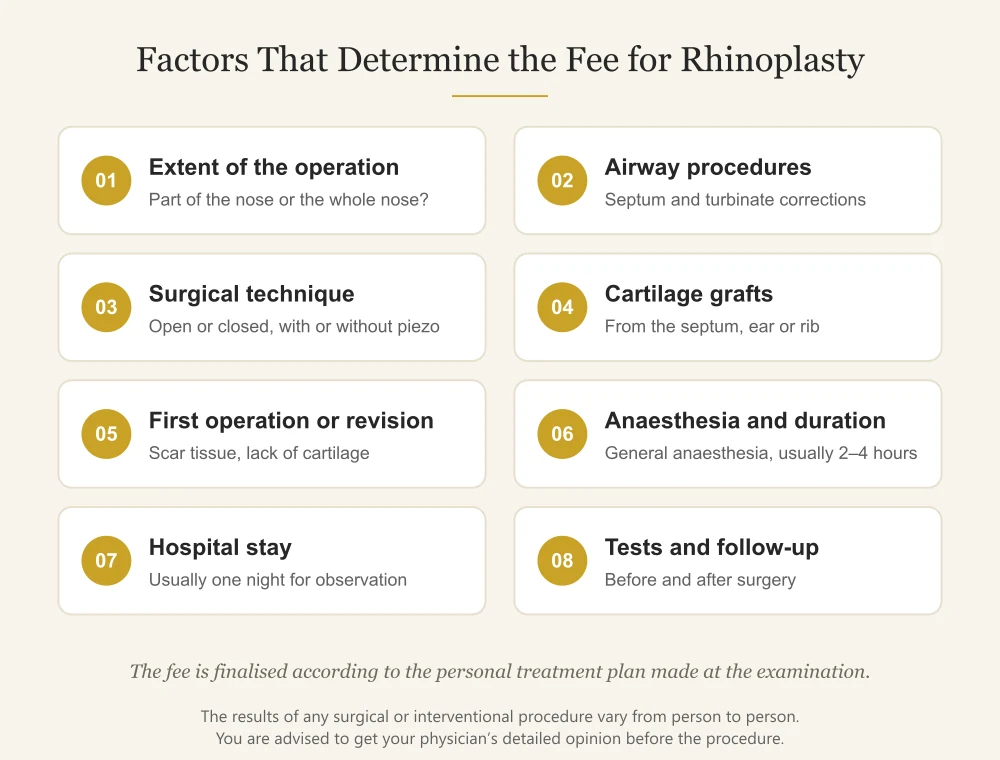 The results of any surgical or interventional procedure vary from person to person. You are advised to get your physician’s detailed opinion before the procedure.
What Determines the Cost of Rhinoplasty?
The factors that make up the fee are linked to one another: most of them change how long the operation takes and which surgical steps it includes.
The extent of the operation
The main factor in the fee is whether surgery is limited to the tip of the nose or involves the whole bony and cartilage framework. A prominent hump, a wide or crooked nose, asymmetry and the shape of the nostrils can each call for additional steps. If a deviated septum makes breathing difficult, straightening it in the same operation (septorhinoplasty) widens the scope; so does treating enlarged turbinates (turbinate hypertrophy), the ridges of tissue on the inner side walls of the nose.
The technique
Open or closed technique, using a piezo (ultrasonic) device to shape the bone, or approaches that preserve the bridge of the nose (preservation rhinoplasty) can change the length of the operation, the equipment needed and the consumables used. The technique is chosen for the structure of your nose and the result you are aiming for, not for its price. For more about the techniques, see closed rhinoplasty and piezo rhinoplasty.
Whether cartilage grafts are needed
Cartilage grafts may be needed to support the tip, rebuild the bridge or strengthen the airway. Cartilage from the septum, the wall that divides the inside of the nose, is usually used first; when there is not enough, cartilage from the ear or a rib is considered. Taking cartilage from another part of the body adds a separate surgical step and extra time to the operation.
First operation or revision
In a nose that has already been operated on, scar tissue, reduced cartilage and altered anatomy make both the planning and the operation more complex. Secondary operations often need grafts and can take longer than a first rhinoplasty, which is reflected in the fee. For details, see our revision rhinoplasty page.
Anaesthesia, length of surgery and hospital stay
Rhinoplasty is usually performed under general anaesthesia and, depending on its extent and the technique used, most often takes 2–4 hours. The anaesthesia team, the time in the operating theatre and the hospital stay make up a significant part of the fee. Most patients stay one night under observation; the stay can be longer if there is a medical need. Operations are performed in a fully equipped hospital licensed by the Turkish Ministry of Health.
Tests before surgery
Blood tests and an anaesthetic assessment are standard steps before surgery. Depending on your age and general health, further tests or an opinion from a specialist in another field may be requested. Asking in advance whether these items are included in the fee saves you surprises later.
Follow-up after surgery
The splint and, if it was needed, the silicone packing inside the nose usually come out on day 5–7; taping and follow-up examinations come next. Because the nose takes months to settle into its final shape, check-ups usually continue at intervals throughout the first year. The quote should state clearly whether check-ups, medication and supplies such as tape are included. The healing period is described in detail in our rhinoplasty recovery guide.
The surgeon’s specialty, the city and the hospital
The specialist training and experience of the surgeon who will operate, and the city and hospital where the operation takes place, also affect the fee; even within Istanbul, fees can vary with the hospital. When you decide, look beyond the figure: consider the surgeon’s field of specialty, who will actually perform the operation and how clearly your questions are answered.
What Should a Written Quote Include?
A written, itemised quote after your examination helps you compare your options properly. Check that it clearly covers the following:
- Name and extent of the operation: whether it is a rhinoplasty or a septorhinoplasty, whether a turbinate procedure or cartilage grafting is planned, and where any graft will be taken from
- Surgeon’s and anaesthesia fees: whether the anaesthesia team’s fee is included in the quote
- Hospital costs: the operating theatre, the length of stay (how many nights) and the type of room
- Tests: blood tests, the anaesthetic assessment and any further tests if needed
- Medication and supplies: the splint, packing, tape and the medication you are given when you are discharged
- Follow-up appointments: how many check-ups are included, and over what period
- The unexpected: what happens if an extra night in hospital, or further treatment because of a complication, is needed
- Corrections: the terms that apply if a minor correction or a revision is considered later
- Validity and payment terms: how long the quote is valid, the payment schedule, and the terms for postponement and cancellation
Hospital, anaesthesia and supply costs can change during the year, so fees are updated from time to time; ask until what date your quote is valid. Two quotes can only be compared fairly if they cover the same things.
Does Turkish Public Insurance (SGK) Cover Nose Surgery?
This section concerns patients insured under the Turkish social security system (SGK). Rhinoplasty done purely to change how the nose looks is not covered by SGK’s general health insurance: under Article 64 of the Social Insurance and General Health Insurance Law No. 5510, SGK does not pay for cosmetic treatment. The exception is treatment that restores the body’s integrity after a work accident, an occupational disease, another accident or an illness, or because of a congenital condition. Whether SGK contributes therefore depends on the purpose of the operation:
- Purely cosmetic rhinoplasty: not covered by SGK; the patient pays the whole fee.
- Procedures to open the airway: treatment of medical problems such as a deviated septum or enlarged turbinates may be covered when medical necessity is documented and the procedure is done at an institution contracted with SGK.
- Deformities after an accident or injury, or present from birth: corrections after a broken nose or for congenital causes may be treated as restoring the body’s integrity; the decision rests on the medical records and the institution’s assessment.
- Operations that combine cosmetic and functional correction: in a septorhinoplasty, SGK may cover only the medical part, and the patient pays for the cosmetic part. How this split is billed varies from one institution to another.
Private hospitals contracted with SGK may charge an additional fee on top of what SGK pays, within the limits set by the regulations. Coverage rules and hospital practices can change over time, so confirm your situation with SGK and with the hospital before surgery.
Septoplasty and SGK
Septoplasty is a functional operation that straightens bent cartilage and bone in the septum to open the airway; it is not considered a cosmetic procedure. When the examination shows that the deviation makes breathing difficult and medical necessity is documented, it can be done under general health insurance at institutions contracted with SGK. What you pay may differ depending on whether the operation takes place in a public hospital, a university hospital or a private hospital contracted with SGK.
On its own, septoplasty does not aim to change the outside of the nose. If you also want a hump removed or the tip reshaped in the same operation, it becomes a septorhinoplasty, and the cosmetic part is not covered by SGK.
Private Health Insurance and Complementary Insurance
Most private health insurance policies exclude cosmetic surgery. Treatment of a functional problem such as a deviated septum may be considered under the terms of your policy. What decides it are the exclusions for conditions that existed before the policy started, waiting periods, the insurer’s network of contracted hospitals and the requirement for approval before surgery (pre-authorisation).
Complementary health insurance, a Turkish top-up policy for people insured with SGK, is meant to cover the additional fee a contracted private hospital charges for treatment that SGK covers; it does not usually pay for cosmetic procedures that SGK excludes. Getting written approval from your insurer before you fix the date of surgery helps to avoid disputes later.
Why Do Rhinoplasty Prices Online Vary So Much?
There are several reasons why the same search turns up very different figures:
- What is included: some figures cover only the surgeon’s fee; others also include the hospital, anaesthesia and check-ups.
- “Prices from” wording: a starting figure for a simple procedure may not reflect the operation you need.
- Different procedures mixed together: tip correction, septorhinoplasty and revision may be listed under the same heading, although their scope differs.
- Date: some pages were written years ago, and costs change every year.
- City and hospital: the hospital setting and the city affect the cost.
- Estimates without an examination: figures given from photos or over the phone are estimates; the structures inside the nose and the cartilage support cannot be assessed without an examination.
When you compare, look beyond the figure: check whether the same scope is offered, who will perform the operation and whether it will take place in a hospital licensed by the Turkish Ministry of Health. Avoid deciding on surgery under the pressure of a promotion or a deadline, or on the figure alone.
Frequently Asked Questions about Rhinoplasty Cost
How much does a nose job cost?
The fee for rhinoplasty is individual and is set after the examination. The extent of the operation, the technique, whether cartilage grafts are needed, whether it is a first operation or a revision, the anaesthesia and the length of the hospital stay all have a direct effect on it. Because a figure quoted for a nose that has not been examined may not reflect your operation, this page gives no figures; once your treatment plan has been made, the fee is clearly communicated to you.
What is the average cost of rhinoplasty?
An average lumps together operations of very different scope, from a correction of the tip alone to a revision that needs cartilage grafts, and quotes that cover only the surgeon’s fee with ones that also include the hospital, anaesthesia and check-ups. So it does not tell you what your operation will cost, and figures from previous years do not reflect today’s costs either. Your own fee is given after the examination, once the surgical plan is clear.
What does the cost of rhinoplasty depend on?
The main factors are: whether surgery involves only part of the nose or all of it; whether breathing problems such as a deviated septum or enlarged turbinates are corrected in the same operation; whether the open or the closed technique is chosen, and whether piezo is used to shape the bone; whether cartilage is taken from the ear or a rib; and the length of the operation, the anaesthesia, the hospital stay, the tests and the follow-up examinations.
Is the fee different if I only have the tip of my nose done?
The extent of the operation is the main factor in the fee, so a correction limited to the tip is priced differently from an operation on the whole bony and cartilage framework. If there is a hump on the bridge, a crooked nose or a breathing problem, however, work on the tip alone may not be enough; what you need is decided at the examination. Who tip surgery suits is explained on our nose tip surgery (tipplasty) page.
Does SGK (Turkish public insurance) cover rhinoplasty?
For patients insured under the Turkish social security system (SGK): SGK does not cover rhinoplasty done purely to change how the nose looks. Treatment of medical problems that make breathing difficult, such as a deviated septum or enlarged turbinates, and correction of deformities caused by an accident or present from birth may be covered when medical necessity is documented and the procedure is done at an institution contracted with SGK. The patient pays for the cosmetic part of the operation; confirm the details with SGK and with the hospital where you will have surgery.
Does SGK cover septoplasty?
Septoplasty is a functional operation to open the airway, so it is not considered cosmetic. For patients insured with SGK, when the examination documents that the deviation makes breathing difficult, it can be done under general health insurance at contracted institutions; contracted private hospitals may also charge an additional fee. If the outside of the nose is changed in the same operation, the cosmetic part is not covered by SGK.
Does private health insurance cover rhinoplasty?
Most private health insurance policies do not cover cosmetic surgery. Treatment of a functional problem may be considered depending on the policy terms, the exclusions for pre-existing conditions, waiting periods and approval before surgery (pre-authorisation). It is advisable to get written approval from your insurer before you fix the date of surgery.
Can I have rhinoplasty at a public hospital in Turkey?
For patients insured with SGK, public hospitals can perform operations that open the airway under SGK cover when there is a medical need. A purely cosmetic nose operation, however, is not covered by SGK even at a public hospital, and the patient pays for it. Whether a hospital offers this operation, what it charges and how long the waiting time is vary from one hospital to another; you need to get this information directly from the hospital concerned.
Is the fee for revision rhinoplasty different from a first operation?
It often is. In a nose that has been operated on before, scar tissue and reduced cartilage mean that grafts are frequently needed, the operation can take longer and the planning is more detailed. The scope and fee of a revision are therefore assessed separately at the examination.
Is rhinoplasty for men priced differently?
Gender alone does not set the fee; the structure of the nose and the extent of the operation do. Men may have thicker nasal skin and stronger bone and cartilage, and an earlier injury to the nose may be more common. These features can affect the planning and the length of the operation. Planning for male patients is explained in detail on our male rhinoplasty page.
Can I find out the price by sending photos?
Photos can give a first impression of the outside of the nose, but skin thickness, cartilage support and the airway inside the nose cannot be assessed from a photograph. The fee is therefore confirmed once your treatment plan has been made at a face-to-face examination.
How Is the Fee Confirmed at the Examination?
At the examination, your concerns and expectations are discussed first. Then the outer structure of the nose, skin thickness, cartilage support and the airway inside the nose are examined, and photographs are analysed to assess your facial proportions. From this, a personalised treatment plan is drawn up and the fee is set according to that plan. To make planning easier, you can bring the following to your examination:
- If you have had nose surgery before, the operation report or discharge summary
- A list of the medicines you take and of any long-term (chronic) conditions
- If you have trouble breathing through your nose, how long it has lasted and any treatment you have had for it
- Your notes on nose shapes you like or would not want
Op. Dr. Ayberk Akçay is a plastic, reconstructive and aesthetic surgeon, a Fellow of the European Board of Plastic, Reconstructive and Aesthetic Surgery (EBOPRAS) and a full member of the Turkish Society of Plastic, Reconstructive and Aesthetic Surgeons; his practice is in Teşvikiye, Şişli, Istanbul. You can read about his training and memberships, and to book an appointment, reach us through the contact page.
This content is for general information only and does not replace an examination, a diagnosis, or legal or insurance advice. Results and recovery vary from person to person.