
Ageing, significant weight gain and loss, gravity and genetic factors make the skin lose its elasticity on the thighs, just as they do in many other parts of the body. The skin of the inner thigh in particular is thin and delicate. Laxity and sagging in this area are more than an aesthetic concern: because the thighs rub together when you walk, they can also cause health problems that reduce everyday comfort, such as chafing rashes, irritation and dark patches of skin left by chafing. Toning exercises and diet programmes are very helpful for strengthening muscle, but they cannot return overstretched, sagging skin to its former shape. The surgical procedure used to remove this excess skin from the thighs and give the lower body a smoother, firmer contour is the thigh lift.
What Is a Thigh Lift?
Known in the medical literature as thighplasty, a thigh lift is a procedure in which excess, sagging skin and subcutaneous fat (the fat beneath the skin) are surgically removed from the thigh, and the remaining tissues are reshaped and tightened.
It is considered especially for people who have lost a large amount of weight after bariatric surgery (a gastric sleeve or gastric bypass) and for skin that has lost its elasticity with age. In a thigh lift, the loose skin of the upper and inner thighs is removed and the remaining tissues are reshaped, with the aim of tightening the skin.
Who Is a Good Candidate for a Thigh Lift?
The operation is intended for people with aesthetic concerns whose general health does not stand in the way of surgery. In general, good candidates meet the following criteria:
- After major weight loss: people who have lost a large amount of weight after a gastric sleeve operation or through an intensive diet and exercise programme, and who now have sagging skin on the thighs.
- Age-related skin laxity: patients whose inner thigh skin sags because the body produces less collagen and elastin with age.
- Discomfort caused by chafing: people who have difficulty walking, chafing rashes or skin irritation because the inner thighs rub against each other.
- A stable weight: having kept a steady weight for at least 6 months before surgery matters for how predictable the result is and how well it holds up over time.
- Realistic expectations: candidates who accept both the aesthetic change that surgery can bring and the surgical scars it will leave.
Results are more predictable in candidates who are in good general health, have no chronic circulation or blood-clotting problems, do not smoke (or stop before the operation) and are physically fit for surgery.
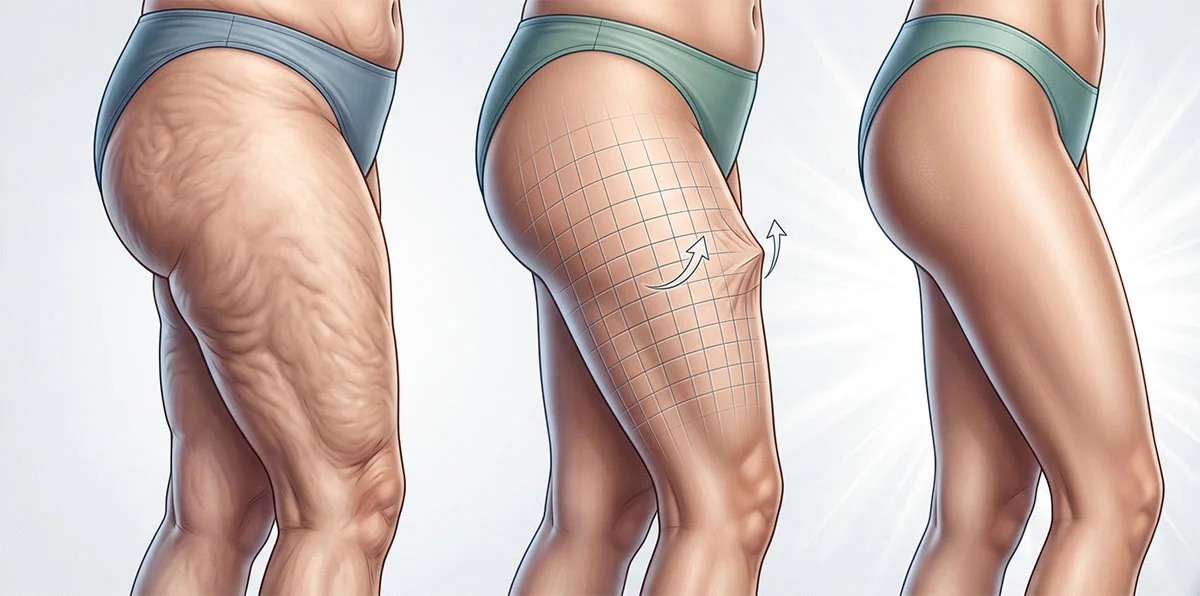 The results of any surgical or interventional procedure vary from person to person. You are advised to get your physician’s detailed opinion before the procedure.
Thigh Lift Techniques
The surgical technique depends on the patient’s anatomy, how much the skin sags and how the fat is distributed. Which technique is used is decided at the examination, according to each patient’s situation.
1. Groin Crease (Inner Thigh) Lift
This technique is chosen when the sagging is limited to the upper part of the inner thigh, close to the groin crease. The incision is hidden in the natural line of the groin crease, so from the outside the scar stays almost entirely within the underwear or swimsuit line. It is a preferred method for mild to moderate sagging.
2. Vertical Thigh Lift
In patients who have lost a great deal of weight, the sagging is not limited to the groin: it extends down the thigh towards the knee. In such cases, a lift through the groin alone is not enough. The incision starts in the groin and runs along the inner thigh down to the knee. Because the excess skin is taken in horizontally, around the thigh, the aim is a noticeably slimmer and firmer thigh.
3. Combined Techniques: Thigh Lift with Liposuction
If there is localised fat in addition to sagging skin, ultrasound- or laser-assisted liposuction is performed before the surgical lift. Once the fat has been removed, the excess skin is cut away and the incisions are stitched. In other words, when the fat volume needs reducing and the skin needs tightening, because there is surplus skin as well as excess fat, the thigh lift is combined with liposuction techniques.
Preparing for a Thigh Lift
The period before surgery matters a great deal for a successful outcome and for keeping the risk of complications as low as possible.
- Stopping blood-thinning substances: medicines such as aspirin and ibuprofen, and supplements that can thin the blood, such as ginkgo biloba and green tea, should be stopped at least 2 weeks before the operation.
- Smoking and alcohol: tobacco products seriously impair blood flow to the tissues and wound healing. Smoking should be stopped completely at least 3–4 weeks before surgery.
- Health screening and tests: blood tests, the anaesthetic assessment and, if considered necessary, an ultrasound scan of the leg veins are completed before surgery.
- Weight stability: you should have reached your target weight before surgery and be maintaining it.
Because all of these details have a direct effect on your recovery, your doctor’s instructions before a thigh lift should be followed to the letter.
How Is a Thigh Lift Performed?
The operation is planned with the patient’s comfort and safety as the priority:
- Anaesthesia: the procedure is usually performed under general anaesthesia, so no pain is felt during the operation.
- Marking and planning: with the patient standing, the amount of skin to be removed and the incision lines are marked precisely.
- Incision and tissue removal: working through the planned incision lines, the surgeon removes the excess skin and the tissue beneath it. Where needed, excess fat is suctioned out with liposuction.
- Tightening the fascia and tissues: the deep fascial layers beneath the skin are anchored upwards and inwards with sutures, rebuilding the contour of the thigh.
- Closure and stitches: the incisions are closed with fine, concealed cosmetic stitches to keep the scars as discreet as possible. Temporary drains may be placed to remove fluid and blood that could collect in the area.
- Dressings and compression garment: at the end of the operation, a special medical compression garment is put on over the legs.
Depending on the extent of the technique used, the operation takes on average 2 to 4 hours.
Recovery After a Thigh Lift
The early period after surgery is critical for the tissues to heal soundly and for the swelling to clear. This is the time when the body settles into its new shape, so recovery after a thigh lift calls for patience and careful use of the compression garment.
Time after surgery | Recovery and what to do |
First 24–48 hours | You rest in hospital. The drains are checked and are usually removed within 1–2 days. Mild aching and a feeling of tightness are kept under control with painkillers. |
Week 1 | Rest continues at home. Short, slow walks around the house support blood circulation. Keep your legs raised when you rest. |
Week 2 | Your stitches are checked. You begin to return to light daily activities and desk work. Avoid putting excessive strain on the incisions when you sit down and stand up. |
Weeks 4–6 | The special medical compression garment is worn continuously up to this point. Most of the swelling goes down. Apart from light walking, strenuous sport should be postponed. |
From month 3 | The shape of the thighs becomes clearer. Activities such as strenuous exercise, gym workouts and swimming can be started with your doctor’s approval. |
Will a Thigh Lift Leave Scars?
By its nature, every surgical incision leaves a scar. In aesthetic surgery, however, the main aim is to hide these scars in the body’s natural creases and to make them as inconspicuous as possible over time.
When the lift is done through the groin only, the scar lies largely within the underwear line. Where a vertical incision is used, a line remains on the inner surface of the thigh that is not easily seen from the front. Surgery without any scar is not possible, but these scars, which are prominent and reddish in the first months, move closer to your skin tone within 1 to 2 years and fade considerably. Scar creams, silicone gel sheets and, when needed, laser treatment can help to minimise how visible they are.
Risks and Complications of a Thigh Lift
As with any surgical operation, this procedure carries certain risks. Appropriate patient selection, careful planning and performing the operation in a fully equipped hospital licensed by the Ministry of Health reduce these risks, but do not eliminate them completely.
- Infection and wound separation: because the groin is a moist area that moves a great deal, wound care and hygiene are especially important.
- Seroma (fluid build-up): a collection of lymph fluid beneath the tissues; it is usually prevented with drains and the special compression garment.
- Asymmetry: there may be slight differences in size or contour between the two thighs.
- Numbness: there may be temporary numbness around the incisions, which improves over the following months as the nerves heal.
- Prominent scarring: in people with a genetic tendency to keloid or hypertrophic scars, the scars may remain more noticeable than expected.
- Blood clots (deep vein thrombosis): a clot forming in the leg veins and, rarely, travelling to the lungs is a serious risk. Walking early and, when needed, clot-preventing treatment help to reduce this risk.
To reduce these risks, it is very important to follow the aftercare and hygiene instructions in full. If you notice sudden shortness of breath, chest pain or palpitations, go to an emergency department without delay; for signs such as marked swelling and pain in one leg, a high fever, or increasing redness or discharge at the incisions, contact your doctor without waiting for your follow-up appointment.
Travelling to Istanbul, Turkey, for a Thigh Lift
Before you travel, you can contact us and send photos on WhatsApp for a preliminary assessment, and you receive the plan in writing. The examination and the operation plan are made in person in Istanbul, and the operation takes place in a fully equipped hospital licensed by the Ministry of Health. As with other body contouring procedures, plan to stay in Istanbul for at least 7 nights; the doctor decides when you are fit to fly home. After you return home, follow-up continues with photo reviews on WhatsApp, and your medical records are given to you in English.
Frequently Asked Questions about Thigh Lift Surgery
How long does thigh lift surgery take?
The operation is usually performed under general anaesthesia and takes on average 2 to 4 hours, depending on the extent of the technique. The time varies with whether a groin crease or a vertical lift is done and whether liposuction is added. You rest in hospital for the first 24–48 hours after surgery.
How long does it take to recover from a thigh lift, and when can I go back to work?
If you have a desk job or work that does not involve physical effort, you can return to work about 10–14 days after surgery; for jobs that involve standing or heavy physical activity, this can take 3 to 4 weeks. The medical compression garment is worn continuously until weeks 4–6, and most of the swelling goes down during this time. Activities such as strenuous exercise, gym workouts and swimming can be started from month 3 with your doctor’s approval.
Is a thigh lift painful?
Because the operation is performed under general anaesthesia, you feel no pain during the procedure. A mild feeling of tightness and aching in the first few days after surgery is normal and is controlled with the painkillers you are prescribed.
Will the scar from a thigh lift go away?
Not completely: like any surgical incision, a thigh lift leaves a permanent scar. With a groin crease lift, the scar lies within the underwear line; with a vertical lift, it lies on the inner side of the thigh. Prominent and reddish in the first months, the scar fades towards your skin tone within 1 to 2 years. Silicone gel, scar creams and, when needed, laser treatment can help to make it less visible.
When will I see the result of my thigh lift?
The change in your thighs is noticeable immediately after surgery. However, it takes on average 3 to 6 months for the swelling to go down completely and for the tissues to settle; the shape of the thighs becomes clearer from month 3. The scars take longer to mature and fade, which can take 1–2 years.
Can the skin sag again after a thigh lift?
The excess skin and tissue removed during surgery do not come back. However, the skin may loosen again over time with significant weight gain or loss, or as a natural result of ageing. Keeping your weight stable and exercising regularly helps to maintain the result for longer.
Can a thigh lift and liposuction be done at the same time?
Yes, the two are often combined. If the thighs have both loose skin and excess fat, liposuction and the skin lift can be planned in the same session, with the aim of a more balanced result. If you also have sagging skin on your arms or abdomen after major weight loss, whether procedures such as an arm lift or a tummy tuck can be done in the same session or in separate sessions is assessed at the examination, according to safety criteria.
Can exercise get rid of sagging inner thighs?
Toning exercises and diet are useful for strengthening the muscles, but they cannot return overstretched, sagging skin to its former state. When there is marked excess skin, a thigh lift is considered; if the sagging comes with fat deposits, the lift and liposuction can be planned together.
What determines the cost of a thigh lift?
The fee depends on the technique (groin crease or vertical lift), whether liposuction is added, whether the operation is combined with other procedures, and how long the operation and the hospital stay last. For this reason, the fee is set after the examination, once your personal plan has been decided.
Appointments and Contact
Sagging inner thighs are sometimes only a concern about appearance; at other times they affect everyday comfort by causing chafing, rashes and irritation when you walk. The degree of sagging, which technique suits you and whether liposuction is needed are assessed at a face-to-face examination; results vary from person to person. To book an examination, get in touch through the contact page.
Op. Dr. Ayberk Akçay is a specialist in plastic, reconstructive and aesthetic surgery, a Fellow of the European Board of Plastic, Reconstructive and Aesthetic Surgery (EBOPRAS) and a full member of the Turkish Society of Plastic, Reconstructive and Aesthetic Surgeons. His practice is in Teşvikiye, Şişli, Istanbul; you can read more about his training and certifications.