
A tummy tuck (abdominoplasty) removes loose, excess skin and fat from the abdomen and, where needed, repairs slack or separated abdominal muscles by stitching them together in the midline. Abdominoplasty is the medical name; most people simply call it a tummy tuck. Depending on how far the sagging extends, the operation is planned as a full or a mini tummy tuck. It is not a weight-loss method, and it leaves a permanent scar, planned to sit low on the abdomen within the underwear line.
Pregnancy, rapid weight gain and loss, ageing, hormonal changes and genetic predisposition can all lead to laxity, sagging and stubborn fat deposits on the abdomen. Exercise and diet can strengthen the muscles and reduce body fat, but they cannot restore excess skin that has lost its elasticity or bring separated abdominal muscles back together. This is when a tummy tuck comes into consideration.
What Is a Tummy Tuck (Abdominoplasty)?
Known in the surgical literature as abdominoplasty, a tummy tuck is a major cosmetic operation performed to remove excess skin and fat from the abdomen and to tighten slack or separated abdominal wall muscles (diastasis recti).
An abdominoplasty is not simply a superficial fat-removal procedure. Its main aim is to rebuild the anatomy of the abdomen from the inside out. When the muscle layer has been stretched out of shape over time and can no longer hold the internal organs in, the abdomen bulges forward. In this operation, the weakened muscles are stitched together like a corset to strengthen the abdominal wall, and the excess, sagging skin over them is then cut away. The aim is a firmer, flatter abdominal profile.
What Does “Abdominoplasty” Mean?
Abdominoplasty is the medical name for a tummy tuck: “abdomen” means the belly, and “-plasty”, which comes from Greek, means shaping. In everyday English the operation is called a tummy tuck. The frequently searched term “full (total) abdominoplasty” describes the classic tummy tuck, while “mini abdominoplasty” describes a partial tummy tuck that treats only the area below the belly button.
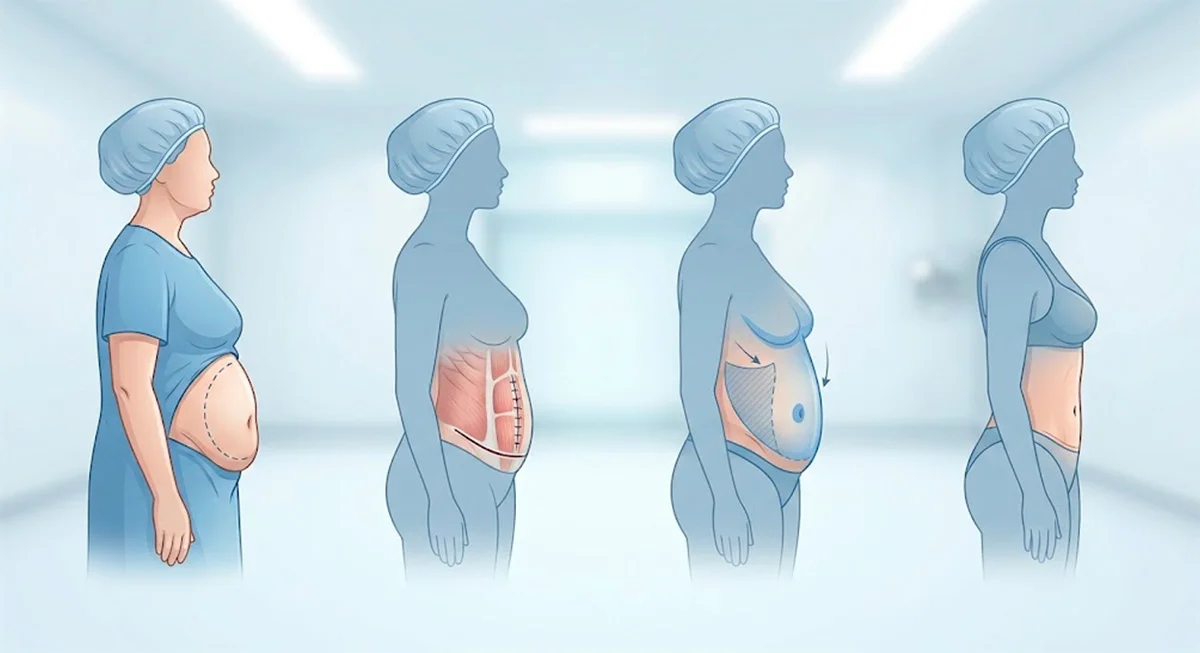 The results of any surgical or interventional procedure vary from person to person. You are advised to get your physician’s detailed opinion before the procedure.
Who Is a Good Candidate for a Tummy Tuck?
People whose abdomen has changed shape noticeably and whose general health does not stand in the way of surgery may be suitable candidates. A tummy tuck is usually considered for:
- Women whose abdomen has changed after pregnancy: during pregnancy the abdominal skin stretches to its limit, and the rectus muscles at the front of the abdominal wall move apart. A tummy tuck is the surgical option considered when sagging does not improve after childbirth despite exercise and diet.
- People who have lost a lot of weight: after bariatric surgery (such as a gastric sleeve) or intensive dieting, a large weight loss leaves behind a deflated, sagging layer of skin on the abdomen. In this situation an abdominoplasty is considered.
- People with age-related skin laxity: the body produces less collagen and elastin with age. This loss of firmness in the abdominal skin can be corrected surgically.
- People close to their ideal weight: a tummy tuck is a body-contouring operation, not a way to lose weight. Being close to your ideal weight helps make the result more predictable.
When Should a Tummy Tuck Be Postponed, and When May It Not Be Suitable?
In the following situations a tummy tuck is postponed or not recommended, or a detailed assessment is needed first:
- Pregnancy or breastfeeding, or less than 6 months since giving birth.
- Plans for another pregnancy in the near future.
- Weight loss that is still under way, or a weight that has not yet stabilised.
- Being unable to stop smoking before surgery.
- Uncontrolled diabetes, heart or lung disease, or bleeding and clotting disorders; a history of deep vein thrombosis or pulmonary embolism.
- Excess fat without loose skin: in this case liposuction alone may be enough.
Types of Tummy Tuck: Full (Total), Mini and Extended Abdominoplasty
Every patient’s anatomy, degree of skin sagging and expectations are different. An abdominoplasty is therefore planned individually, and there are three main techniques:
1. Full (Classic) Tummy Tuck, or Full Abdominoplasty
This is performed for people with marked sagging and muscle laxity in both the upper and the lower abdomen. The incision, a little longer than a caesarean scar, is placed so that it stays within the underwear. The belly button is repositioned, the muscles of the entire abdominal wall are tightened, and the excess skin is removed completely.
2. Mini Tummy Tuck (Mini Abdominoplasty)
This is preferred when the problem is limited to the area below the belly button and the belly button does not need to be moved. The incision is shorter, and recovery is quicker than after a full tummy tuck.
3. Extended Tummy Tuck
This technique is chosen when the sagging and excess skin are not limited to the front of the abdomen but extend towards the waist and flanks. In the same operation, it also aims to bring out the curve of the waist.
Mini or Full Tummy Tuck: Which One Do I Need?
Because it is done through a shorter incision, the mini tummy tuck is an option patients often ask about, but it is not enough for every abdomen. Which method suits you depends on whether the sagging is only below the belly button or also in the upper abdomen, and on how far up the separation of the abdominal muscles extends. The table below summarises the general differences between the two methods; the final decision is made at the examination.
| Feature | Mini tummy tuck | Full tummy tuck |
|---|---|---|
| Area corrected | Excess skin below the belly button | Upper and lower abdomen |
| Incision | Low, at the level of the pubic area; shorter | Low, at the level of the pubic area, running between the two hip bones |
| Belly button | Usually stays where it is | Repositioned; a fine scar remains around the belly button |
| Muscle repair | Only below the belly button, if needed | From just below the breastbone down to the pubic area |
| Recovery | Usually shorter | Longer; the first two weeks call for more care |
A mini tummy tuck is usually considered for people who are close to their ideal weight, have good skin quality and whose only concern is limited sagging below the belly button. If there is also laxity in the upper abdomen, or a muscle separation that extends above the belly button, the mini method cannot correct these areas; choosing it just for a shorter scar may not give the result you expect. If the sagging also extends to the waist and flanks, the extended method, in which the incision is lengthened towards the sides, is considered.
Tummy Tuck After Pregnancy: When Can It Be Done?
During pregnancy, the abdominal skin and muscles stretch to make room for the growing womb. Some of this recovers after the birth, but after several pregnancies, a twin pregnancy or a large baby, or when the skin has little natural elasticity, sagging below the belly button, stretch marks and separation of the abdominal muscles in the midline (diastasis recti) can become permanent. This muscle separation can make the abdomen stick out even after weight loss, and exercise does not always close it. You can read more about how pregnancy changes the abdomen in our guide to the tummy tuck and mommy makeover process.
For a tummy tuck after pregnancy, the usual advice is to wait at least 6 months after giving birth, until breastfeeding has finished and your weight has been stable for a few months. This time allows the abdominal skin and muscles to recover as far as they can on their own, hormones to settle and your weight to stabilise. If you had a caesarean section, the caesarean area must also have healed completely; doing a tummy tuck in the same operation as a caesarean section is generally not recommended.
Because a caesarean scar usually lies at the level of the new incision, it can be removed together with the excess skin or incorporated into the new scar line, depending on where the scar is and how much excess skin there is. If you are also considering procedures such as a breast lift or breast augmentation alongside the tummy tuck, the plan is made as a mommy makeover.
Abdominal Muscle Separation (Diastasis Recti) and Muscle Repair
The two vertical muscles at the front of the abdomen (the rectus muscles) are joined in the midline by a band of connective tissue. During pregnancy or with significant weight changes, this band can stretch and widen, and the muscles move apart; this is called abdominal muscle separation, or medically diastasis recti (rectus diastasis). When there is a separation, you may notice a bulge along the midline, especially when you sit up from lying down.
During a tummy tuck, the separated muscles are brought together by stitching them in the midline; this is called muscle repair (plication). In a full tummy tuck the repair can run from just below the breastbone down to the pubic area; in a mini tummy tuck it is done only below the belly button, if needed, so it cannot correct a separation that extends above the belly button. The examination assesses how far up the separation extends and whether there is also a hernia. A feeling of tightness in the abdomen is expected in the first weeks after muscle repair, which is why it is important to wait at least 6–8 weeks before heavy lifting and abdominal exercises.
Can Exercise Fix Diastasis Recti?
Exercise strengthens the abdominal and core muscles and can improve the appearance of a mild separation. With a marked separation, however, exercise does not always close the gap and does not remove sagging skin; in that case muscle repair may be needed, together with removal of the excess skin if there is any. The degree of separation and the method that suits you are determined at the examination.
How to Prepare for a Tummy Tuck
A successful abdominoplasty starts with a thorough examination and careful planning. At your consultation with your plastic surgeon, your general health, any chronic conditions, the medicines you take and your aesthetic expectations are discussed in detail.
The main points to keep in mind before surgery are:
- Smoking: tobacco products seriously impair the blood supply to the tissues and wound healing. You must stop smoking completely at least 3–4 weeks before surgery.
- Blood thinners: aspirin, herbal teas, vitamin E and other supplements with a blood-thinning effect should be stopped under your doctor’s supervision.
- Stable weight: keeping your weight stable over the last few months before surgery matters for accurate surgical planning.
How Is a Tummy Tuck Performed?
An abdominoplasty is performed under general anaesthesia and takes on average 2.5 to 4 hours, depending on the extent of the technique used. The operation generally involves the following steps:
- The incision: the incision line is made between the two hip bones, planned so that it stays hidden under the underwear line.
- Tightening the muscles: the abdominal skin and the fat beneath it are lifted off the underlying muscle layer up to the breastbone. Weakened or separated abdominal muscles are stitched together in the midline, creating an internal corset.
- Removing the excess skin: the skin of the upper abdomen is drawn downwards, and the excess skin and the fat beneath it are cut away.
- Shaping the belly button: a new opening for the belly button is made in the tightened skin at the right position, shaped to look natural, and stitched in place.
- Closing the incision: temporary drains may be placed to stop fluid from collecting in the tissues. The incisions are closed with fine cosmetic suturing techniques.
Recovery After a Tummy Tuck
The weeks after surgery have a direct effect on the quality of the result. Recovery from an abdominoplasty calls for patience, and your doctor’s advice should be followed exactly.
- Hospital stay: patients usually stay in hospital for 1 or 2 nights.
- Compression garment: at the end of the operation you are fitted with a medical compression garment. It reduces swelling, helps the tissues settle and adhere in their new position, and needs to be worn continuously for about 4–6 weeks.
- Pain relief: any pain in the first few days is controlled with prescribed painkillers.
- Posture and movement: in the first days, to reduce tension on the stitches, you are advised to walk slightly bent forward and, when lying down, to keep your legs slightly bent with a pillow under your knees.
- Returning to work and social life: patients with desk jobs can usually go back to work within 10–14 days.
- Physical activity: strenuous exercise, heavy lifting and activities that strain the abdominal muscles should be avoided for at least 6–8 weeks.
Tummy Tuck Recovery Timeline, Week by Week
The timeline below shows the usual course after a full tummy tuck. After a mini tummy tuck the times are mostly shorter; if liposuction or other procedures were added, they may be longer. Your own timeline becomes clear at your check-ups.
| When | What usually happens |
|---|---|
| First 1–2 days | Monitoring in hospital, painkillers and the compression garment. Short walks begin on the same day or the day after, with the upper body bent slightly forward. |
| Week 1 | Rest at home. If drains were used, they are removed at a check-up once the fluid has decreased. You are told on which day you may shower. |
| Week 2 | Standing upright gradually becomes easier. People with desk jobs usually return to work within 10–14 days. |
| Weeks 3–6 | You keep wearing the compression garment (for about 4–6 weeks in total). Daily tasks become easier; heavy lifting and abdominal exercises are not allowed yet. |
| Weeks 6–8 | After a check-up, a gradual return to exercise; strenuous exercise starts at this stage at the earliest. |
| Months 3–6 | Most of the swelling subsides; numbness in the lower abdomen usually starts to lessen. |
| Months 6–12 | The abdomen settles into its final contour; the scar continues to fade. |
For the first weeks, you are advised to sleep on your back with your head and knees slightly raised. You can drive again once you need fewer painkillers and can turn your upper body comfortably and brake hard in an emergency; this is usually after about two weeks. In the first months it is normal for swelling to increase during the day and in the evening. Numbness in the skin above the incision lessens over the months; recovery can take up to a year, and reduced sensation may remain permanently in a small area.
Aftercare: What Should I Pay Attention to After a Tummy Tuck?
The following advice makes recovery easier:
- Compression garment: once you are allowed to shower, take the garment off only for short periods such as showering; do not wear it less or stop wearing it unless your doctor advises you to.
- Walking: make your short walks a little longer each day; avoiding long periods without moving supports your circulation.
- Coughing and sneezing: gently supporting your abdomen with a pillow when you cough, sneeze or laugh reduces the strain on the incision and the repaired muscles.
- Constipation: painkillers and moving less can cause constipation; plenty of fluids and high-fibre foods help you avoid straining, and if needed your doctor will recommend a suitable medicine.
- Smoking: after surgery too, do not use cigarettes or any nicotine products, including e-cigarettes, until the wounds have fully healed.
- Baths, pools and the sea: do not take a bath or go into a swimming pool, the sea or a sauna until the wounds have closed completely.
- Physically demanding work: wait until the heavy-lifting restriction ends (at least 6–8 weeks) before going back to this kind of work.
- Returning to exercise: after your check-up, start with light exercise such as brisk walking; if your muscles were repaired, exercises that strain the abdominal muscles directly, such as sit-ups, are added last.
- Massage: where your doctor recommends it, lymphatic drainage massage can help reduce swelling; ask your doctor before massaging the incision or the abdominal skin yourself.
Which Symptoms Should I Report to the Doctor Straight Away?
- Sudden shortness of breath, chest pain or palpitations.
- Swelling, pain and redness in one leg.
- A high temperature; increasing redness or warmth along the incision, or a foul-smelling discharge.
- Pain that keeps getting worse and does not respond to medication, or swelling that grows quickly on one side.
- The incision opening up, or the skin around the incision turning darker.
If you notice any of these signs, let us know straight away by calling +90 532 178 83 05. With symptoms such as shortness of breath or chest pain, go to the nearest emergency department without delay.
Tummy Tuck with Liposuction (Lipoabdominoplasty)
In some patients, tightening the skin alone may not shape the waistline as much as desired. In such cases the abdominoplasty is combined with liposuction. This combined technique is called lipoabdominoplasty.
Liposuction removes stubborn fat from the waist, upper abdomen and hips, while the tummy tuck removes the excess skin and tightens the abdominal skin. The aim is a more balanced transition between the front and side profiles.
Tummy Tuck Risks and Possible Complications
As a major operation performed under general anaesthesia, a tummy tuck carries the risks that any surgery can carry, including those related to anaesthesia. Knowing in advance about the possible complications and how they are managed is part of making the right decision:
- Seroma (fluid collection): fluid gathers under the skin; if necessary, it is drained at a check-up.
- Haematoma (collection of blood) and bleeding: uncommon, but may require further treatment.
- Delayed wound healing: part of the incision may open or form a scab, and rarely there may be some loss of skin tissue. Smoking, diabetes and excess weight increase this risk.
- Infection: usually treated with antibiotics and wound care.
- Blood clots (deep vein thrombosis) and a clot travelling to the lungs: a serious but uncommon risk. Early walking, compression stockings and, when needed, anti-clotting medication are used to reduce it.
- Changes in sensation: numbness in the skin between the belly button and the incision is common; sensation partly returns over the months, but reduced sensation may remain permanently in one area.
- Scar and contour problems: the scar may thicken or widen, small bulges (“dog ears”) may form at the ends of the incision, or there may be slight asymmetry; a minor correction is sometimes needed.
To reduce these risks, your general health and test results are assessed before surgery, you stop smoking, the operation is performed in a fully equipped hospital licensed by the Ministry of Health, and you attend all your follow-up visits after surgery. Your individual level of risk is discussed at the examination.
Will a Tummy Tuck Leave a Scar?
Scarring is one of the things patients ask about most. A scar is unavoidable after an abdominoplasty, but it is carefully planned so that it stays within the area covered by a bikini or underwear.
In the first months the scar may be pink and noticeable; it usually starts to fade from around month 6 and, within 1–2 years, becomes a less visible line closer to your skin colour. Scar creams and, when needed, laser treatments can help make the scar less visible.
Scar Care Tips
How a scar finally looks depends largely on your skin type and genetics, but what you do while it heals can still make a difference:
- Avoid heavy lifting and movements that stretch the incision for as long as you have been advised.
- Once the wound has fully closed, use the silicone gel or silicone strips your doctor recommends on a regular basis.
- Protect the scar from the sun for at least a year; sun exposure can darken it.
- Do not smoke; smoking slows wound healing and can contribute to a wider scar.
- Always mention changes such as increasing redness, a raised or thickening scar, or itching at your check-up; if needed, scar treatment is planned.
After a mini tummy tuck the scar is shorter, and because the belly button usually stays where it is, there is no scar around it. After a full tummy tuck, a fine scar around the belly button remains in addition to the horizontal scar low on the abdomen. The scar does not disappear completely, but it usually fades over time and becomes less noticeable along the underwear line.
How Long Do the Results Last?
Because excess skin is removed and slack muscles are repaired, the change usually lasts a long time. However, ageing, significant weight changes and a new pregnancy can affect the abdomen again. Keeping to your ideal weight and exercising regularly help to maintain the result; results vary from person to person.
Travelling to Istanbul, Turkey, for a Tummy Tuck
Before you travel, you can send photos on WhatsApp for a preliminary assessment and receive your plan in writing; to begin, contact us. The examination and the final operation plan are made in person in Istanbul, and the operation takes place in a fully equipped hospital licensed by the Ministry of Health. For a tummy tuck, plan to stay in Istanbul for at least 7 nights; you fly home only when the doctor confirms that you are fit to travel. After you return home, follow-up continues with photo reviews on WhatsApp, and your medical records are given to you in English.
Frequently Asked Questions about Tummy Tuck Surgery
Is a tummy tuck the same operation as an abdominoplasty?
Yes. “Tummy tuck” is the everyday name for the operation; its medical name is abdominoplasty. The extent of the operation is planned as a full, mini or extended tummy tuck, depending on how widespread the sagging is.
How long does a tummy tuck take?
A full tummy tuck is performed under general anaesthesia and usually takes 2.5 to 4 hours, depending on its extent; additional procedures such as liposuction can make it longer. After the operation, patients usually stay in hospital for 1 or 2 nights. How long a mini tummy tuck takes and how long you stay in hospital are decided at the examination, depending on the extent of the procedure.
Is a tummy tuck risky or dangerous?
A tummy tuck is a major operation performed under general anaesthesia, and it carries risks such as a collection of fluid or blood, delayed wound healing, infection and, although uncommon, blood clots. Smoking, diabetes and excess weight increase these risks. Tests before surgery, stopping smoking, a licensed and fully equipped hospital, walking early and compression stockings reduce the risks, but they cannot remove them completely. Your individual level of risk is discussed at the examination.
How long does it take to recover from a tummy tuck?
Recovery happens in stages. People with desk jobs usually return to work within 10–14 days; the compression garment is worn for about 4–6 weeks, and you wait at least 6–8 weeks before strenuous exercise and heavy lifting. It can take 6–12 months for the swelling to go down completely and for the abdomen to reach its final shape. These times are usually shorter after a mini tummy tuck and may be longer if additional procedures were done.
When do the swelling and firmness go away after a tummy tuck?
In the first months it is normal for swelling to increase during the day and in the evening. Most of the swelling usually subsides between months 3 and 6, and the abdomen reaches its final shape between months 6 and 12. During this time the abdomen may also feel tight or firm; this usually eases as the swelling goes down. Firmness that lasts longer than expected, or gets worse, is assessed at a check-up.
Is a tummy tuck a hard operation to go through?
It is a major operation, performed under general anaesthesia and usually lasting 2.5–4 hours. The most demanding period is the first week or two: tightness, restricted movement and pain are expected at this stage, and the pain is controlled with prescribed medication. Arranging help at home for the first days and following the advice on walking, lying down and the compression garment make the process easier.
How much weight will I lose with a tummy tuck?
A tummy tuck is not a weight-loss method; the aim is to change the shape of your abdomen, not the number on the scales. The amount of skin and fat removed depends on how much sagging there is, varies from person to person and may not make a noticeable difference on the scales. The result is judged by your waist measurement and appearance rather than your weight. If you are overweight, losing weight before surgery is recommended.
Would liposuction alone be enough instead of a tummy tuck?
If your skin is elastic, there is no excess skin and your abdominal muscles are not separated, liposuction alone may be enough. If there is sagging skin below the belly button or a muscle separation, liposuction does not correct these; the sagging may even become more noticeable once the fat has been removed. In that case a tummy tuck, or a tummy tuck combined with liposuction (lipoabdominoplasty), is considered; the decision is made at the examination, based on the condition of your skin and muscles.
Who is a mini tummy tuck for?
A mini tummy tuck is considered for people whose sagging is limited to a small area below the belly button, who have no laxity in the upper abdomen, are close to their ideal weight and have good skin quality. The belly button usually stays where it is, and the scar is shorter. If there is also sagging in the upper abdomen or a muscle separation extending above the belly button, the mini method is not enough; which method suits you is decided at the examination.
Can I have a tummy tuck after gastric sleeve surgery?
Yes. For people who have lost a lot of weight through bariatric surgery (such as a gastric sleeve) or intensive dieting, a tummy tuck is an operation often considered for the loose skin left on the abdomen. Your weight loss should be complete and your weight stable over the last few months. If the excess skin extends to the waist and sides, an extended tummy tuck is considered. Sagging skin on the arms and legs is treated with separate operations, an arm lift or a thigh lift; which procedures are done, and in what order, is decided at the examination.
Will my tummy tuck scar fade?
The scar does not disappear completely, but in most people it fades over time. Pink and slightly raised in the first months, it usually starts to lighten from around month 6 and comes closer to your skin colour within 1–2 years. The incision is planned to sit within the underwear or bikini line. How the scar finally looks depends on your skin type, your genetics and how it is cared for while it heals.
Can I get pregnant after a tummy tuck?
Yes, pregnancy is possible after the operation; a tummy tuck is not a medical obstacle to pregnancy. However, a new pregnancy stretches the abdominal skin again and the repaired muscles may separate again, which can change the result of the operation. For this reason the operation is recommended once your family is complete. If you are thinking about becoming pregnant in the near future, mention this at the examination.
Will a tummy tuck remove my stretch marks from pregnancy?
Stretch marks on the skin that is removed go with that skin; in a full tummy tuck this is usually most of the stretch marks below the belly button. Stretch marks above the belly button are not removed; because the skin is pulled down, they move lower, and some may become less noticeable. How many of your stretch marks can be removed is assessed at the examination, based on the condition of your skin.
Is a tummy tuck the same as abdominal etching (six-pack surgery)?
No. A tummy tuck removes sagging skin and repairs slack muscles, so it leaves a horizontal scar low on the abdomen. Abdominal etching (six-pack surgery) is a liposuction-based procedure that sculpts the layer of fat over the muscles in people who are close to their ideal weight and whose skin does not sag. For someone with sagging skin, abdominal etching alone is not enough; which procedure suits you is decided at the examination.
When can I stand up straight and sleep on my side after a tummy tuck?
In the first days the upper body is kept slightly bent forward to reduce tension on the incision; an upright posture usually returns gradually within 1–2 weeks. For the first weeks, sleeping on your back with your head and knees slightly raised is recommended. You can usually start sleeping on your side within a few weeks, as pain and tightness ease; the timing is decided at your check-ups.
What determines the cost of a tummy tuck, and does SGK (Turkish public insurance) cover it?
The fee depends on the method (mini, full or extended), additional procedures such as liposuction, the length of the operation and anaesthesia, the length of your hospital stay and supplies such as the compression garment. For this reason the fee is given after the examination, once your personal plan has been made. For patients insured in Türkiye: SGK, the Turkish public health insurance, does not cover operations performed for cosmetic reasons.
Considering a Tummy Tuck? Take the First Step
If loose abdominal skin or slack abdominal muscles bother you, an examination that looks at your abdomen and your expectations together will show whether this operation is a suitable option for you. Op. Dr. Ayberk Akçay is a specialist in plastic, reconstructive and aesthetic surgery, a Fellow of the European Board of Plastic, Reconstructive and Aesthetic Surgery (EBOPRAS) and a full member of the Turkish Society of Plastic, Reconstructive and Aesthetic Surgeons. His practice is in Teşvikiye, Şişli, Istanbul; you can read about his training and memberships on the About Dr. Akçay page.
For a treatment plan tailored to you, an assessment of your body and answers to all your questions, get in touch with us and book a consultation.