
Cosmetic breast surgery (aesthetic breast surgery) is the umbrella term for operations that change the size, shape or position of the breasts, or the balance between the two breasts. It describes a group of operations rather than a single one: a breast that is small or has lost volume is enlarged, a sagging breast is lifted and a large, heavy breast is reduced; where necessary, these operations are combined. The surgical treatment of breast enlargement in men (gynecomastia) is also covered under this heading. Which operation suits you is decided at your consultation, by assessing the volume of your breasts, the degree of sagging, the quality of your skin, your concerns and your expectations together.
 The results of any surgical or interventional procedure vary from person to person. You are advised to get your physician’s detailed opinion before the procedure.
What Is Cosmetic Breast Surgery?
Each operation in this group targets a different feature of the breast and has its own medical name: breast augmentation, which aims to add volume, is called augmentation mammaplasty; breast lift, which addresses sagging, is called mastopexy; and the operation that makes the breast smaller and lighter is called reduction mammaplasty. These operations are mostly performed for reasons of appearance. Breast reduction performed because of the pain and skin problems caused by large breasts, however, belongs as much to reconstructive (restorative) surgery as to aesthetic surgery.
Am I a Good Candidate?
Breast surgery is considered for people whose breasts have finished developing, whose health allows surgery and anesthesia, and who have realistic expectations of the result. Breast surgery is not planned during pregnancy or breastfeeding. If you are thinking of becoming pregnant soon, if your weight is not stable or you are planning significant weight loss, if you still smoke, or if a chronic condition such as diabetes is not under control, postponing the operation may be advised.
Which Operation for Which Concern?
The table below summarizes common concerns and the operations usually considered for them. It is only a guide: two concerns that look similar can have different causes, and the plan that suits you is decided at your consultation.
| Concern | Operation usually considered |
|---|---|
| The breasts look small or empty; no sagging, or only very slight sagging | Breast augmentation |
| The breasts have sagged and the nipples have dropped; volume is sufficient | Breast lift (mastopexy) |
| The breasts have sagged and the upper part has emptied | Breast lift with implants |
| The breasts are large and heavy, with complaints such as pain or irritation under the breasts | Breast reduction |
| A marked difference in size or shape between the two breasts | Augmentation, lift, reduction or a combination of these |
| Breast enlargement in men | Gynecomastia surgery (male breast reduction) |
| Changes in both the breasts and the abdomen after childbirth and breastfeeding | Mommy makeover |
Small Breasts or Lost Volume: Breast Augmentation
Breast augmentation (breast enlargement) aims to add volume to breasts that stayed small as they developed, or that have lost volume after pregnancy, breastfeeding or weight loss. Volume can be increased in two ways: with silicone implants, or with your own fat, taken by liposuction from an area such as the abdomen, hips or thighs and then prepared.
- The shape, base width, profile and volume of the implant, the incision site and whether the implant goes over the muscle, under the muscle or in the dual plane are chosen on the basis of the measurements taken at your consultation.
- With fat transfer, part of the injected fat is absorbed over time; the method therefore suits a moderate enlargement rather than a marked increase in volume, and a second session is sometimes needed.
- Silicone implants are not lifetime devices: they need check-ups for as long as they remain in the body, and they may need to be replaced or removed in the future.
The operation, breastfeeding and recovery are explained in detail on the breast augmentation surgery page, and implant types, implant lifespan and implant replacement on the breast implants page.
Sagging Breasts: Breast Lift
Pregnancy, breastfeeding, weight changes, age and gravity can loosen the ligaments and skin that support the breast, so that the breast and nipple drop. In a breast lift (mastopexy), excess skin is removed, the breast tissue is reshaped and the nipple is moved up while keeping its connection to the tissue beneath it; if needed, an enlarged areola is made smaller. The volume of the breast, however, stays largely the same.
- The degree of sagging is determined by the position of the nipple relative to the breast crease (inframammary fold), and the technique is chosen according to this degree.
- The operation does not stop aging or the effect of gravity; a new pregnancy or significant weight change can, over time, cause some sagging to return.
Degrees of sagging, techniques, breast lift with implants and the recovery timeline are covered on the breast lift (mastopexy) page.
Large, Heavy Breasts: Breast Reduction
Large, heavy breasts can cause neck, back and shoulder pain, deep grooves in the shoulders from bra straps, and recurring rashes and irritation under the breasts; they can make exercising and finding clothes difficult. In breast reduction, excess breast tissue, fat and skin are removed; the nipple is moved, together with the tissue beneath it, to its new, higher position, and the breast is reshaped. For this reason, the operation also lifts the breast.
- It is not possible to name a specific bra size before the operation; the plan aims for breasts that suit your body measurements and are easier to carry.
- There is a safety limit to how much tissue can be removed: because the nipple is moved together with the tissue that nourishes it, the blood supply of this tissue must be preserved.
- Removed tissue does not grow back; however, significant weight gain, pregnancy and hormonal changes can enlarge the remaining breast tissue again.
Techniques, breastfeeding and the conditions for cover by the Turkish social security system (SGK) are explained on the breast reduction surgery page.
Breast Enlargement in Men: Gynecomastia
Fullness of the chest in men comes from enlarged breast gland tissue (true gynecomastia), from fat built up on the chest (pseudogynecomastia) or, often, from both together. The operation is also different from breast reduction in women: the aim is not to reshape the breast but to remove the appearance of a breast and create a flat chest contour.
- Before surgery is planned, the cause of the enlargement (certain medicines, anabolic steroids, hormonal problems) is assessed. Enlargement that appears during puberty often goes away on its own within two years.
- Fatty tissue is removed by liposuction, and firm gland tissue through a small half-moon incision at the lower edge of the areola; in advanced cases, excess skin is also removed, and the scar is then longer.
Causes, grades and wearing a compression garment are explained on the gynecomastia surgery (male breast reduction) page.
After Childbirth: Mommy Makeover
Pregnancy and breastfeeding can cause volume loss and sagging in the breasts, and loose skin, separation of the abdominal muscles and localized fat deposits on the abdomen. A mommy makeover is the name for a combination of operations put together for each person to address these changes: a breast operation such as a lift, augmentation with implants or a reduction is planned together with procedures such as a tummy tuck and liposuction.
- Whether the procedures can be done in a single session is decided on safety criteria; the longer the operation, the higher the likelihood of problems with blood clots, bleeding and wound healing.
- If the scope is extensive, the surgery can be split into two stages a few months apart; for example, the abdomen and waist first, then the breasts.
Which procedures can be combined and the right timing after childbirth are covered in detail on the mommy makeover page.
Uneven Breasts: Breast Asymmetry
Most women have a slight difference in size or shape between their two breasts. A marked difference, however, can make choosing bras and clothes difficult; it may be a difference in volume, shape, degree of sagging or the level of the nipples.
- The plan depends on the source of the difference, and each breast is assessed separately: the aim is to reduce a difference in volume with augmentation or reduction, and a difference in sagging and nipple level with a lift; where necessary, different procedures are performed on the two breasts.
- The aim is not to make the two breasts identical but to reduce the difference between them; a slight difference may remain after surgery.
- If the difference is only in the nipple or areola (a large or long nipple, a wide areola, an inverted nipple), a smaller procedure may be enough; the options are explained on the nipple surgery page.
- If a difference is new or has become noticeable within a short time, the cause of this change is investigated before any aesthetic plan is made.
What Is Assessed at the Consultation?
The consultation begins with listening to your concerns and expectations; your breasts are then examined and measured while you stand. The main findings that shape the plan are:
- The volume of the breasts, tissue thickness and skin elasticity
- The degree of sagging and the level of the nipples
- The width of the rib cage, the breast base and the shoulders
- Differences in size and shape between the two breasts
- Complaints such as neck, back or shoulder pain, or rashes under the breasts
- General health, medicines and supplements you take, smoking, and whether your weight is stable
- Plans for future pregnancy and breastfeeding
If necessary, breast imaging is also requested before the operation. Bringing any previous breast tests and a list of the medicines you take to the consultation makes the assessment easier.
How Is Breast Surgery Performed?
Breast operations are performed in a fully equipped hospital licensed by the Turkish Ministry of Health, with an anesthesia team present. Although the details vary with the type of operation, the process usually follows these steps:
- Preparation: blood tests and an anesthetic assessment are carried out. If you smoke, you will be asked to stop before the operation, and to stop medicines and herbal supplements that thin the blood, under your doctor’s guidance.
- Marking: measurements are taken, and the incision lines and, if needed, the new position of the nipple are marked while you stand.
- Anesthesia: augmentation with implants, breast lift and breast reduction are performed under general anesthesia. For fat transfer and gynecomastia surgery, the type of anesthesia depends on the extent of the procedure.
- Surgery: through the chosen incision, an implant is placed or excess skin and tissue are removed; the breast is reshaped and the incisions are closed in layers. If considered necessary, a drain is placed for a short time.
- After surgery: you are fitted with a supportive surgical bra or, after gynecomastia surgery, a compression vest.
Incision Sites and Scars
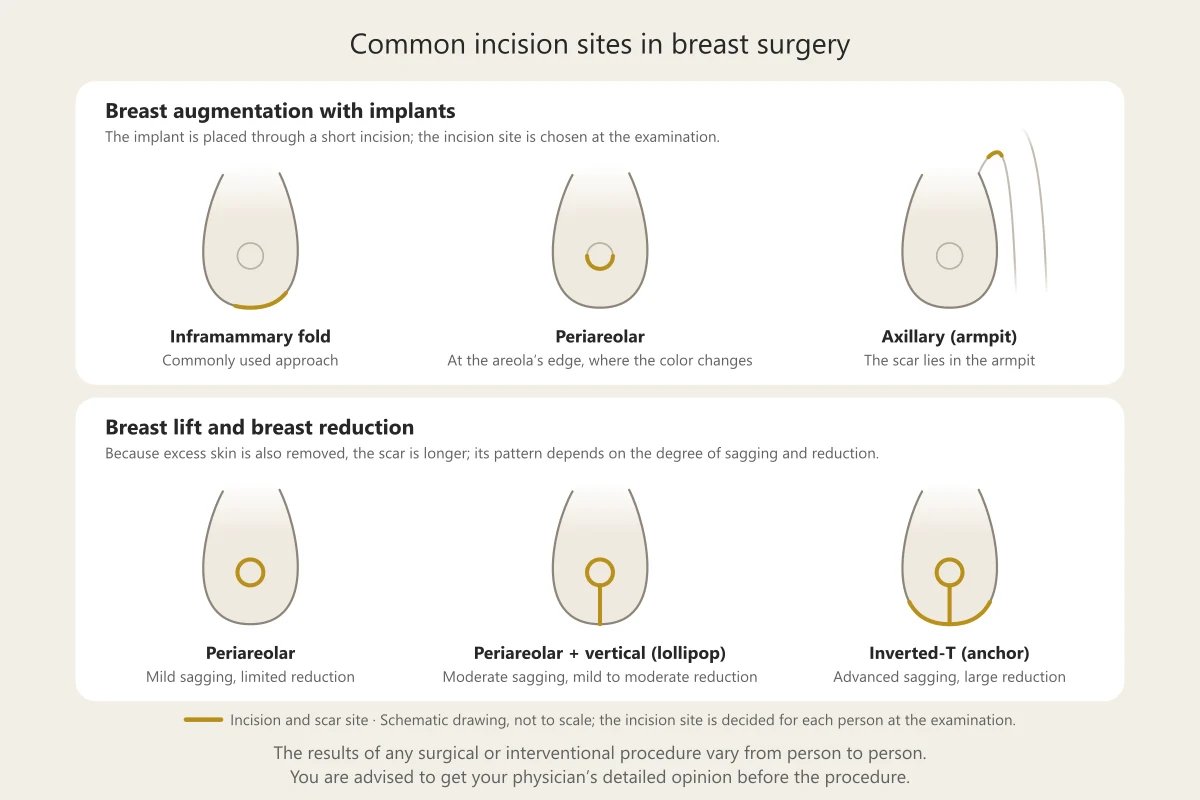
The site and length of the incision depend on the type of operation and on how much skin has to be removed. In augmentation with implants, the incision is made only to insert the implant; in a lift or reduction, excess skin is also removed, so the scar is longer. The incision sites commonly used in breast surgery for women are:
- Breast crease (inframammary fold): a frequently chosen approach for augmentation with implants; the scar lies in the fold beneath the breast.
- Around the areola (periareolar): at the edge of the darker area surrounding the nipple (the areola), on the line where the color changes. It is used for augmentation with implants, for lifts in mild sagging and for limited reductions.
- Armpit (axillary): an option in augmentation with implants for those who want no scar on the breast; the scar lies in the armpit.
- Around the areola plus a vertical incision (lollipop): a vertical line running from the areola down to the breast crease is added; this is used for moderate sagging and for mild to moderate reductions.
- Inverted-T (anchor): a horizontal line along the breast crease is added to the lollipop scar; this is used for advanced sagging and large reductions.
With fat transfer, scarring is limited to a few small entry points where the fat is taken and where it is injected into the breast. Every operation involving an incision leaves a permanent scar: in the first months, scars can be pink and slightly raised; they usually take 6 months to 1 year, sometimes longer, to mature, and in most people they become thinner and fade over time. In some people the scar can thicken (hypertrophic scar) or a keloid can develop; the final appearance depends on skin type and how healing progresses. Treatments that can be used for these scars are explained on the scar revision page.
Operation Time and Recovery: An Overview
The times below are the general ranges given on each operation’s own page; they vary with the individual and with any procedures performed at the same time.
| Operation | Operation time | Hospital stay | Return to desk work |
|---|---|---|---|
| Breast augmentation (with implants) | Usually 1–2 hours | One night for most patients | Usually at the end of the first week |
| Breast lift | Usually 2–3 hours | One night for most patients | Usually within 7–10 days |
| Breast reduction | Usually 2.5–4 hours | Usually one night | Usually within 7–10 days |
| Gynecomastia surgery | Usually 1–3 hours | Same day or one night | Toward the end of the first week for most patients |
| Mommy makeover | Usually 3–6 hours | Usually 1 or 2 nights | Usually in weeks 2–3 |
- Tightness, swelling and mild to moderate pain are expected in the first days; the pain is mostly eased with prescribed painkillers.
- Short walks start in the first days; heavy lifting and movements that strain the arms are avoided in the first weeks.
- How long the surgical bra or compression vest is worn and when you can return to sports depend on the operation; your personal timetable is given at discharge and at your follow-up visits.
- The swelling subsides over months and the breast gradually takes on its final shape; the scars take longer to mature.
At discharge, you are also told which symptoms you should report without waiting for your follow-up appointment, such as rapidly increasing swelling and pain in one breast, a fever or a painful swelling in your leg. If you develop sudden shortness of breath, or chest pain that starts suddenly and feels different from the pain of the operation, go to an emergency department without delay.
What Are the Risks of Breast Surgery?
Like any surgical procedure, breast surgery carries risks. They can be reduced through appropriate patient selection, careful planning and following the advice given after surgery, but they cannot be reduced to zero.
- In all breast operations: bleeding and a collection of blood (hematoma), a collection of fluid (seroma), infection, delayed wound healing, a noticeable or thick scar and asymmetry between the two sides. Reduced or increased sensation in the nipple and breast can also occur; in most patients these changes settle within months, but in some they can be permanent. In some cases, a corrective operation may be needed.
- In operations with implants: hardening and tightening of the capsule around the implant (capsular contracture), rupture or displacement of the implant, and a rare type of lymphoma associated with implants (BIA-ALCL).
- In operations that remove skin and tissue: an effect on the ability to breastfeed and, although rare, impaired blood supply to the nipple with resulting tissue loss.
- Fat necrosis: in fat transfer and in reduction, if part of the fatty tissue loses its blood supply, firm lumps that can be felt may form in the breast.
- Risks that apply to any operation: problems related to anesthesia and, although uncommon, a blood clot in the deep veins of the leg (deep vein thrombosis) and this clot traveling to the lungs (pulmonary embolism).
Smoking, excess weight (a high body mass index) and poorly controlled diabetes make some complications more likely. The risks that apply to you are discussed one by one at your consultation and during the informed consent process before the operation.
What Affects the Cost of Breast Surgery?
The fee for breast surgery varies from person to person and is set once your personal plan has been finalized at the consultation. The main factors that affect the fee are:
- The type of operation, and whether more than one procedure will be combined in the same session
- Whether implants will be used, and the type of implant
- The technique used and the length of the operation
- The type of anesthesia, the length of the hospital stay and the tests before the operation
- Supplies such as a surgical bra or compression vest, and follow-up visits after the operation
An examination is needed before a fee can be given; for an appointment, you can find our contact details here.
Traveling to Istanbul, Turkey, for Breast Surgery
Before you travel, you can send photos on WhatsApp for a preliminary assessment and receive your plan in writing; to begin, contact us. The examination and the operation plan are made in person in Istanbul, the operation takes place in a fully equipped hospital licensed by the Turkish Ministry of Health, and your surgeon decides when you are fit to fly home. For breast augmentation, a breast lift or a breast reduction, plan to stay in Istanbul for about 6–7 nights, or at least 7 nights when it is combined with body contouring such as a tummy tuck; for other procedures, the length of your stay is confirmed in your written plan before you book flights. Back home, follow-up continues with photo reviews on WhatsApp, and your medical records are given to you in English.
Frequently Asked Questions about Breast Surgery
At what age can breast surgery be done?
In women, breast operations are planned once breast development is complete, usually from the age of 18. In young people whose large breasts cause severe pain, posture problems or recurring skin problems, a reduction may be considered earlier; this decision is made after a detailed assessment, and for those under 18 the consent of a parent or guardian is required. There is no upper age limit: at an older age, the decision depends more on general health and the results of breast tests than on age itself.
Do I need a mammogram or breast ultrasound before surgery?
Depending on your age and risk profile, for example if you have a family history of breast cancer, a breast ultrasound or mammogram is requested before the operation. These tests show the current state of the breast tissue and provide a point of comparison for later screening. If a finding that needs further investigation is detected, the operation is postponed until that finding has been assessed. After surgery, you continue with the screening appropriate for your age; telling the team before the scan that you have had breast surgery or have implants ensures that the test is carried out and interpreted accordingly.
Does breast surgery affect breastfeeding?
The effect depends on the type of operation and the technique; how far the ability to breastfeed will be preserved cannot be known in advance. In augmentation, the implant is placed behind the milk glands, so many women with implants can breastfeed; even so, the proportion who can feed their baby on breast milk alone may be lower, and an incision around the areola can affect the milk ducts and nerves. In a lift or reduction, the outcome depends on how far the nipple’s connection to the milk-producing gland tissue beneath it can be preserved and, in a reduction, on the amount of tissue removed; after a reduction, breastfeeding may be only partly possible or not possible at all. If you want to breastfeed in the future, mention it at your consultation; it is taken into account when the incision site and technique are chosen.
Which doctor should I see for breast surgery?
For breast augmentation, breast lift and breast reduction, and for gynecomastia surgery, you should see a specialist in plastic, reconstructive and aesthetic surgery. At the first appointment, which operation is suitable, which tests are needed before surgery and whether your expectations are realistic are assessed together. If there is a finding such as a lump in the breast, discharge from the nipple or puckering of the skin, it needs to be assessed by the appropriate specialist before any aesthetic plan is made.
Can breast asymmetry be corrected with exercise or without surgery?
The breast is made up of glandular tissue and fat, whereas chest exercises work the muscle beneath the breast. Exercise can therefore support your posture, but it does not remove a difference in volume or sagging between the two breasts. Creams and pills that are claimed to enlarge or reduce the breasts have not been scientifically shown to work either. If a marked difference bothers you, the options are discussed at your consultation.
Is breast surgery covered by Turkish social security (SGK)?
This concerns patients insured under the Turkish social security system (SGK). Breast operations performed only to change appearance are not covered. Cover for a breast reduction performed because of medical problems caused by large breasts, and for gynecomastia surgery, depends on the conditions of the Health Implementation Communiqué (SUT) and on documented medical necessity, which for breast reduction means a medical board report. Private practice services and private doctors’ fees are outside SGK cover, and private health insurance cover depends on the terms of your policy; it is advisable to confirm the current conditions with SGK, your insurer and the institution before planning surgery.
How long after breastfeeding can I have breast surgery?
It is usually recommended to wait at least 6 months after breastfeeding has stopped completely and milk production has ended. This gives the breast tissue, which changes during breastfeeding, time to settle in volume and shape, so that the measurements and the choice of implant or technique can be made more accurately. If a tummy tuck is also planned as part of a mommy makeover, at least 6 months should also have passed since childbirth, and your weight should have been stable for a few months.
Consultation and Appointments
To work out the plan that suits you, it may be helpful to ask these questions at your consultation:
- Which operation is right for my concern, and why?
- Will I need implants? If so, how will the type, volume and placement be chosen?
- Where will the incision and the scar be?
- Which tests do I need before the operation?
- When can I return to work, sports and my daily routine?
- What does the fee include?
Results vary from person to person; the aim of the consultation is to establish whether an operation is right for you and, if so, which one. Op. Dr. Ayberk Akçay is a plastic, reconstructive and aesthetic surgeon, a Fellow of the European Board of Plastic, Reconstructive and Aesthetic Surgery (EBOPRAS) and a full member of the Turkish Society of Plastic, Reconstructive and Aesthetic Surgeons; his practice is in Teşvikiye, Şişli, Istanbul. You can book a consultation in Istanbul through the contact page.