Revision rhinoplasty is a second (sometimes third) nose operation to correct problems with appearance or breathing in people who have already had a nose job or other nose surgery. It is also known as revision nose surgery, a revision nose job, corrective rhinoplasty, a second nose job or secondary rhinoplasty.
After a first operation, the inner structure of the nose has changed: scar tissue forms between the tissue layers, and some of the cartilage may have been reduced or weakened. Revision therefore needs a more detailed assessment than a first operation, and often additional cartilage support. On this page you will find when revision is considered, when it can be done, where cartilage grafts are taken from and what to expect during recovery. For general information on nose surgery, see our rhinoplasty (nose job) page.
How Does Revision Differ from a First Rhinoplasty?
In a first rhinoplasty (primary rhinoplasty), the surgeon works with tissue that has not been operated on before. In a revision, the effects of the previous operation are at the centre of the plan: scar tissue makes the tissue layers stick to each other, missing cartilage may need to be replaced, and the skin may not be as elastic as it was. The main differences can be summarised as follows:
| Aspect | First rhinoplasty | Revision rhinoplasty |
|---|---|---|
| Tissue | Not operated on before | Scar tissue and altered anatomy |
| Cartilage grafts | If needed, mostly taken from the septum | Often needed; taken from the ear or a rib if the septum does not provide enough |
| Technique | Open or closed | Often the open technique |
| Length of the operation | Usually 2–4 hours | Usually 3–5 hours |
| Time for the final shape to settle | Usually 6–12 months | Usually 12–18 months, sometimes longer |
When Is Corrective Nose Surgery Needed?
The need for revision does not always stem from a problem with the first operation. Scar tissue contracting during healing, cartilage shifting over time or a blow to the nose after surgery can also affect the result. The reasons generally fall into two groups.
Reasons Related to Appearance
- A hump, step or irregularity on the bridge that has remained or become noticeable again
- A dip in the bridge caused by removing too much of it or by weakened septal support (a saddle-nose appearance)
- A tip that has drooped over time, has stayed too upturned or looks asymmetric
- Fullness just above the tip (a “pollybeak” or parrot-beak appearance)
- A nose that looks shifted off the midline of the face, or crookedness that persists
- Asymmetry of the nostrils and the sides of the nose, or a nostril rim that has been pulled upwards
- A nose that has been made too small for the proportions of the face and looks “operated on”
Reasons Related to Breathing
- A deviated septum (the wall dividing the nose) that was not corrected or has become bent again
- The sides of the nostrils, or the narrow airway passage inside the nose (the internal nasal valve), collapsing inwards when you breathe in because cartilage support has weakened
- Loss of support in the middle part of the bridge, which may come with an inverted-V appearance from the outside
- Adhesions (bands of scar tissue) inside the nose, or enlarged turbinates
A blocked feeling in the first weeks and months after surgery is mostly due to swelling and eases over time. If the blockage persists, its cause is investigated at an examination that includes a look inside the nose. Not every irregularity calls for major surgery; in some cases a more limited procedure may be enough.
A Minor Touch-Up or a Full Revision?
The extent of a revision depends on the size of the problem and the condition of the nose’s supporting structures:
- Minor correction (touch-up): Considered for limited, well-defined problems such as a small irregularity left on the bridge or a step in the bone; in these cases the closed technique, in which the incisions stay inside the nose, can also be used.
- Full revision: With structural problems such as a dip in the bridge, loss of tip support or the sides of the nostrils collapsing when you breathe in, the support may need to be rebuilt with cartilage grafts; the open technique is often preferred for these operations.
Even for a minor correction, it is usual to wait until the nose has reached its final shape, that is, at least 12 months. Which group the problem falls into and which approach suits it are determined at the examination, which also includes a look inside the nose.
When Can a Second Nose Operation Be Done?
For a revision, it is usual to wait at least 12 months after the first operation. There are two main reasons for this. First, swelling in the tip can last for months, and the shape you see while the swelling persists is not the final shape of the nose. Second, scar tissue takes time to soften and mature; operating on tissue that has not yet matured is technically more difficult and can increase the formation of new scar tissue. For noses with thick skin or long-lasting swelling, extending this period to up to 18 months may be recommended.
In some situations an earlier assessment may be needed: examples include marked, persistent difficulty breathing, a graft that has shifted or become visible under the skin, an infection, or a serious blow to the nose after surgery. The timing and extent of any intervention are decided individually at the examination.
Unhappy with Your First Operation? What to Do While You Wait
The waiting period is not wasted time. During it, the following steps are useful:
- Not deciding on a second nose operation while the swelling persists and before the nose has reached its final shape
- Continuing to attend your check-ups and raising your concerns openly at these appointments
- Tracking how your nose changes with photos taken at regular intervals, in the same light and from the same angles
- Writing down your concerns and putting them in order of importance: is it mainly the appearance or your breathing that bothers you?
- Gathering the reports from the previous operation (operation note, discharge summary) and photos from before your first operation
- Having any nasal blockage that continues after the swelling period checked at an examination
Cartilage Grafts in Revision Rhinoplasty
A cartilage graft is a piece of cartilage used to rebuild the support of the nose, fill in missing parts or keep the airway open. In revision surgery, grafts can be used to support the tip, rebuild the bridge, strengthen the sides of the nostrils and camouflage small irregularities. The patient’s own cartilage (an autologous graft) is generally preferred; because it is the person’s own tissue, the body is not expected to reject it. Artificial materials such as silicone, on the other hand, have limited use in nose surgery because of the risk of infection and of working their way out through the skin over time (extrusion).
 The results of any surgical or interventional procedure vary from person to person. You are advised to get your physician’s detailed opinion before the procedure.
Septal Cartilage
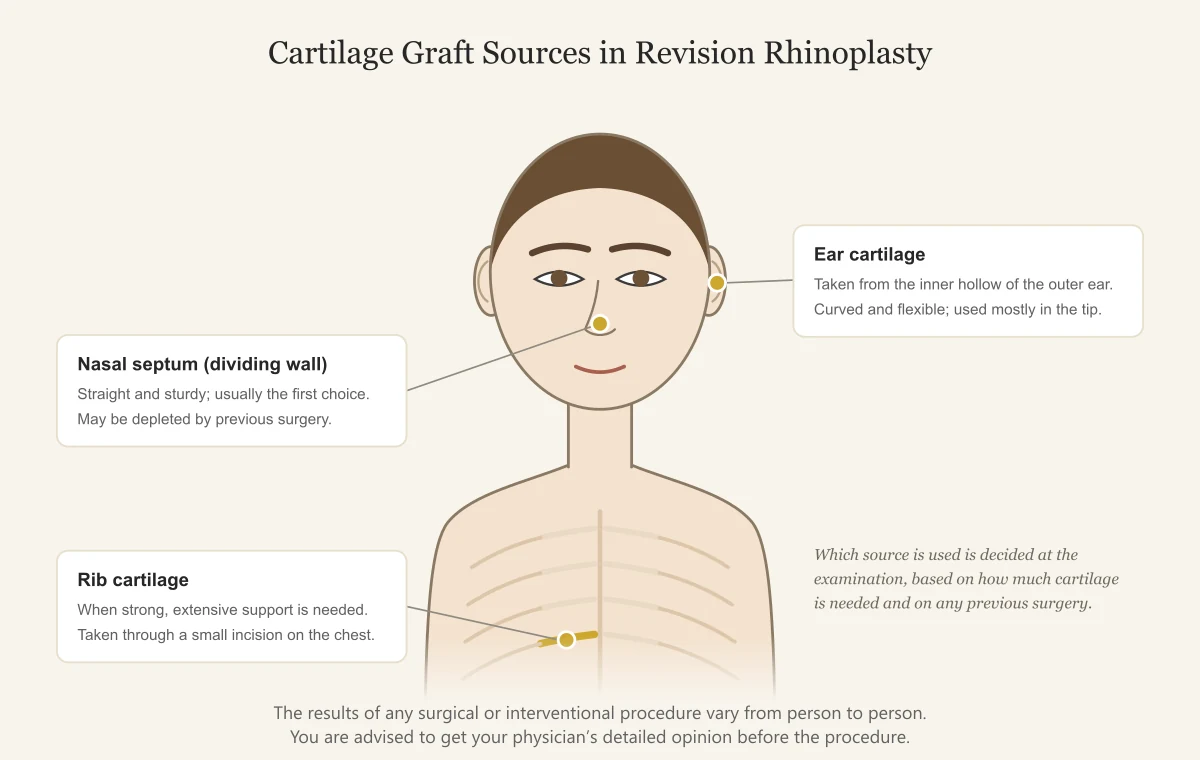
Because it is straight and firm, cartilage from the septum is usually the first choice; as it is taken from inside the nose, it needs no additional incision. However, if part of the septum was removed or used as a graft in the first operation, there may not be enough cartilage left for the revision.
Ear Cartilage
Ear cartilage is a common source when the septum does not provide enough. It is taken through a small incision from the hollow bowl of the outer ear (the concha); the outward appearance of the ear usually does not change noticeably. Because it is curved and flexible, it is most useful for supporting the tip and the sides of the nostrils; where strong structural support is needed, it may not be enough on its own.
Rib Cartilage
Rib cartilage is considered when there is a marked dip in the bridge, when the tip needs strong support, or when septal and ear cartilage have already been used. It is taken through a small incision on the chest; this leaves a permanent scar there, and there may be pain in the first days. Rib cartilage can bend (warp) somewhat over time; measures to reduce this tendency are built into the surgical plan. Although uncommon, the lining of the lung can be injured while the cartilage is being taken, and air can leak into the chest cavity (pneumothorax).
Which source is used is decided at the examination, based on the amount of cartilage needed, which tissues were used in previous operations and the structure of the nose. Some patients may need cartilage from more than one source.
How Long Does Nose Surgery with Rib Cartilage Take?
Revision rhinoplasty usually takes 3–5 hours; harvesting and preparing rib cartilage can add to this time. When rib cartilage is used, healing is followed separately for the chest and for the nose:
- Chest: In the first days there may be pain where the cartilage was taken; it is controlled with the painkillers your doctor recommends. Heavy lifting is avoided for a while.
- Nose: Healing follows the usual course after revision, described below; the pain in the chest may delay your return to desk work a little.
If rib cartilage was taken and your chest pain keeps getting worse, let your surgeon know without delay; if you have sudden shortness of breath or severe chest pain, call the emergency services immediately (112 in Turkey).
How Is Revision Rhinoplasty Performed?
Consultation and Planning
Planning begins with a conversation about your concerns and priorities: is it mainly the appearance, your breathing, or both that bothers you? The outer structure of the nose, skin thickness, cartilage support and the inside of the nose are examined in detail. Reports from previous operations and photos from before the first operation, if you have them, help to establish which tissues were removed or used. Analysing photographs makes it easier to discuss realistic goals, but it is not an exact preview of the outcome of surgery. Before the operation, blood tests and an anaesthetic assessment are carried out. Because smoking reduces the blood supply to the tissues and impairs healing, you are advised not to smoke before or after the operation.
Open or Closed Technique
In revision surgery the open technique is often preferred, because it allows the scar tissue to be assessed in detail and grafts to be placed accurately; with this technique, a small incision is made across the columella, the strip of tissue between the nostrils. In some cases where the problem is limited and well defined, the closed rhinoplasty approach, in which the incisions stay inside the nose, may also be suitable. To correct irregularities of the nasal bones, the piezo rhinoplasty technique, which works with ultrasonic instruments, can be used. If there is a breathing problem, the septum and the turbinates can be corrected in the same session (septorhinoplasty).
The Day of Surgery
Revision rhinoplasty is performed under general anaesthesia in a fully equipped hospital licensed by the Ministry of Health. How long it takes depends on the effects of the previous operation and on whether a graft has to be harvested; it usually takes 3–5 hours. At the end of the operation a splint is applied to the bridge and, if needed, soft silicone packs with a central channel you can breathe through are placed inside the nose. Most patients stay one night in hospital for observation.
Recovery After Revision Rhinoplasty
The early stages of recovery are similar to those after a first nose operation; the main difference is that swelling lasts longer because of the scar tissue. The usual course is as follows:
- First week: Swelling and bruising are noticeable during this time. You keep your head raised, use cold compresses and protect the splint. If cartilage was taken from the ear or the chest, that area also needs care during this period.
- Around day 7: The splint, the stitches and any silicone packs are removed, and the advice on activities is updated.
- 2–4 weeks: Most of the visible swelling goes down, and most people return to desk work during this period. Strenuous sport and wearing glasses remain restricted for a while longer.
- 3–6 months: The nose comes noticeably closer to its final shape, while swelling in the tip continues for a while longer.
- 12–18 months: The last swelling in the tip resolves and the final shape emerges. With thick skin this can take longer.
Things to Keep in Mind After Revision
- Keep all your check-up appointments, and do not judge the final look of your nose too early while the swelling persists
- Follow the care instructions for the site the cartilage was taken from; if rib cartilage was used, avoid heavy lifting for a while
- Protect your nose from knocks and take a break from contact sports for the recommended period
- Avoid smoking; this matters even more for tissues whose blood supply is already reduced by scarring
- If recommended, keep up the taping and the instructions for caring for the inside of your nose
For detailed advice on sleeping position, cleaning your nose, sport and sun exposure, read our rhinoplasty recovery guide.
What Are the Risks of Revision Rhinoplasty?
Revision is technically more difficult than a first nose operation, and some risks may be more pronounced. The following are discussed in detail before surgery and given to you in writing as part of the informed consent process:
- Risks related to anaesthesia
- Bleeding and haematoma; because of scar tissue, the tendency to bleed may be slightly greater than in a first operation
- Infection; this risk may be higher in operations that use grafts
- Prolonged swelling and reduced sensation in the tip (usually temporary)
- Asymmetry or irregularities not being fully corrected
- A graft shifting, becoming visible under the skin, partly resorbing or changing shape
- Breathing complaints not resolving completely
- Adhesions forming inside the nose
- A hole forming in the septum (perforation)
- Wound-healing problems in skin whose blood supply is reduced by scar tissue (rare)
- Pain, tenderness and a scar where the cartilage was taken; when rib cartilage is taken, uncommonly an injury to the lining of the lung (pneumothorax)
- With the open technique, a fine scar on the columella
- The need for a further correction later on
What Can I Realistically Expect from Revision?
The aim of revision is not a nose without any imperfections, but a meaningful improvement in appearance and breathing. Scar tissue, skin that has become thinner or thicker and reduced cartilage support can limit how finely and how clearly the contours of the nose can be shaped. Some problems can be corrected only partly, not completely. Results vary from person to person, and the same result cannot be expected in every patient.
It can be disappointing when a first operation does not turn out as you hoped; even so, it is important not to rush into a new decision. If expectations are not realistic, if the tissues have not yet healed or if your general health is not suitable, you may be advised to postpone the revision or not to have it at all. Setting priorities and talking openly about what can and cannot change are essential parts of the process.
Travelling to Istanbul, Turkey, for Revision Rhinoplasty
Before you travel, you can send photos of your nose on WhatsApp for a preliminary assessment, and you receive the plan in writing; to start, contact the practice. You are examined and your operation plan is finalised in person in Istanbul, the operation is performed in a fully equipped hospital licensed by the Ministry of Health, and your surgeon decides when you are fit to fly home. For rhinoplasty, a stay of about 6–7 nights is typical. Once you are home, follow-up continues with photo reviews on WhatsApp, and your medical records are given to you in English.
Frequently Asked Questions about Revision Rhinoplasty
How do I know whether I need a revision after rhinoplasty?
It is usual to wait at least 12 months after the first operation before assessing this; the shape you see while swelling persists is not the final shape of your nose. After this period, a hump or irregularity that is still noticeable, a collapsed or drooping tip, persistent crookedness or asymmetry, and nasal blockage that continues after the swelling period may call for a revision assessment. The decision rests on an examination that includes a look inside the nose.
Is revision rhinoplasty difficult or risky?
Revision is technically more difficult than a first nose operation: because of scar tissue, reduced cartilage and altered anatomy, the planning is more detailed and the operation usually takes longer. The risks are similar to those of a first operation, but bleeding, prolonged swelling and graft-related problems may be more common. The risks that apply to you are assessed at the examination.
Can a revision be done 6 months after the first operation?
In most cases this is not recommended. At six months the swelling in the tip usually persists and the scar tissue has not yet matured, so the shape you see at this stage is often not the final one. It is usual to wait at least 12 months. In situations such as serious difficulty breathing, a graft that has shifted or an infection, an earlier assessment may be needed.
How long does revision rhinoplasty take?
It depends on the effects of the previous operation and the extent of the correction; it usually takes 3–5 hours. Taking cartilage from the ear or a rib can make it longer. The operation is performed under general anaesthesia, and most patients stay one night in hospital.
Will I be in pain after the operation?
In the first days, a feeling of fullness, pressure and blockage in the nose is usually more prominent than pain; these complaints are generally controlled with the painkillers your doctor recommends. If rib cartilage was taken, there may also be pain at the chest incision in the first days. If the pain does not ease despite painkillers or suddenly becomes severe, let your surgeon know without delay.
Will there be a scar on my nose?
In a revision performed with the open technique, the small incision on the columella (the strip of tissue between the nostrils) leaves a fine scar, which usually fades over time. With the closed technique, the incisions stay inside the nose, so no incision scar is visible from the outside. Whichever technique is used, if the nostrils need to be narrowed, a fine scar may remain in the natural crease where the side of the nostril meets the cheek.
Does taking rib cartilage leave a scar?
Yes, a small, permanent scar remains on the chest, although it usually fades over time. The incision site is planned so that the scar is as inconspicuous as possible, and pain is expected in this area in the first days. Rib cartilage is used when more support is needed; in many revisions, septal or ear cartilage may be enough.
Is revision rhinoplasty done with the open or the closed technique?
The open technique is often preferred for revisions, because it makes it easier to see the scar tissue in detail, rebuild the tip and place grafts accurately. If the problem is limited, for example a small irregularity or a bony step on the bridge, the closed technique may also be suitable. Which technique suits you is decided at the examination.
Can a revision be done on the nose tip alone?
Yes. If the problem lies only in the tip, for example if the tip has drooped over time, has stayed too upturned or looks asymmetric, the revision can be planned for the tip alone. Rebuilding the support of the tip often requires a cartilage graft; if the septum does not provide enough, ear cartilage can be used, and rib cartilage where strong support is needed. The open technique is generally preferred for rebuilding the tip, and here too it is usual to wait at least 12 months. Operations on the tip alone are described separately on the tip rhinoplasty (nose tip surgery) page.
Will revision improve my breathing?
If the blockage is caused by a structural problem such as a deviated septum, enlarged turbinates or weakened cartilage support, addressing these causes in the revision can noticeably improve breathing. Temporary blockage due to swelling is expected in the first weeks of recovery. Because causes unrelated to surgery, such as allergies, can also affect breathing, the outcome varies from person to person.
How is revision planned for men?
The principles of revision are the same for men and women; in men, an additional aim is to preserve or restore lines that suit a male face. A nose that has been made too small, has a tip lifted too far or has a scooped bridge can look feminine on a man’s face; in that case the support of the nose is often rebuilt with cartilage grafts. After revision, the final shape usually takes 12–18 months to emerge; with the thick skin that is common in men, this can take longer. The planning criteria for a male nose are explained on the male rhinoplasty page.
How many times can a nose be operated on?
There is no set limit, but with every new operation scar tissue increases, the skin can lose elasticity and less cartilage remains available. For this reason, goals are kept more limited for a third or later operation, and the decision is made only after the condition of the tissues has been assessed in detail.
Is there a fee for revision, and what does it depend on?
The fee depends on the extent of the correction, whether grafts are needed and where the cartilage will be taken from, the length of the operation and anaesthesia, and the length of the hospital stay. For this reason, it is set after the examination, once the surgical plan is clear. If the surgeon who performed your first operation is going to carry out the correction, it is worth asking them which terms will apply. For details, see our page on the factors that affect rhinoplasty cost.
What should I bring to a revision consultation?
Bringing any reports from previous operations (operation note or discharge summary), photos of your nose from before the first operation and from afterwards, and the results of any previous imaging makes the assessment easier. It also helps to make a note of the medicines you take and any illnesses you have had.
Consultation for Revision Rhinoplasty
How Do I Choose a Surgeon for Revision Rhinoplasty?
Revision requires detailed planning that takes into account the effects of the previous operation and the limits of the tissues. When choosing a surgeon, the following points can guide you:
- The surgeon is a specialist in one of the specialties that operate on the nose (plastic, reconstructive and aesthetic surgery, or ear, nose and throat surgery) and has experience of graft work with septal, ear and rib cartilage
- The inside of the nose, as well as the outside, is examined in person
- The reports and photos from previous operations are reviewed
- You are told clearly which technique and which cartilage source are recommended and why, what the risks are and what may not be correctable
- Informed consent is obtained in writing, and a follow-up plan is made for the recovery period
Whether the revision is carried out by the surgeon who did the first operation or by another surgeon is the patient’s decision; in either case, sharing the records of the previous operation makes the assessment easier.
A revision plan is made individually, after an in-person examination and a review of the information about previous operations. Op. Dr. Ayberk Akçay is a specialist in plastic, reconstructive and aesthetic surgery, a Fellow of the European Board of Plastic, Reconstructive and Aesthetic Surgery (EBOPRAS) and a full member of the Turkish Society of Plastic, Reconstructive and Aesthetic Surgeons. You can read more about his training and memberships. The practice is in Teşvikiye, Şişli, Istanbul. For appointments and questions, get in touch through our contact page.