
Labiaplasty (also called labioplasty) is an operation that reduces and reshapes the inner labia (labia minora), the folds on either side of the vaginal opening, by removing excess tissue; it is also known as labia reduction. It is usually considered because of chafing and irritation, discomfort in tight clothing or during sport, difficulty keeping the area clean, or a marked difference between the two sides. The operation is generally performed under local or general anaesthesia, as a day case. The shape and size of the inner labia vary greatly from woman to woman, and most of these variations are normal; the decision whether or not to have surgery is a personal one and should never be made under pressure.
 The results of any surgical or interventional procedure vary from person to person. You are advised to get your physician’s detailed opinion before the procedure.
What Is Labiaplasty?
The external genital area (vulva) is made up of the fuller, hair-bearing outer labia (labia majora); the thin, hairless inner labia between them (labia minora); the fold of skin at the upper end of the inner labia that covers the clitoris (the clitoral hood); and the vaginal opening. The inner labia cover the vaginal opening and the opening of the urethra, help keep the area moist and play a part in sexual arousal. Labiaplasty does not remove all of this tissue, only the part that protrudes, hangs down or creates a marked difference between the two sides.
When people talk about “vaginal cosmetic surgery” or “genital cosmetic surgery”, they usually mean this operation. In fact, labia reduction is performed on the external labial tissue, not on the vagina itself, and it does not tighten the vaginal canal. Vaginal tightening (vaginoplasty) is a different operation; if that is your concern, it is planned after a separate assessment.
How Much Do the Inner Labia Vary in Appearance?
The length, width, colour and edge shape of the inner labia vary a great deal from person to person; there is no single “normal” or “ideal” appearance. In many women, the inner labia extend beyond the outer labia, and it is rare for the two sides to be exactly alike. It is also common for the edges to be darker than the surrounding skin, or wavy.
Visible inner labia are therefore not, on their own, a disease or a reason for surgery; the operation is an option for adult women who are themselves bothered by these differences and whose symptoms persist.
Why Do Women Seek Labiaplasty?
Behind most requests are physical symptoms that affect daily life, and sometimes a woman’s own discomfort with her appearance. Commonly mentioned reasons include:
- Irritation and chafing: redness, burning or tenderness where the tissue rubs against underwear and clothing.
- Discomfort in clothing and during sport: pinching when wearing tight trousers, leggings or swimwear; pressure and pain during activities such as cycling, horse riding and running.
- Difficulty with hygiene: trouble keeping the area clean, especially during periods and after using the toilet.
- Discomfort during intercourse: pain caused by the inner labia being pulled inwards or stretched.
- Asymmetry: one side being noticeably longer than the other or a different shape.
- Changes after childbirth and with age: the tissue lengthening, sagging or changing shape after giving birth or over the years.
- Appearance: a woman’s own discomfort with how her inner labia look.
Pain during intercourse can have many causes besides the size of the inner labia, such as infection, dryness or muscle tension, so with this kind of symptom other possible causes are also considered at the examination. For women whose abdomen, waist and breasts have also changed after childbirth, genital procedures can be discussed as part of a mommy makeover (post-pregnancy cosmetic surgery) plan.
Who Is a Good Candidate, and Who Should Wait?
Suitable candidates usually have the following in common:
- Being an adult whose genital development is complete.
- Symptoms that have continued for some time and affect daily life, or a long-standing concern about appearance.
- General health that does not rule out surgery and anaesthesia.
- If you smoke, being able to stop for a period before and after surgery, because smoking delays wound healing.
- Realistic expectations: the aim is to relieve symptoms and improve proportions; results vary from person to person, and the two sides are not expected to be identical.
When to Postpone Surgery or Get Assessed First
- Under 18: because the inner labia continue to develop for some time after puberty, cosmetic surgery is not planned before this age.
- Active infection: a yeast (fungal) infection, bacterial vaginosis, genital herpes or another sexually transmitted infection is treated first.
- Pregnancy and after childbirth: surgery is not performed during pregnancy; after giving birth, it is usual to wait at least 6 months for the tissues to recover. If you are still breastfeeding or are thinking of another pregnancy soon, the timing is discussed together at the examination.
- Unexplained findings: if there is new swelling, a sore, itchy white patches or a change in colour on the inner labia, the cause is investigated first; if necessary, a gynaecological or dermatological assessment is requested.
- Uncontrolled medical conditions: conditions such as diabetes or a blood-clotting disorder need a detailed assessment before surgery.
- Pressure or intense body image concerns: if the decision is being driven by a partner’s or other people’s wishes, or by comparison with images seen on social media, or if worry about appearance seriously affects daily life, it may be wiser to pause before surgery and, if needed, talk to a mental health professional.
What Is Assessed at the Examination?
The examination is carried out with respect for your privacy and with your consent; if you wish, someone close to you can be present. First, your symptoms and the situations in which they occur, your childbirth history and pregnancy plans, your menstrual cycle, the medicines you take and any previous operations are discussed. The examination then looks at:
- The length and thickness of the inner labia, and whether the excess is concentrated in the upper, middle or lower part.
- The colour and folds of the edges, and any difference between the two sides.
- Skin folds on the clitoral hood and how they join the inner labia.
- The volume and skin of the outer labia, and the amount of fat over the pubic bone (mons pubis).
- Whether there are signs of infection, irritation or another condition in the skin or mucosa.
If photographs are needed for planning, they are taken only with your consent and stored as part of your medical record. At the end of the consultation, you discuss openly which technique is recommended, why, and how much tissue will be left.
How Is Labiaplasty Performed?
The tissue to be removed is marked before the operation. In planning, the deciding question is not so much how much tissue will be removed as how much will be left: care is taken to leave the inner labia wide enough to keep carrying out the functions described above. Two main techniques are used for labia reduction; depending on where the excess lies and the shape of the edge, adapted versions or combinations of the two may also be used.
Trim (Edge) Resection
The excess tissue is removed along the free edge of the inner labia, following a line drawn beforehand, and the new edge is closed with fine stitches. The same procedure can reduce both the length of the protruding tissue and a dark or irregular edge.
Wedge Resection
A V-shaped piece, like a slice of cake, is removed from the part of the inner labia that protrudes most, usually the middle; the remaining front and back sections are then stitched together. This shortens the inner labia while most of the natural edge stays in place.
| Feature | Trim resection | Wedge resection |
|---|---|---|
| Colour and folds of the edge | Altered, because the natural edge is removed | Largely preserved |
| Stitch line | Runs along the edge | Runs across the inner labia |
| Mainly preferred for | Excess spread along the edge, or dark-coloured excess | Excess concentrated in the middle section; asymmetry |
| Main points to watch | Removing too much tissue; an irregular or notched edge | Separation along the stitch line; poor blood supply to the end section of the inner labia |
No single technique suits every patient; the choice is made together at the examination, based on the structure of your inner labia, where the excess lies and your expectations.
Preparing for Surgery
- The necessary blood tests and an anaesthetic assessment are carried out.
- The operation is usually scheduled for a time outside your period.
- Medicines with a blood-thinning effect, some painkillers and herbal supplements are stopped for a period before surgery, with your doctor’s knowledge and, if necessary, in agreement with the doctor who prescribed them; do not stop these medicines on your own.
- Having loose, comfortable clothes, cotton underwear and sanitary pads ready for the day of surgery will make things easier.
Anaesthesia, Length of Surgery and Going Home
The operation is performed in a fully equipped hospital licensed by the Ministry of Health. When labia reduction is done on its own, it is performed under local anaesthesia in suitable patients (with sedation, a light sleep-like state, added if needed) and under general anaesthesia in some patients; the type of anaesthesia is decided together with the anaesthesia team, taking into account the extent of the procedure and your preference. The operation usually takes 1–2 hours; additional procedures make it longer. The incisions are closed with fine dissolvable stitches that do not need to be removed. Most patients go home the same day after a few hours of observation; when more than one procedure is done together, an overnight stay in hospital may be needed.
Other Genital Procedures That Can Be Planned at the Same Time
At the examination, the surrounding areas are assessed along with the inner labia. Not every patient needs an additional procedure, and treating one area does not mean the others must be treated too:
- Clitoral hood reduction: when the inner labia are reduced, the skin folds at the sides of the clitoral hood can remain disproportionately prominent. In that case, the excess skin of the hood can be reduced without touching the clitoris itself and with care to protect the nerves. Because the area is sensitive, possible changes in sensation are discussed separately.
- Outer labia (labia majora): fat taken from your own body can be transferred into outer labia that have lost volume with age or weight loss. If there is marked excess skin, it can be removed through an incision placed in the fold between the outer and inner labia.
- Pubic mound (mons pubis): fullness from fat over the pubic bone can show in tight clothing. In people with elastic skin, this fullness can be reduced with liposuction; if the loose skin is part of sagging in the lower abdomen, it can be addressed within a tummy tuck plan.
The more procedures are done in the same session, the longer recovery may take; the plan is made according to your symptoms and priorities.
Recovery After Labiaplasty
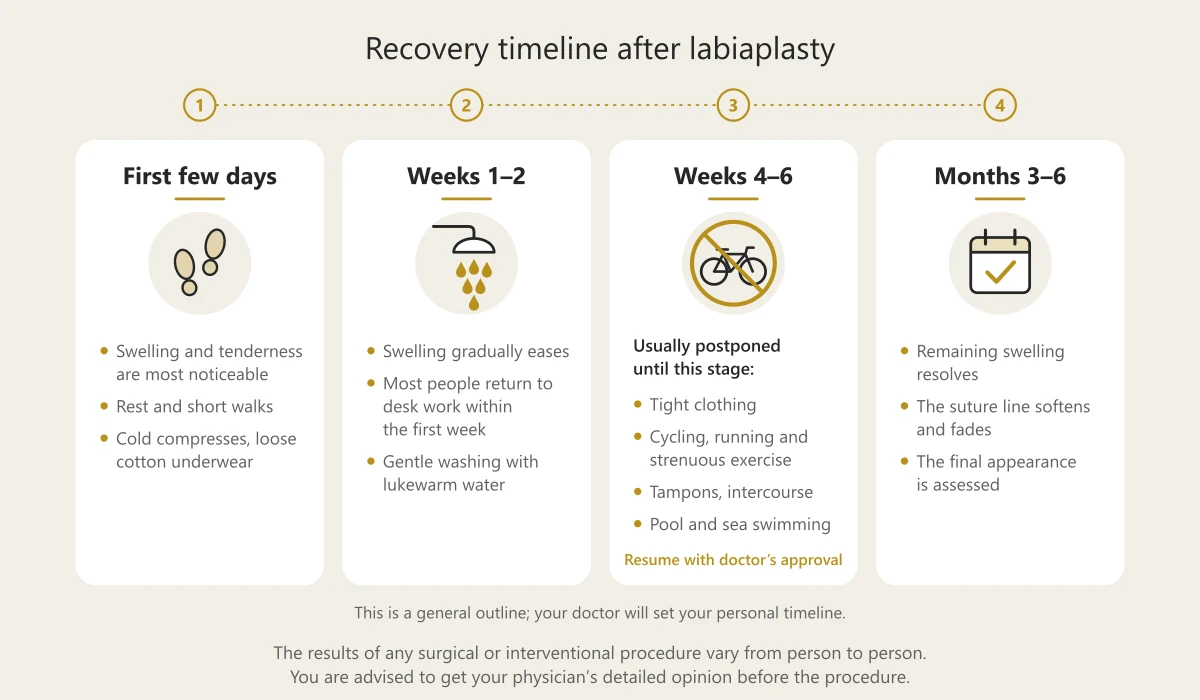
Recovery varies from person to person, with the technique used and with whether additional procedures were done. The table below is a general outline; your personal timetable is given to you at discharge.
| Period | What usually happens? | Recommendations |
|---|---|---|
| First 2–3 days | Swelling, tightness and tenderness are at their most noticeable; there may be light bloody discharge and a burning sensation when passing urine. | Rest and short walks around the house; cold compresses wrapped in a cloth, applied over your underwear; sanitary pads and loose cotton underwear. |
| Week 1 | Swelling and bruising begin to ease; sitting for long periods may still be uncomfortable. | Most people can return to a desk job after a few days to a week; for jobs that involve standing or physical effort, this can extend to 2 weeks. |
| Weeks 2–3 | Most of the swelling goes down; daily life becomes noticeably easier. | Daily activities and walking are gradually increased. |
| Weeks 4–6 | Wound healing is largely complete; mild swelling may last a little longer. | Tight clothing, cycling, horse riding, running and strenuous sport, swimming in pools or the sea, tampons or menstrual cups, and sexual intercourse are usually postponed until this stage; you return to them gradually, based on the assessment at your follow-up examination. |
| Months 3–6 | Any remaining swelling resolves and the tissues soften. | The final appearance is usually assessed during this period. |
Hygiene and Daily Care
- Wash the area gently with lukewarm water as often as your doctor recommends, and pat it dry with a clean towel without rubbing; you will be told at discharge when you can start showering.
- If your doctor recommends it, a short, lukewarm sitz bath can be soothing; long soaks in the bath, Turkish baths (hammams) and saunas are postponed until the wounds have fully healed.
- Pouring lukewarm water over the area while you pass urine can ease the burning; after using the toilet, wipe from front to back.
- Constipation and straining can put stress on the stitch line; drinking plenty of fluids and eating a high-fibre diet help.
- If you need to sit for long periods, using a soft cushion and standing up often makes it more comfortable.
- If you have a period after surgery, use sanitary pads and change them often.
- Do not apply any cream, antiseptic or herbal product that your doctor has not recommended; waxing and other hair removal are postponed until healing is complete.
Symptoms to Report to Your Doctor Straight Away
- Rapidly increasing, tense and painful swelling on one side (this may be a sign of a blood collection).
- Bleeding that soaks a pad quickly or does not stop.
- Fever; increasing redness, warmth or foul-smelling discharge.
- Obvious opening of the stitch line.
- Being unable to pass urine, or pain that keeps getting worse despite medication.
- Painful swelling in one leg.
If you develop sudden shortness of breath or chest pain, call the emergency number (112 in Turkey) without delay or go to the nearest emergency department.
Risks and Possible Complications
Like any operation, labiaplasty carries risks. Careful planning and following the aftercare advice reduce these risks but do not eliminate them completely:
- Bleeding and blood collection (haematoma): usually occurs in the first few days; the collected blood may need to be drained and, rarely, a further operation may be needed.
- Infection: if it develops, it needs treatment and can prolong healing; following the hygiene advice reduces this risk.
- Wound separation: part of the wound may open; small separations often close on their own, while larger ones may need re-stitching.
- Asymmetry and irregular edges: a difference between the two sides may remain, or irregularities such as notches or bumps may appear along the edge.
- Too little or too much tissue removed: if too little tissue is removed, symptoms may persist. Removing too much can cause dryness, tightness at the vaginal opening and discomfort; this risk increases when near-complete removal of the inner labia is requested.
- Changes in sensation: numbness around the stitch line or, conversely, oversensitivity.
- Scar problems: a thickened, tight or tender scar, which can rarely cause pain during intercourse.
- Need for a correction: because of asymmetry, remaining excess or wound problems, some patients may need a second, minor procedure (revision).
- General surgical risks: rare but serious risks that apply to every operation, such as complications of anaesthesia and blood clots forming in the leg veins.
Because tissue that has been over-removed cannot be fully replaced, the options for correcting a previous operation (revision labiaplasty) are limited and are assessed individually at the examination. This is why cautious planning matters so much at the first operation.
What Determines the Cost of Labiaplasty?
The fee is set after the examination, once your personal plan has been finalised. The main factors that affect it are:
- The technique and the extent of the area to be treated.
- Whether procedures such as clitoral hood reduction, outer labia procedures or liposuction of the pubic area are added to the plan.
- The type of anaesthesia (local anaesthesia, sedation or general anaesthesia) and the length of the operation.
- The length of the hospital stay, pre-operative tests and follow-up examinations.
When weighing up your options, it is important to ask what the fee covers and whether the proposed plan is right for you.
Is Labiaplasty Covered by Insurance?
For patients insured under the Turkish social security system (SGK), genital cosmetic surgery that only aims to change appearance is not covered. Whether an operation for functional symptoms is covered in public hospitals or SGK-contracted institutions depends on official criteria and documented medical necessity, and private practice services and private doctors’ fees are outside SGK cover. With private health insurance, coverage depends on the terms of your policy.
Travelling to Istanbul, Turkey, for Labiaplasty
If you live abroad, you can get in touch through the contact page before you travel. The examination and the operation plan are made in person in Istanbul, the operation takes place in a fully equipped hospital licensed by the Ministry of Health, and the doctor decides when you are fit to fly home. The length of your stay depends on the procedure and is confirmed in your written plan before you book flights. Your medical records are given to you in English.
Frequently Asked Questions about Labiaplasty
What causes enlarged or sagging inner labia?
Most often it is a structural feature you are born with: the inner labia become more prominent with the hormonal changes of puberty, and the two sides can develop differently. Pregnancy and vaginal birth, significant weight changes and the loss of tissue elasticity that comes with age can also make the tissue look longer or looser. After the menopause, thinning of the outer labia can make the inner labia more noticeable.
Is labiaplasty painful, and how long does the pain last?
The procedure is done under anaesthesia. With local anaesthesia, you may feel brief stinging and burning while the area is being numbed, and during the procedure a sensation of touch or pulling rather than pain. Once the anaesthetic wears off, the burning and aching that most people feel is mild to moderate and is controlled with prescribed painkillers; the discomfort eases steadily over the following days. Because pain thresholds and the extent of the procedure differ from person to person, recovery does not follow the same course for everyone.
When do the stitches fall out, and is itching normal?
The visible stitch knots usually start to fall out on their own within 2–3 weeks; depending on the material used, the thread can take longer to disappear completely. Itching, stinging or a pulling sensation are normal as the stitches dissolve and the wound heals. During this time, do not pull or cut the knots and do not scratch the area; finding a small piece of thread on your pad is nothing to worry about.
Will there be a scar?
As with any incision, the incisions made in this operation leave scars, and these scars are permanent. The mucosa of the inner labia is generally a tissue that heals well: the stitch line may look pink and slightly raised in the first weeks, then softens and fades over the months and often becomes less noticeable. The final appearance of the scar varies from person to person, depending on tissue type, the technique used and how healing progresses.
Does labiaplasty cause loss of sensation?
In labiaplasty, the clitoris itself is not touched; the surgery is on the excess tissue of the inner labia. Changes in sensation around the stitch line are often temporary and usually lessen over the months as the nerve endings heal. Rarely, numbness or oversensitivity can be permanent; this possibility should be discussed openly before you decide on surgery.
Does labiaplasty prevent a vaginal birth?
Generally, no. A healed surgical site is not considered an obstacle to vaginal birth, and not having given birth yet is no obstacle to surgery either. Scientific data on this are limited: during a vaginal birth, the healed stitch line can rarely tear, and the shape of the inner labia may change again after childbirth. It is helpful to tell the doctor who will deliver your baby that you have had this operation.
Can the inner labia grow back after surgery?
The tissue removed during surgery does not grow back. However, the remaining tissue can change shape over the years with pregnancy and childbirth, hormonal changes, weight changes and age, so it cannot be said that the result will stay the same for life.
Is laser or non-surgical labia reduction possible?
“Laser labiaplasty” usually means that the incisions are made with an energy source such as a laser or radiofrequency device instead of a scalpel or scissors; the tissue is still removed, stitches are still placed and recovery is similar. Laser or radiofrequency treatments applied without incisions have not been shown to reduce the size of the inner labia significantly; reducing protruding excess tissue requires a surgical procedure.
What kind of doctor performs labiaplasty?
Labia reduction is performed both by specialists in plastic, reconstructive and aesthetic surgery and by obstetrician-gynaecologists. If you have symptoms such as vaginal laxity, urinary incontinence, uterine prolapse or irregular bleeding, these also need to be assessed separately by an obstetrician-gynaecologist.
Examination and Appointments
Bringing a list of the medicines you take and, if available, the results of any recent gynaecological examination or tests makes the assessment easier. Asking the following questions at the consultation will help clarify the plan that suits you:
- Which technique do you recommend for me, and why? Where will the stitch line be?
- How much tissue will be removed, and how much will be left?
- Do I need a procedure on the clitoral hood or the outer labia?
- Which type of anaesthesia will be used, and can I go home the same day?
- When can I return to work, sport and sexual activity?
- What happens if there is asymmetry or a wound problem?
- What does the fee include?
Results vary from person to person; the purpose of the examination is to establish together whether this operation is the right option for you. Op. Dr. Ayberk Akçay is a plastic, reconstructive and aesthetic surgeon, a Fellow of the European Board of Plastic, Reconstructive and Aesthetic Surgery (EBOPRAS) and a full member of the Turkish Society of Plastic, Reconstructive and Aesthetic Surgeons; his practice is in Teşvikiye, Şişli, Istanbul. You can read about his training and memberships, and to book an appointment at the practice in Istanbul, get in touch through the contact page.