
Nipple surgery is the general name for small surgical procedures that correct the size, shape or direction of the nipple and of the darker ring of skin around it (the areola). It covers three procedures: reducing a long or wide nipple, reducing a wide areola, and drawing out an inverted (retracted) nipple. When performed on their own, these procedures are mostly done under local anaesthesia and take little time; you can usually go home the same day. The size, colour and shape of the nipple and areola vary greatly from person to person, and most of these differences are normal; surgery is an option for adults who are bothered by how they look or by the problems they cause.
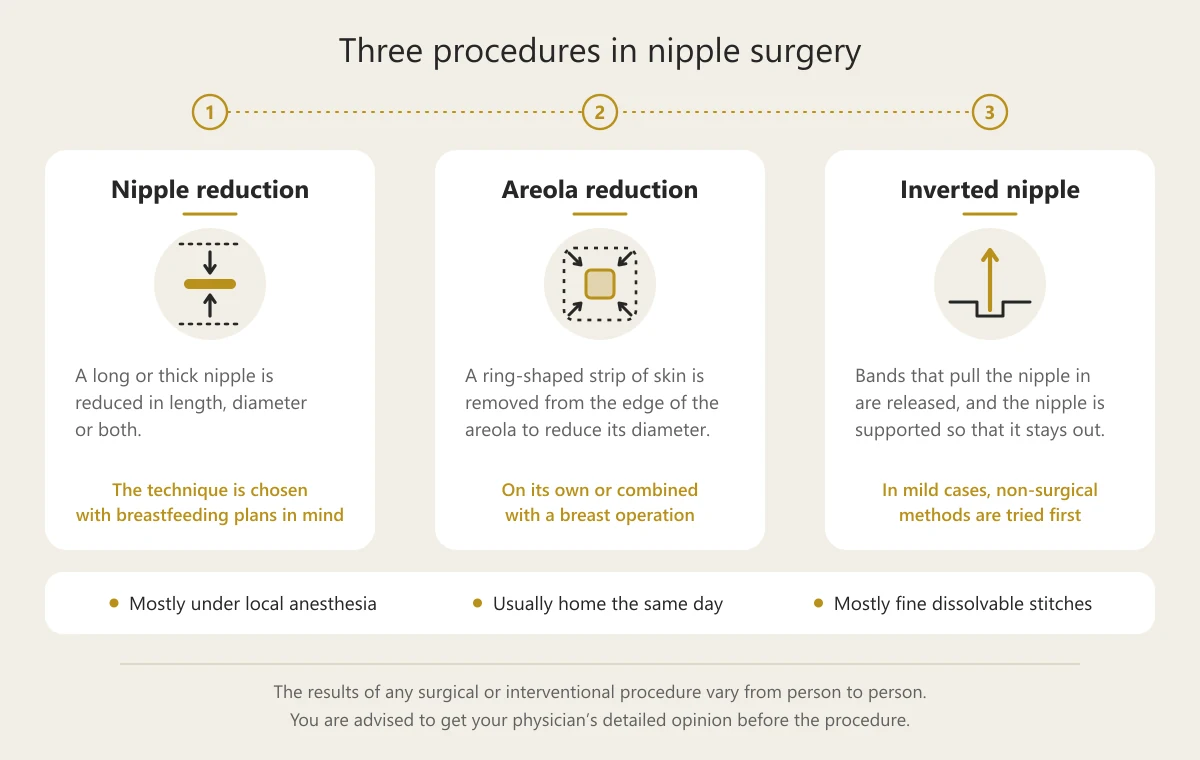 The results of any surgical or interventional procedure vary from person to person. You are advised to get your physician’s detailed opinion before the procedure.
What is nipple surgery?
The nipple is the part that projects from the centre of the breast and where the milk ducts open. It is rich in nerve endings, and thanks to the smooth muscle fibres it contains, it becomes more prominent in response to stimuli such as cold. The areola is the area around the nipple that is darker than the surrounding skin; the small bumps on it are glands whose secretions protect the skin during breastfeeding. In everyday speech, “nipple” often refers to both; however, it is the part causing the concern that determines which procedure is needed.
| Concern | Procedure usually considered | Where the incision is made |
|---|---|---|
| A long or thick nipple that shows through clothing and becomes irritated by friction | Nipple reduction | At the base of the nipple and, if needed, on its side |
| An areola that looks wide for the breast, or a clear difference between the two sides | Areola reduction | The edge of the areola, along the line where the colour changes |
| A nipple that does not come out, or that pulls back in quickly | Inverted nipple correction | A small incision at the base of the nipple |
| A wide areola together with sagging or large breasts | Areola reduction during a breast lift or breast reduction | The incisions of the main operation |
These procedures can be done separately or combined in the same session; if you have more than one concern, a single plan covering them is made at the examination.
Normal variation, and changes that need a medical check first
The length of the nipple and the diameter and colour of the areola change with puberty, pregnancy, breastfeeding, changes in weight and age. It is rare for the two sides to be exactly alike, and there is no single “ideal” size that applies to everyone. The aim is therefore not to reach a particular measurement but to achieve a more balanced proportion with the rest of the breast.
If a nipple has newly turned inwards in adulthood, or if you notice a lump in the breast or armpit, spontaneous discharge from the nipple, or a change in the skin of the nipple or areola such as a sore, crusting or puckering, this finding is assessed with breast imaging (a breast ultrasound or mammogram, depending on your age) before any cosmetic plan is made. If needed, an assessment by a general surgeon is also requested; cosmetic planning is considered only once it is clear that the finding is benign.
Nipple reduction
A long or thick nipple is often simply part of a person’s natural build; a nipple that lengthened during pregnancy and breastfeeding may also not return to its former shape once breastfeeding is over. Some people are bothered by how visible their nipples are under thin clothing, others by tenderness caused by friction during sport or in daily life. Nipple reduction decreases the length, the width or both:
- Reducing the length: A thin ring of skin is removed from the base of the nipple, and the tip is lowered towards the base and stitched. Because the central milk ducts stay in place, this approach is often preferred by people who want to breastfeed in the future.
- Reducing the width: A small wedge of tissue is removed from the side or underside of the nipple and the edges are joined; care is taken to place the stitch line on the less visible side.
- Removing part of the tip: For very long nipples, part of the tip is removed and the nipple is reshaped. Because this technique cuts the milk ducts, it can affect breastfeeding, so it is usually considered for people whose family is complete.
A cautious approach to planning is important: a nipple that has been over-reduced or flattened is difficult to restore. The blood supply and sensation of the nipple set the limit on how much tissue can be removed.
Areola reduction
A wide areola may be inherited, or it can widen with pregnancy and breastfeeding, weight gain, sagging of the breast or stretching of the skin in large breasts. An areola that is both wide and puffed forward like a dome can be part of a developmental condition called tuberous breast, in which the base of the breast is narrow; in that case, reducing the areola alone is not enough, and the shape of the breast is also addressed.
For areola reduction, the desired new diameter is marked at the examination while you are standing. A ring of skin is removed from the outer edge of the areola, and the surrounding breast skin is stitched to the edge of the smaller areola. The scar lies along the line where the darker and lighter skin meet. To reduce the areola’s tendency to widen again over time, a supporting stitch may be placed all the way round beneath the skin; depending on the technique, this stitch may be made with a non-dissolvable thread.
Areola reduction can be done on its own; but if the wide areola comes with sagging, the areola is also reduced during a breast lift, in which the nipple and areola are moved upwards, and in large, heavy breasts during a breast reduction. Which breast operation suits which problem is summarised on the breast surgery page. This procedure does not change the colour of the areola; after the reduction, the remaining areola has the same colour and texture as before.
What causes inverted nipples, and how are they corrected?
With an inverted nipple (sometimes called a retracted or “innie” nipple), the nipple sits level with or below the surface of the areola instead of projecting from it. It can affect one or both sides and is more common than people think. It is usually present from birth: tight bands of connective tissue pulling the nipple inwards, short milk ducts and a lack of supporting tissue beneath the nipple all play a part, and the condition is usually noticed during puberty as the breasts develop. Less often, it develops later in life: inflammation during breastfeeding, widening of the milk ducts with inflammation around them, breast surgery, sudden weight loss or sagging of the breast can pull the nipple inwards. A nipple that has newly turned inwards in adulthood is first assessed with breast imaging, as described above, because in rare cases it can be the first sign of an underlying breast disease.
Grades of inverted nipple
In the classification commonly used in plastic surgery, the grade depends on how easily the nipple can be drawn out by hand and whether it then stays out:
- Grade 1 (mild): The nipple comes out easily when gentle pressure is applied around the edge of the areola or in response to stimuli such as cold, and it stays out for a while. The milk ducts are usually normal.
- Grade 2 (moderate): The nipple can be drawn out by hand but soon pulls back in when released. There is a moderate amount of tight connective tissue beneath it, and the milk ducts are somewhat short. Most cases fall into this group.
- Grade 3 (severe): The nipple cannot be drawn out by hand, or only with difficulty. The connective tissue is markedly tight, the milk ducts are short and there is little supporting tissue beneath the nipple. Moisture trapped on the inverted surface can cause irritation and recurring inflammation.
The grade can differ between the two breasts. It directly affects the chance of breastfeeding, whether non-surgical methods are likely to help and which surgical technique is used.
Non-surgical options
Mild inversion often causes no problems and needs no treatment. For people who are bothered by the appearance or who want to make breastfeeding easier in the future, the first step is usually a non-surgical method:
- Suction (vacuum) cups: Small cups placed over the nipple that create a gentle pull can gradually stretch the connective tissue when used regularly over several weeks. They often help in grade 1, and help some people in grade 2; once you stop using them, the nipple may turn in again. If the skin becomes red or sore, take a break.
- Support while breastfeeding: A baby feeds by taking not just the nipple but a large part of the areola into its mouth, so breastfeeding is often possible with grade 1 and grade 2 inversion. Using a breast pump briefly before a feed, or gently rolling the nipple between your fingers, can draw the nipple out; support from a lactation consultant in the first days makes latching on easier. In some mothers, regular breastfeeding can help the nipple stay out more over time.
- Caution in pregnancy: As pregnancy progresses, the nipple often becomes somewhat more prominent by itself. Because stimulating the nipple can trigger contractions of the womb, you should consult the doctor following your pregnancy before using a suction cup or a similar method while pregnant.
Creams and care products that claim to draw the nipple out have not been shown to work.
Surgical correction: techniques that preserve or divide the milk ducts
Surgery is considered for people who have not had enough benefit from non-surgical methods, or who have grade 2 or grade 3 inversion. Through a small incision at the base of the nipple, the bands pulling the nipple inwards are released; to stop the nipple slipping back in, a supporting purse-string stitch is placed around its base, and if needed, small flaps of tissue prepared from beneath the areola, with their blood supply preserved, are placed beneath the nipple for support. The key question in choosing the technique is whether the milk ducts can be preserved:
| Feature | Duct-preserving techniques | Techniques that divide the ducts |
|---|---|---|
| What is done? | Only the tight connective tissue pulling the nipple inwards is released; the ducts are left in place | The short ducts holding the nipple in are also cut to release it |
| Mainly used for | Grades 1 and 2; people who want to breastfeed in the future | Grade 3; nipples that cannot be corrected enough while the ducts are preserved |
| Breastfeeding | Aims to preserve the possibility of breastfeeding, although this cannot be known for certain | Breastfeeding from that nipple is usually not possible |
| Nipple turning in again | More likely, especially in the more severe grades | Less common, but it can still happen |
For people who want to breastfeed in the future, a duct-preserving method is usually the first choice. In grade 3, the possibility that this method may not be enough and that the ducts may need to be divided is discussed openly with you before surgery; you make the final decision, taking your wish to breastfeed into account.
Nipple and areola reduction in men
Men can also have long or thick nipples, wide areolas and inverted nipples; nipple reduction and areola reduction are performed with techniques similar to those used in women, mostly under local anaesthesia. In men, however, an areola that looks wide or puffs forward is often caused by enlarged breast gland tissue underneath. In that case, reducing only the areola or the nipple is not enough: the glandular tissue is removed with gynecomastia surgery (male breast reduction) and, if needed, the areola is reduced in the same session. As in women, a newly developed firm lump on one side, a nipple that has started to turn inwards or nipple discharge in a man is first assessed medically.
Who is it suitable for, and who should wait?
Suitable candidates are usually adults who have finished developing, whose general health does not stand in the way of the procedure, whose concern has not changed for some time and who have realistic expectations. Because smoking impairs the blood supply to the nipple and wound healing, smokers are asked to stop for a period before and after the procedure. In the following situations, the procedure is postponed or another assessment is carried out first:
- Pregnancy and breastfeeding: The procedure is not performed during this time, because the nipple and areola keep changing. Once breastfeeding has completely stopped and milk production has ended, there is usually a wait of at least 6 months so that the tissues can settle into their final form.
- Plans for a pregnancy in the near future: Another pregnancy and period of breastfeeding can enlarge the nipple and areola again, so nipple reduction and areola reduction are often left until your family is complete. With an inverted nipple, your wish to breastfeed directly affects the timing and the technique; this is discussed together at the examination.
- Breasts that are still developing: During puberty, the shape of the nipple can change as the breast develops, and mild inversion can lessen on its own; a cosmetic procedure is usually planned after the age of 18.
- Active inflammation or discharge: If there is inflammation, an abscess or discharge around the nipple, its cause is investigated and treated first.
- Uncontrolled medical conditions: Conditions such as diabetes or a blood-clotting disorder need a detailed assessment before the procedure.
How is nipple surgery performed?
The examination starts by listening to your concerns and expectations; then the length and width of the nipple, the size of the areola, the difference between the two sides, the grade of any inversion, the volume of the breast and any sagging are assessed. You are asked about previous pregnancies and breastfeeding, whether you would like to breastfeed in the future, the medicines you take and whether you smoke. If photographs are needed for planning, they are taken only with your consent and kept as part of your medical record.
- Anaesthesia: Nipple and areola procedures done on their own are mostly carried out under local anaesthesia, with sedation (a light, sleep-like state) added if needed. Procedures planned together with a breast operation are done under that operation’s anaesthesia, usually a general anaesthetic.
- Duration: Procedures done on their own usually take between 30 minutes and 1.5 hours; treating both sides, or combining several procedures in the same session, takes longer.
- Stitches and dressings: The incisions are mostly closed with fine, dissolvable stitches. After inverted nipple correction, a protective shield with an open centre or a special dressing may be used to keep pressure off the nipple.
- Going home: The procedure is performed in a fully equipped hospital licensed by the Ministry of Health; after a procedure done on its own, most people go home the same day after a short period of observation.
Medicines with a blood-thinning effect and some herbal supplements are stopped for a while before the procedure, with your surgeon’s knowledge and, if necessary, in agreement with the doctor who prescribed them; do not stop these medicines on your own.
What is recovery like?
The table below is a general guide for procedures done on their own; if the procedure was combined with a breast lift or breast reduction, the recovery timeline of that operation applies. Your personal timeline is given to you when you leave hospital and at your check-ups.
| When | What usually happens | Recommendations |
|---|---|---|
| First 2–3 days | Mild pain, swelling and tenderness; there may be a small amount of blood-stained ooze on the dressing. | Keep the dressing clean and dry; the pain usually settles with prescribed painkillers. Most people can return to desk work within 2–3 days. |
| Weeks 1–2 | Swelling and bruising decrease; there may be itching and a prickling feeling as the stitches dissolve. | You will be told at your check-up how to shower and how to care for the dressing. Avoid heavy lifting and movements that strain the arms; light exercise such as brisk walking can usually begin from week 2. |
| Weeks 3–6 | Wound healing is largely complete; the scar may look pink and slightly raised. | Running, jumping and sports that strain the chest muscles are usually resumed gradually in weeks 4–6, based on the assessment at your check-up. |
| Months 3–6 | Any remaining swelling resolves; the shape of the nipple and areola settles. | The final appearance is usually assessed during this period. |
| 6 months to 1 year | The scar matures and, in most people, becomes thinner and fades. | Protect the scar from direct sun for the first year. |
Bras, sleeping and daily care
- Bras: After a procedure done on its own, a soft, supportive bra without underwiring that does not press on the wound is recommended for the first weeks. After inverted nipple correction, bras and tight clothing that press on the nipple are usually avoided for 2–3 weeks. When you can switch to an underwired bra is decided at a follow-up visit.
- Sleeping: Do not sleep on your front for the first weeks, so that there is no pressure on the nipple; sleeping on your back is more comfortable.
- Pool, sea and sauna: Wait until the wounds have fully closed before swimming in a pool or the sea; also stay away from Turkish baths (hammams) and saunas for a few weeks.
- Care: Do not pick off scabs or stitch knots, and do not apply any cream or herbal product to the area that your surgeon has not recommended. Once the wound has closed, silicone gel or tape may be recommended for scar care.
Symptoms to report to your doctor straight away
- Darkening or bluish discolouration of the nipple or areola, or a cold, pale appearance (this may be a sign of a circulation problem).
- Rapidly increasing, tense and painful swelling on one side, or bleeding that does not stop.
- A fever; increasing redness, warmth or a foul-smelling discharge.
- The wound opening along the stitch line.
Risks and possible complications
Although they are performed on a small area, nipple and areola procedures carry risks, like any surgery. Careful planning and following the advice given during recovery reduce the risks but do not eliminate them completely:
- Changes in sensation: Numbness, reduced sensation or, conversely, oversensitivity in the nipple and areola. This often improves within months but can be permanent in some people.
- Effects on breastfeeding: With techniques in which the milk ducts are cut or the surgery is carried out around the ducts, breastfeeding may be partly or entirely impossible. The ability to breastfeed can also be affected with duct-preserving techniques.
- The scar around the areola: Every incision leaves a permanent scar. Even though the scar lies along the line where the colour changes, it may heal lighter or darker than the surrounding skin, or thicken; in the first weeks, puckering and wrinkling may be seen at the edge of the areola, and this usually smooths out within months.
- Widening of the scar and the areola: After areola reduction, skin tension can cause the scar to widen over time, and the diameter of the areola can increase again to some extent.
- Asymmetry: The two sides may heal differently; a difference in the size, shape or direction of the nipples or areolas may remain.
- Recurrence of inversion: A corrected nipple can be pulled back in over time.
- Over-reduction or flattening: The nipple may end up smaller or flatter than expected; this is difficult to correct.
- Loss of nipple tissue: Loss of part of the tissue because of an impaired blood supply to the nipple is rare; it is more likely in smokers and when several procedures are combined.
- General surgical risks: Bleeding and a collection of blood (haematoma), infection, delayed wound healing, opening of the stitch line and risks related to anaesthesia.
Some people may need a minor corrective procedure (revision) for reasons such as asymmetry, remaining excess tissue or the nipple turning in again. The risks that apply to you are discussed one by one at the examination and during the informed consent process before the procedure.
What does the cost of nipple surgery depend on?
The fee is set once your individual plan has been confirmed at the examination. The main factors that affect it are:
- The procedure (nipple reduction, areola reduction or inverted nipple correction), and whether more than one of them is done in the same session.
- Whether one side or both are treated; for an inverted nipple, the grade of inversion and the technique used.
- The type of anaesthesia (local anaesthesia, sedation or general anaesthesia) and the length of the procedure.
- Whether the procedure is combined with an operation such as a breast lift, breast reduction or gynecomastia surgery.
- Tests before the procedure and follow-up examinations.
An examination is needed before fee information can be given; to arrange a day and time for your examination, please use our contact details.
Travelling to Istanbul, Turkey, for nipple surgery
Before you travel, you can contact the practice and send photos on WhatsApp for a preliminary assessment; your plan is then given to you in writing. In Istanbul, you are examined in person and the procedure is planned with you; operations take place in a fully equipped hospital licensed by the Ministry of Health. The length of your stay depends on the procedure and is confirmed in your written plan before you book flights, and your surgeon decides when you are fit to fly home. After you return home, follow-up continues with photo reviews on WhatsApp, and your medical records are given to you in English.
Frequently Asked Questions about Nipple and Areola Surgery
Will areolas and nipples that grew during pregnancy go back to how they were?
During pregnancy, hormones make the areola wider and darker, and the nipple can grow and become more prominent. In the months after breastfeeding ends, these changes partly reverse in most women, but they may not return completely to how they looked before pregnancy. Because the extent of this varies from person to person, if you are considering a procedure, you should wait until this period is over.
Can the areola be made smaller without surgery?
There is no cream, exercise or device that has been shown to reduce the diameter of the areola. Products claimed to lighten its colour do not change its diameter and can irritate this sensitive skin. Surgery is the way to reduce the diameter of an areola that is structurally wide; a wide areola that does not bother you needs no treatment.
Will the areola reduction scar be visible?
Because the scar is placed at the edge of the areola, along the line where the darker and lighter skin meet, it becomes less noticeable over time in most people; however, it is permanent and does not disappear completely. In the first months it may look pink and slightly raised, and as it matures it becomes thinner and fades. How it finally looks depends on your skin type, how the wound heals and the tension on the stitch line.
Does nipple reduction affect breastfeeding?
It depends on the technique. With techniques that remove tissue only from the base or the side of the nipple, the central milk ducts are left in place with the aim of preserving the possibility of breastfeeding; with techniques that remove part of the tip, breastfeeding from that nipple may become difficult or impossible. With no technique can it be said for certain in advance that breastfeeding will be preserved; if you would like to breastfeed in the future, mention this at the examination so that it can be taken into account when the technique is chosen.
Can an inverted nipple correct itself?
Mild inversion can lessen on its own as the breasts develop during puberty, during pregnancy or as the baby suckles during breastfeeding. In more severe grades, where the nipple cannot be drawn out by hand, it is not expected to correct itself. Inversion that has been present since birth and has not changed for years is generally harmless; treatment is planned according to your symptoms and wishes.
Can the nipple turn in again after surgery?
It can. Recurrence is seen most often in the first months after surgery, and it is more likely with severe inversion and with techniques that preserve the milk ducts. During this period, it is important to protect the nipple from pressure and to attend your check-ups regularly. If the inversion comes back, a second correction can be planned, again taking your wish to breastfeed into account.
Does a nipple piercing correct an inverted nipple?
A piercing can keep the nipple out for as long as it stays in place, but it is not a treatment. It carries risks such as infection and abscess of the nipple, damage to the milk ducts and scarring, and the nipple can turn in again once the piercing is removed. If a wound at the piercing site does not heal, or you notice discharge or a painful swelling, you should see a doctor.
Does the procedure hurt?
Under local anaesthesia, you feel a brief stinging and burning sensation while the area is being numbed; once the numbness sets in, you feel touch and pulling rather than pain for the rest of the procedure. For anxious patients, sedation can be added to the local anaesthetic. Because pain thresholds vary from person to person, the experience is not the same for everyone.
Can I have mammograms after nipple surgery?
Yes. These procedures do not prevent breast ultrasound or mammography, and you should continue with the breast screening appropriate for your age. Scar tissue in the treated area may be visible on the images; mentioning that you have had this procedure before the scan ensures that the results are interpreted accordingly.
Is nipple surgery covered by SGK in Turkey?
This applies to patients insured under the Turkish social security system (SGK). Nipple and areola procedures intended only to change appearance are not covered by SGK. For a functional problem, such as severe inversion that causes recurring inflammation, cover depends on the official criteria and on documentation of medical necessity. Services at a private practice and private doctors’ fees are outside SGK cover; with private health insurance, cover depends on the terms of your policy.
Your examination and appointment
Bringing a list of the medicines you take and the results of any previous breast ultrasound or mammogram to your examination makes the assessment easier. Asking the following questions at the consultation helps to clarify the plan that suits you:
- Is my concern caused by the nipple or by the areola, and which procedure is recommended?
- Does the recommended technique preserve the milk ducts? Will I be able to breastfeed in the future?
- Where will the scar be, and what care will it need?
- Will the procedure be done under local anaesthesia, and will I be able to go home the same day?
- When can I return to work, sport and my daily routine?
- What happens if the nipple turns in again or a difference remains between the two sides?
- What does the fee include?
Results vary from person to person; the purpose of the examination is to work out together whether one of these procedures is right for you. Op. Dr. Ayberk Akçay is a plastic, reconstructive and aesthetic surgeon, a Fellow of the European Board of Plastic, Reconstructive and Aesthetic Surgery (EBOPRAS) and a full member of the Turkish Society of Plastic, Reconstructive and Aesthetic Surgeons; his practice is in Teşvikiye, Şişli, Istanbul. You can read about his training and memberships, and to book an appointment at the practice in Istanbul, please reach us through the contact page.