Double chin liposuction is a surgical procedure that removes fat which has built up under the chin and has not gone away with diet or exercise. The fat is removed with fine cannulas inserted through an entry point a few millimetres long, to give the jawline and the neck a more defined line. It is also known as double chin surgery or under-chin fat removal; the medical name is submental liposuction. In people with elastic skin whose problem is mainly fat, it may be enough on its own; if the skin sags or there are prominent muscle bands in the neck, a different plan is needed. Below you will find the causes of a double chin, who the procedure suits, how it differs from a neck lift, the chin strap, recovery and the risks.
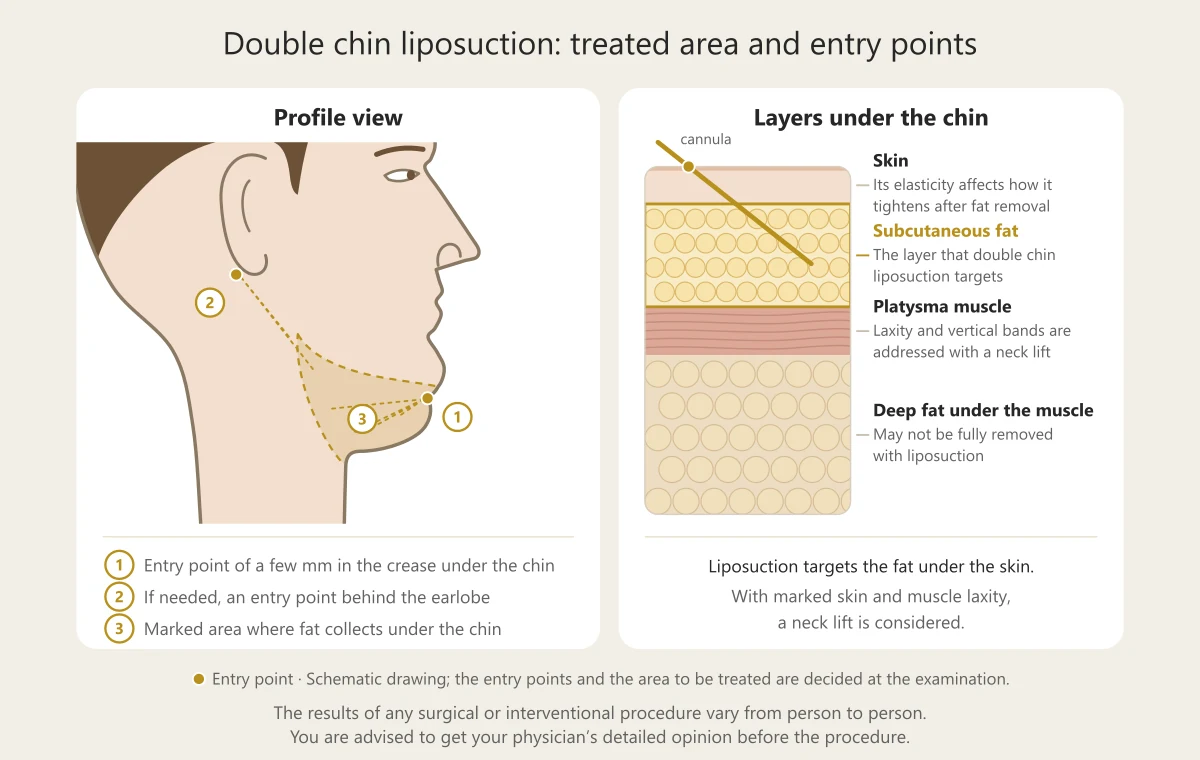 The results of any surgical or interventional procedure vary from person to person. You are advised to get your physician’s detailed opinion before the procedure.
What Is Double Chin Liposuction?
Double chin liposuction works on the same principle as liposuction on other parts of the body: excess fat under the skin is removed with fine cannulas and controlled suction. The area under the chin, however, is small, mobile and close to important structures, so it is treated with fine cannulas and great care. The aim is not to remove all the fat in the area, but to bring the transition between the chin and the neck into harmony with the rest of the face.
The procedure targets the fat under the skin; it does not remove sagging skin, tighten a loose neck muscle or change the shape of the jawbone.
What Causes a Double Chin?
Fullness under the chin does not always have the same cause, and several factors are often involved at once:
- Genetics: In some people, fat under the chin runs in the family; it can also appear in young people of normal weight.
- Weight gain: The area under the chin is one of the places where fat collects when you put on weight, and it does not always slim down to the same extent when you lose weight.
- Ageing: With age, the skin loses its elasticity and the thin platysma muscle at the front of the neck loosens; sagging under the chin and vertical bands in the neck can become noticeable.
- Structures beneath the muscle: Deep fat and the salivary glands beneath the platysma muscle can also contribute to fullness under the chin.
- Bone structure: A receding chin or a low-set hyoid bone in the neck widens the angle between the chin and the neck and can make a double chin look more prominent than it really is.
That is why the first step at the examination is to work out which layer the fullness comes from. In a simple test, the tissue under the chin is held between two fingers while the neck muscles are tensed; what remains between the fingers is mostly fat under the skin. Rarely, fullness in the neck is caused by something other than fat, such as the thyroid gland or the lymph nodes; if this is suspected, it is assessed first.
Who Is Double Chin Liposuction Suitable For?
Good candidates for this procedure are usually people whose fullness under the chin comes mainly from fat and whose skin is elastic enough to adapt to the new contour once the fat is removed. Suitability is assessed at the examination; in general, the following are looked for:
- A limited amount of fat under the chin that has not gone down despite diet and exercise.
- Skin that has kept its elasticity, with no marked sagging or folds and no vertical muscle bands in the neck.
- A weight that has been stable for a few months.
- No uncontrolled illness, and no bleeding or clotting disorder, that would rule out surgery and anaesthesia.
- If you smoke, being able to stop for a while before and after the procedure.
- Realistic expectations: the procedure aims to slim the area under the chin and define the jawline; it does not change the overall structure of the face, and results vary from person to person.
Skin quality matters more than age. A double chin can also appear at a young age, and in younger people the skin usually tightens better after the fat is removed; later in life, if the skin has lost elasticity, liposuction alone may not be enough. Cosmetic double chin liposuction is planned for adults.
When Is It Not Suitable?
During pregnancy and breastfeeding, if you plan to lose a significant amount of weight in the near future, or if you have a condition such as uncontrolled diabetes, heart disease or lung disease, the procedure is postponed or needs a detailed assessment. If the skin sags noticeably, a neck lift is considered instead of liposuction alone.
Double Chin Liposuction or a Neck Lift?
Which procedure is right is decided not by personal preference but by the cause of the fullness under the chin, the elasticity of the skin and the condition of the neck muscles:
- If there is only excess fat: In people with elastic skin, double chin liposuction may be enough on its own; elastic skin usually adapts to the new contour after the fat is removed.
- If there is fat together with mild laxity: How much the skin will tighten cannot be predicted exactly in advance; the options and what to expect are discussed in detail at the examination.
- If there is sagging skin, folds or prominent vertical bands: Removing fat alone will not correct this; skin that has lost its elasticity may look looser once the fat is gone. In this case a neck lift (sometimes informally called a “double chin lift”), in which the excess skin is removed and the loose platysma muscle is tightened, is considered; if needed, the fat under the chin is removed as part of that operation.
- If the fullness comes from structures beneath the muscle: Deep fat may not be fully removable with liposuction and may need to be reshaped through a short incision under the chin.
- If the cheeks also sag along the jawline: Cheeks sagging towards the edge of the jaw (jowls) are usually caused by sagging of the deep tissues of the face, and liposuction does not correct this. In such cases, a deep plane facelift and a neck lift may be considered together.
- If the fullness is in the cheeks: When fullness in the middle and lower cheeks comes from the fat pads deep in the cheeks (the buccal fat pads, also called Bichat’s fat pads), this fat is reduced not with liposuction but with buccal fat removal (bichectomy), performed from inside the mouth.
Once the fat has been removed, muscle bands or fullness from the salivary glands that the fat used to hide may become more noticeable; this possibility is also assessed at the examination.
| Feature | Double chin liposuction | Neck lift | Non-surgical methods (fat dissolving) |
|---|---|---|---|
| What does it target? | Excess fat under the skin | Sagging skin and the loose platysma muscle; if needed, the fat under the chin | A limited amount of fat under the skin |
| Incision and scar | An entry point a few millimetres long in the natural crease under the chin; if needed, also behind the earlobe | Usually incisions that start in front of the earlobe and run behind the ear into the hair-bearing scalp; if needed, a short incision under the chin | No incision |
| Anaesthesia | Usually local anaesthesia, with sedation if needed | Usually general anaesthesia | Usually not needed |
| Sessions | Usually a single session | A single operation | Usually more than one session |
| Does it correct marked skin sagging? | No | Aims to correct it | No |
Fat-Dissolving Injections or Liposuction?
“Dissolving” a double chin usually refers to fat-dissolving injections under the chin; the medical name is injection lipolysis. The substance, injected into the fat with a fine needle, breaks down fat cells; the body clears the broken-down cells over time, and the slimming appears gradually. There is no incision, but because only a limited amount of fat can be reduced in one session, most people need several sessions. Device treatments that work with cooling, heat or ultrasound energy may also be marketed under the same name; they, too, are aimed at limited amounts of fat, and their effects vary from person to person.
Noticeable swelling under the chin is expected after each injection session; tenderness, bruising, firmness and numbness are also possible. Less often, the swelling can cause temporary difficulty swallowing, the nerve branch that moves the lower lip can be affected, causing an uneven smile (usually temporary), or a wound can develop in the skin. Injections are a medical procedure too and should be given by a doctor.
The choice between the two methods depends on the amount of fat and the condition of the skin:
- Fat-dissolving injections: Usually considered for people with elastic skin and only a small amount of fat under the chin who do not want a surgical procedure.
- Double chin liposuction: When there is more fat, it allows more of it to be removed in a single session and the jawline to be shaped in a more controlled way; on the other hand, it requires a small entry point, anaesthesia and a recovery period with a chin strap.
Like liposuction, injections do not tighten sagging skin or correct muscle bands in the neck. There is no reliable scientific evidence that so-called double chin exercises, creams or home devices reduce the fat under the chin.
How Is Double Chin Liposuction Performed?
- Examination and planning: The source of the fullness, the elasticity of the skin and the angle between the chin and the neck are assessed, and together you decide whether liposuction alone will be enough.
- Preparation before surgery: The necessary blood tests are done. You are asked to stop smoking and, in agreement with your doctor, to stop any medicines or herbal supplements that thin the blood.
- Markings: The area to be treated is marked while your head is upright.
- Anaesthesia: The procedure is performed in a fully equipped hospital licensed by the Ministry of Health. On its own, it is usually done under local anaesthesia, with sedation (a light sleep) if needed; when it is combined with another operation, general anaesthesia is usually preferred.
- Entry points: An entry point a few millimetres long is usually made in the natural crease just below the chin; if needed, a small entry point can also be added behind each earlobe. A special fluid is first injected into the area to help reduce bleeding and prepare the fat for removal.
- Removing the fat: The fat is removed with fine cannulas, leaving a thin, even layer of fat under the skin; removing too much fat can cause hollows and irregularities. Near the lower edge of the jawbone, the work is done with particular care because of the nerve branch that moves the lower lip.
- Chin strap: The entry points are closed and an elastic chin strap is put on while you are still in the operating theatre.
- Discharge: After the procedure on its own under local anaesthesia, most patients can leave the hospital the same day after a short period of observation. Before you leave, how to use the strap, pain relief and the schedule of check-ups are explained to you.
On its own, double chin liposuction usually takes between 30 minutes and 1 hour. It can also be planned in the same session as another operation that affects the profile, such as a neck lift, facelift or nose job (rhinoplasty); in that case, the operating time, the type of anaesthesia and the hospital stay depend on the combined procedure.
Recovery and the Chin Strap
Recovery varies from person to person and with the size of the treated area. The timeline below gives a general picture; your own schedule is given to you when you are discharged.
- First 2–3 days: Tightness, swelling and tenderness are most noticeable in these days; pain is usually mild and is controlled with the prescribed medication. The strap is worn day and night; sleeping on your back with your head raised on a few pillows helps the swelling go down. Some fluid leaking from the entry point for a while is normal.
- Week 1: Bruising may spread down towards the neck and fades as it changes colour. Most patients can return to desk work and social life towards the end of this week.
- Week 2: In most patients, swelling and bruising go down considerably within the first two weeks. The strap is usually still worn, but only at night.
- The following weeks: The area under the chin may feel slightly firm, numb or uneven in places; this usually softens over time. Strenuous exercise and heavy lifting are resumed with your doctor’s approval, usually after a few weeks.
- Months 3–6: The remaining swelling resolves and the skin settles onto the new contour; the final look of the jawline usually becomes clear during this period.
The swelling in the first weeks hides the real contour, so you need to wait this period out before judging the result. You are advised to stay away from hot environments such as saunas, Turkish baths (hammams) and sunbeds for a few weeks and to protect the entry point from the sun. Massage or lymphatic drainage is done only if your doctor recommends it.
How Long Do I Need to Wear the Chin Strap?
The elastic chin strap is part of the recovery: it helps reduce swelling and fluid build-up under the skin and helps the skin adapt to the new contour. In the first days (usually 3–7 days) it is worn continuously and taken off only for short periods, for example to shower; after that, it is usually worn at night for another 1–3 weeks, for as long as your doctor recommends. The strap should not be so tight that it is uncomfortable. How long you wear it is decided at your check-ups according to how the swelling progresses; do not stop wearing it without asking your doctor.
Symptoms to Report to Your Doctor Straight Away
- Swelling and tightness in the neck that increase quickly or become more marked on one side.
- Pain that keeps getting worse and does not respond to medication.
- A fever; increasing redness, warmth or discharge at the entry point.
A feeling of pressure that makes it hard to breathe or swallow is an emergency: call 112 in Turkey (or your local emergency number) without waiting, or go to the nearest emergency department.
What Are the Risks and Possible Complications?
As with any surgical procedure, double chin liposuction has risks. Appropriate patient selection, careful planning and following the instructions after surgery reduce these risks, but do not eliminate them entirely.
- Expected, temporary effects: Swelling, bruising and tightness; firmness, reduced sensation or numbness under the chin, which is usually temporary.
- Contour irregularities: Rippling, hollows or a difference between the two sides. Removing too much fat can also leave a hollow under the chin and make the muscle bands more visible; in some cases a corrective procedure may be needed.
- Skin laxity becoming more visible: If the skin is not elastic enough, sagging may become more visible after the fat is removed.
- Fluid or blood collection: A seroma or haematoma under the skin, which may need to be drained.
- Infection, wound healing and scarring: Infection at the entry point, delayed healing, a noticeable scar or a change in skin colour.
- Nerve effects: Rarely, the nerve branch that moves the lower lip can be affected, causing asymmetry of the lower lip when smiling (a “crooked smile”). This is usually temporary.
- Heat-related skin damage: Can rarely occur with methods that use energy, such as ultrasound.
- Complications related to the anaesthesia or to the medicines given.
Smoking, uncontrolled chronic illness and not wearing the strap as recommended can make some of these risks more likely. Possible risks are assessed for you individually at the examination and discussed openly.
What Determines the Cost of Double Chin Surgery?
The fee for double chin surgery is not the same for every patient; it is set at the examination, once your personal plan is clear. The main factors that affect it are:
- The size of the area to be treated: only under the chin, or a wider area along the jawline?
- Whether liposuction is done on its own or together with an operation such as a neck lift or facelift.
- The type of anaesthesia (local anaesthesia, sedation or general anaesthesia) and the length of the procedure.
- The technique used and the planned hospital stay.
- The chin strap and the follow-up after surgery.
When weighing up your options, it is important to ask what the fee covers and whether the proposed plan is right for you.
Travelling to Istanbul, Turkey, for Double Chin Liposuction
Before you travel, you can send photos on WhatsApp for a preliminary assessment, and the plan is then given to you in writing. The examination and the operation plan are made in person in Istanbul, and the procedure takes place in a fully equipped hospital licensed by the Ministry of Health. The length of your stay depends on the procedure and is confirmed in your written plan before you book flights; your surgeon decides when you are fit to fly home. After you return home, follow-up continues with photo reviews on WhatsApp, your medical records are given to you in English, and you can contact us to start planning.
Frequently Asked Questions about Double Chin Liposuction
How long is the recovery after double chin liposuction?
Most people can return to desk work and social life after about a week. Swelling and bruising usually go down considerably in the first two weeks, while slight firmness and reduced sensation under the chin can last for weeks, sometimes a few months. The final look of the jawline usually becomes clear within 3–6 months; timings vary with the person and the size of the treated area.
How long does the procedure take, and can it be done under local anaesthesia?
On its own, the procedure usually takes between half an hour and an hour. It is mostly done under local anaesthesia, with sedation (a light sleep) added if needed; if it is done in the same session as a neck lift or facelift, general anaesthesia is usually preferred. After the procedure on its own, most patients leave the hospital the same day; the type of anaesthesia and the hospital stay are planned together at the examination.
Is the procedure difficult or painful?
Double chin liposuction is a short procedure performed through small entry points; even so, like any surgical procedure, it requires careful planning and following the instructions during recovery. It is performed under anaesthesia; with local anaesthesia, you may feel a brief sting or burning while the area is being numbed, and a sensation of pressure or pulling during the procedure. Afterwards, most patients describe tightness and tenderness under the chin rather than pain; these are usually most noticeable in the first days and are controlled with the prescribed medication.
Is double chin removal surgery risky?
Like any operation, this procedure carries risks. Swelling, bruising and temporarily reduced sensation are expected effects; rippling or asymmetry, fluid or blood collecting under the skin, infection and a noticeable scar are less common. A rare risk is that the nerve branch responsible for moving the lower lip is affected, causing asymmetry of the lower lip when smiling; this, too, is usually temporary. Appropriate patient selection and careful technique reduce these possibilities but do not bring them down to zero; the risks are discussed with you individually at the examination.
Will the skin under my chin sag once the fat is removed?
Skin that has kept its elasticity usually tightens and settles onto the new jawline after the fat is removed. In skin that has lost elasticity, however, looseness under the chin may become more visible after the procedure; that is why a neck lift is considered for people with marked sagging. Wearing the chin strap as recommended helps the skin tighten.
Will there be a scar?
The entry points, a few millimetres long, are usually made in the natural crease under the chin and, if needed, behind the earlobes. The scars fade over time but may not disappear completely; how they end up looking varies from person to person, depending on skin type. Protecting the entry point from the sun is recommended in the first months.
Can the fat come back after double chin liposuction?
Fat cells removed by liposuction do not grow back, so as long as your weight stays stable, the area under the chin largely stays slimmer. With significant weight gain, however, the fat cells left in the area can enlarge and fullness under the chin can return; keeping the result therefore depends on maintaining your weight. The skin and tissues of the neck continue to loosen with age.
Can men have double chin liposuction?
Yes. Double chin liposuction is performed on men as well as women, and the criteria are the same: the fullness should come mainly from fat and the skin should be elastic. In men, the aim is often a more defined, sharper jawline; the plan is based on the structure of the face. Because the entry point is in the beard area, when you can start shaving again is decided at your check-up.
How many sessions do fat-dissolving injections take, and do the results last?
There is no set number of sessions that applies to everyone; it depends on the amount of fat and how you respond to the first treatment. Before deciding on another session, the swelling needs to go down so that the result can be seen. Like the fat cells removed by liposuction, fat cells that have been broken down do not grow back; however, if you gain weight, the cells remaining under the chin can enlarge. If the injections do not slim the area enough, liposuction can still be considered later; please mention any previous treatments at the examination.
Consultation and Appointments
At the consultation, you discuss whether double chin liposuction alone will be enough or whether it should be planned together with a neck lift or facelift. You may find it useful to ask these questions:
- How much of the fullness under my chin is due to fat?
- Will my skin be able to adapt to the new contour once the fat is removed?
- What type of anaesthesia will be used, and will I be able to leave the same day?
- How long will I need to wear the chin strap, and when can I go back to work?
Results vary from person to person; the purpose of the consultation is to establish whether this procedure is the right option for you. Op. Dr. Ayberk Akçay is a specialist in plastic, reconstructive and aesthetic surgery, a Fellow of the European Board of Plastic, Reconstructive and Aesthetic Surgery (EBOPRAS) and a full member of the Turkish Society of Plastic, Reconstructive and Aesthetic Surgeons; his practice is in Teşvikiye, Şişli, Istanbul. To book a consultation, please get in touch through the contact page.