
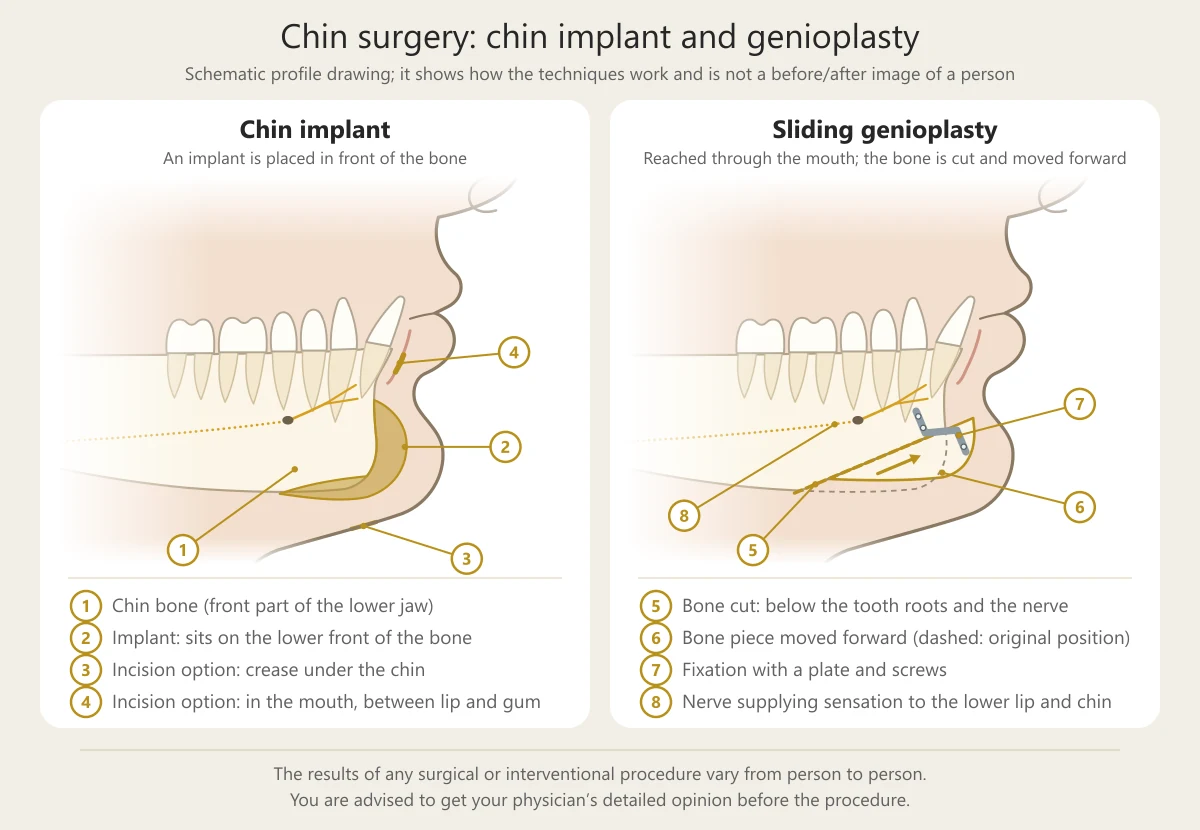
Chin surgery is the general term for procedures that aim to bring a chin that is receding or small, short, long, overly prominent or asymmetrical into better balance with the rest of the face. There are two main surgical methods. With a chin implant, an implant is placed in front of the chin bone through a small incision in the crease under the chin or inside the mouth; with a genioplasty, the bone that forms the chin is cut, moved forwards, upwards or downwards, and fixed in its new position with small plates and screws. For a mild deficiency, filler, which adds volume to the chin without touching the bone, can be a temporary, non-surgical option. Which method is suitable is decided at the examination, according to the direction and amount of change needed and the structure of your bone, teeth and soft tissues.
 The results of any surgical or interventional procedure vary from person to person. You are advised to get your physician’s detailed opinion before the procedure.
What Is Chin Surgery?
The chin is the front-most part of the lower jawbone and marks the lower border of the face. In profile, the nose, the lips and the chin are judged in relation to one another: when the chin is set back or small, the nose can look bigger than it is and the lips more prominent, and the transition between the chin and the neck becomes less defined. A chin that juts too far forward or is long, on the other hand, can make the lower part of the face look heavy. Known informally as chin reshaping and medically as mentoplasty, these procedures aim to change the projection, length and width of the chin and the balance between its two sides.
The most common reasons people come for an examination are:
- A receding or small chin (microgenia): in profile, the chin sits clearly behind the line of the lower lip; this is the most common situation.
- A short or long chin: the distance between the lower lip and the lower edge of the chin is short or long compared with the other proportions of the face.
- An overly prominent chin: the chin juts too far forward.
- Asymmetry: the chin is shifted to one side of the midline, or its two sides differ.
- Strain in the chin when closing the lips: in people who have to make an effort to close their lips, the chin muscle contracts, and the chin can look puckered, with a dimpled, orange-peel appearance.
Is a Receding Chin Always Caused by the Chin Itself?
No. A chin that looks set back in profile may be caused by a small chin, but it may also be caused by the whole lower jaw sitting further back; the two are told apart at the examination by looking at how your teeth meet (your bite) and at the position of the lower jaw. People whose teeth do not meet properly (a bite problem, or malocclusion), or whose whole lower jaw sits markedly back or forward, are assessed and treated by orthodontists and oral and maxillofacial surgeons; these operations, which correct the position of the jawbones together with the bite (orthognathic surgery, or corrective jaw surgery), are not covered on this page. The methods described below are for people whose bite is suitable and whose problem lies mainly in the chin itself.
How Is Chin Surgery Performed?
Before a method is chosen, the projection, length and symmetry of the chin are measured, and photographs taken from different angles are used in planning. If a genioplasty is being considered, an X-ray or a CT scan may be requested to show the bone structure, the length of the tooth roots and the course of the nerve. The operations are performed in a fully equipped hospital licensed by the Ministry of Health.
Chin Implant
A chin implant (also called a chin prosthesis) is an implant made to mimic the shape of the bone and placed on the front surface of the bony chin. The most commonly used material is solid medical-grade silicone, which contains no gel; other materials, such as porous polyethylene, also exist. The size and shape of the implant are chosen according to how far the chin is to be brought forward and how much it is to be widened to the sides; extended models that run sideways along the edge of the jaw aim to give a smoother transition to the jawline.
When it is done on its own, the procedure is usually performed under local anaesthesia with sedation (a light sleep) or under general anaesthesia, and it mostly takes between 30 minutes and 1 hour. The implant can be placed through one of two routes:
- Under the chin: a short incision is made in the natural crease beneath the chin. The position of the implant is easier to control, and the implant does not come into contact with bacteria from the mouth; a fine but permanent scar remains under the chin, where it often lies in shadow.
- Inside the mouth: the chin is reached through an incision in the groove between the lower lip and the gum, so there is no incision in the skin of the face. With this route, oral hygiene becomes even more important, and the chin muscle, which is divided during the incision, is carefully stitched back into place.
Over the bone, a pocket is prepared that is just large enough for the implant to fit without moving. The implant is positioned on the lower part of the bone, away from the tooth roots and from the openings through which the nerves that supply sensation to the lower lip leave the bone; if needed, it is secured with a stitch or a small screw. The incision is closed in layers, and the chin is supported with tape for a few days. After the procedure on its own, most patients go home the same day.
Genioplasty (Sliding Genioplasty)
Genioplasty literally means “chin surgery”; in everyday use, the term usually refers to a sliding genioplasty, in which the bone of the chin is cut and repositioned. The operation is performed under general anaesthesia and, on its own, usually takes 1–2 hours:
- Incision: a horizontal incision is made on the inner surface of the lower lip, slightly in front of the groove between the lip and the gum; there is no incision in the skin of the face.
- Bone cut: the chin bone is cut along a horizontal line below the roots of the lower front teeth and below the openings through which the nerves that supply sensation to the lower lip leave the bone. The muscle attachments on the inner surface of the cut segment are preserved, and the segment keeps its blood supply through them.
- Repositioning: the bone segment is moved in the planned direction: a chin that is set back can be brought forward, one that juts out too far can be moved back, and one that has shifted to the side can be brought to the midline. To shorten a long chin, a thin slice of bone is removed between two cuts; to lengthen a short chin, the segment is moved down and, if needed, the gap is filled with a bone graft or a bone substitute material.
- Fixation: the segment is fixed in its new position with titanium plates and screws; over the following weeks, the bone knits together, much as a fracture heals.
- Closing: the chin muscle is stitched back into place, the incision inside the mouth is closed with dissolvable stitches, and the chin is supported with tape. Some patients go home the same day; others stay in hospital for one night.
Because this method uses your own bone, problems specific to implants, such as the implant shifting or the bone beneath it wearing away, are not expected, and the chin can be changed in more than one direction. When the bone is brought forward, the muscles under the chin that are attached to it come forward too; this can help to define the angle between the chin and the neck. On the other hand, it is a more extensive operation than an implant.
Chin Reduction
When the chin is long or juts too far forward, the aim is not to add volume but to reduce the bone. A limited reduction can be achieved by filing the bone down, either through the mouth or from under the chin. For a more marked length or projection, a genioplasty is usually preferred: the chin is shortened by removing a slice of bone, or the bone segment is moved back. When the bone is made smaller, the soft tissue over it does not always shrink to the same extent; because over-reduction can make the soft tissue of the chin sag, the plan takes this into account.
Chin Implant, Genioplasty or Filler: Which Is Right for You?
The three methods approach the same problem in different ways. When the chin lacks mild to moderate forward projection but its length and symmetry are suitable, an implant is often enough. When the chin needs to be lengthened or shortened, a marked asymmetry needs to be corrected or a larger advancement is required, genioplasty becomes the main option. For people with a mild deficiency who are not considering surgery, or who first want to see the change temporarily, filler is an option.
| Feature | Chin implant | Genioplasty | Filler |
|---|---|---|---|
| What does it change? | Enlarges the chin forwards and, to some extent, to the sides | Moves the bone forwards, backwards, up, down or to the side; shortening and lengthening are possible | Gives the chin limited volume and projection; does not change the bone |
| Anaesthesia | Local anaesthesia with sedation, or general anaesthesia | General anaesthesia | Anaesthetic cream; no surgery needed |
| Incision and scar | A fine, permanent scar under the chin, or an incision inside the mouth that cannot be seen from the outside | An incision inside the mouth that cannot be seen from the outside | No incision; the needle or cannula entry points close within a short time |
| Recovery | Relatively short and mild | Longer; the bone takes weeks to heal | Usually back to daily life the same day; swelling and bruising can last from a few days to 1–2 weeks |
| How long does the effect last? | Long-lasting; the implant stays in the body unless it is removed | Long-lasting; the bone heals in its new position | With hyaluronic acid filler, usually from a few months to 1.5 years; it needs to be repeated |
| Main risks | Infection (the implant may need to be removed), the implant shifting or becoming noticeable, wearing away of the bone underneath | Numbness of the lower lip and chin, mostly temporary; a step at the edge of the bone; rarely, the tooth roots being affected | Swelling, bruising, irregularities; blockage of a blood vessel, an uncommon but serious risk |
Chin filler is usually hyaluronic acid filler, injected just in front of the bone; the treatment is quick and the change is visible straight away, while the final look is assessed once the swelling has gone down. Filler also has its limits: on its own, it may not be enough to correct a markedly receding chin, it cannot make a long or prominent chin smaller, and when it is repeated in large amounts it can make the chin look wider or heavier than it is. Hyaluronic acid filler can be dissolved if necessary. Fat injection using your own fat (fat transfer) can also add volume, but how much of the fat will take cannot be predicted exactly in advance. Fillers and fat injections in the face also carry risks, such as blockage of a blood vessel (vascular occlusion); these risks and the precautions to take are discussed in detail at the examination.
Who Is a Good Candidate for Chin Surgery?
Suitable candidates usually have the following in common:
- A suitable bite, but a chin that looks set back, small, short or long in profile, or a marked difference between its two sides.
- Healthy teeth and gums: especially for operations through the mouth, no untreated tooth decay, gum disease or infection.
- No uncontrolled illness, and no bleeding or clotting disorder, that would rule out surgery and anaesthesia.
- If you smoke, being able to stop at least 2 weeks before the operation and throughout recovery.
- Realistic expectations: the aim is a chin that suits your own facial proportions, not to copy a look from a photograph, and results vary from person to person.
Who Should Wait?
- Young people whose face and jaw have not yet finished developing.
- People who are wearing braces or planning orthodontic treatment: as the teeth move, the appearance of the lips and chin can change too, so the decision about the chin is usually made according to the result of the orthodontic treatment.
- Anyone who is pregnant or breastfeeding.
Nose and Chin Together: Balancing the Profile
When the nose is made smaller, a deficient chin can become more noticeable in profile. That is why, in people considering a nose job (rhinoplasty), the position of the chin is also assessed and, where needed, the two areas are treated within a single plan; this approach is also popularly known as profile balancing (profileplasty). The plan also takes into account how a change in one area will affect the appearance of the other.
The chin also matters for the way the neck looks. A receding chin widens the angle between the chin and the neck and can make fullness under the chin look more prominent than it really is. If there is also fat under the chin, double chin liposuction can be planned together with a procedure that brings the chin forward; if the implant is to be placed from under the chin, the same incision can be used.
Recovery after Chin Surgery
Recovery depends on the method used, any procedures done at the same time and the individual. The table below gives a general outline for a chin implant and a genioplasty done on their own; your personal timetable is given to you when you are discharged.
| Period | Chin implant | Genioplasty |
|---|---|---|
| First 2–3 days | Swelling, tightness and tenderness are at their most noticeable; the chin is supported with tape or an elastic bandage. Pain is usually mild to moderate and is controlled with the medication you are prescribed. | Swelling and tightness are usually more pronounced than after an implant; bruising may spread down towards the neck. Numbness of the lower lip and chin is common. You eat liquid and soft foods. |
| Week 1 | The swelling starts to go down. If the incision was made under the chin, the stitches are usually removed on day 5–7. Most people return to desk work during this week. | The swelling starts to go down; the soft diet continues. You keep up your oral care and attend your follow-up visits regularly. |
| Weeks 2–3 | Most of the visible swelling subsides; the dissolvable stitches inside the mouth start to fall out on their own. Gentle walking and everyday tasks can continue. | Most people return to desk work within 1–2 weeks; the swelling may still be noticeable. You move back to a normal diet once you are given the go-ahead at a follow-up visit. |
| Weeks 4–6 | Strenuous exercise and contact sports can usually be resumed after 4–6 weeks, with your doctor’s approval. | The bone is still healing. Strenuous exercise can usually be resumed after week 6, and contact sports usually after 2–3 months, with your doctor’s approval. |
| Months 3–6 | The remaining mild swelling resolves; the final shape of the chin can usually be assessed from month 3 onwards. | The final contour usually emerges within 3–6 months; changes in sensation can take months to recover. |
In the first weeks, swelling can make the chin look bigger or more asymmetrical than it really is, and your lower lip may feel restricted when you smile or speak. These changes lessen as the tissues settle; you need to wait for the swelling to resolve before judging the result. In the first few days, you are advised to sleep on your back with your head raised on a few pillows, to apply cold compresses at intervals as your doctor explains, and to avoid any pressure on or knocks to the chin. Stay away from hot environments such as saunas, Turkish baths (hammams) and sunbeds for a few weeks.
Eating and Oral Care
If the incision is inside the mouth, the wound is in constant contact with food and saliva, so aftercare is an important part of healing:
- Eating: in the first few days, choose liquid or soft, lukewarm foods such as soup, yoghurt and purées; avoid very hot, hard, crunchy, spicy and acidic foods. After a genioplasty, the soft diet usually lasts for the first 2 weeks.
- Oral care: after meals, rinse your mouth gently with the mouthwash your doctor recommends, and brush your teeth with a soft toothbrush without touching the incision line.
- Stitches: do not pull your lower lip down to look at the stitches, and do not touch the incision with your tongue or fingers.
- Smoking and alcohol: smoking delays wound healing and increases the risk of infection, so do not smoke during recovery. Alcohol is also not recommended in the first few days.
Symptoms to Report to Your Doctor Straight Away
- Swelling or tightness that increases rapidly or becomes more pronounced on one side, or pain that does not respond to medication.
- A fever; increasing redness at the incision, a discharge of pus, or a bad taste or smell in the mouth.
- The incision inside the mouth opening up, or the implant becoming visible through the incision.
- Pain and swelling that increase again after the first few days; a feeling that the implant has moved.
- After a genioplasty: new pain or sensitivity in the teeth, or a change in the way your teeth meet.
Swelling that makes it hard to breathe or swallow is an emergency: call 112 in Turkey (or your local emergency number) without waiting, or go to the nearest emergency department.
What Are the Risks of Chin Surgery?
Chin operations usually heal without problems; even so, as with any surgical procedure, they carry risks. Careful planning reduces these risks but does not eliminate them completely.
Risks Common to Both Methods
- Expected effects: swelling, bruising and tightness; most of this settles within weeks.
- Changes in sensation: the nerves that supply sensation to the lower lip, the chin and the gums of the lower front teeth leave the bone through openings below the premolar teeth. Although they are protected during the operation, they can be stretched or otherwise affected, which can cause numbness or tingling in the lower lip and chin. This is more common after a genioplasty; it mostly improves within weeks to months, but in rare cases it can be permanent.
- Asymmetry, or too little or too much change: most faces already have a slight asymmetry before surgery; after the operation, a difference between the two sides may remain, or the change may be smaller or greater than expected. An additional procedure may be needed to correct this.
- Changes to the smile and lower lip: in operations through the mouth, if the chin muscle that was stitched back does not heal in its new position, the soft tissue of the chin can sag, the lower lip can drop and more of the lower teeth can show; correcting this may require further surgery.
- Bleeding, a collection of blood and wound problems: these are uncommon; the collected blood may need to be drained, or a wound that has opened may need to be stitched again. Rarely, the scar under the chin can become thickened.
- Anaesthetic risks.
Risks Specific to Chin Implants
- Infection: this can develop shortly after the operation or months later. In the early stage, it can be brought under control with medication; if the infection does not clear up, the implant has to be removed. A new implant can be planned only after the tissues have healed.
- The implant shifting or becoming noticeable: the implant can move out of position, tilt or become more noticeable over time; a hard blow to the chin can also dislodge it. To correct this, the implant may need to be repositioned or replaced.
- Wearing away of the bone underneath: over the years, pressure from the implant can cause some wearing away (resorption) of the bone beneath it. This usually causes no symptoms and does not noticeably change the appearance; it is one of the reasons why the implant is placed on the lower part of the bone.
Risks Specific to Genioplasty
- Effects on the tooth roots: the bone cut is planned below the roots of the lower front teeth; rarely, a tooth root can be affected, the tooth can become sensitive or lose sensation, and dental treatment may be needed.
- A step or irregularity at the edge of the bone: the edges of the moved segment can leave a step or a dip along the edge of the jaw that can be felt; if it is noticeable, an additional procedure may be needed to correct it.
- Problems with the plates and screws: they may be felt under the skin or cause discomfort, and rarely an infection can develop around them.
- Delayed bone healing or the segment shifting: both are uncommon and may require further treatment.
At the examination, the possible risks are assessed for you individually and discussed openly.
What Affects the Cost of Chin Surgery?
The fee is not the same for everyone; it is set once your personal plan has been finalised at the examination. The main factors are:
- The method: implant, genioplasty, chin reduction or filler.
- The type of implant; for a genioplasty, the plates and screws used and, if needed, a bone graft.
- The type of anaesthesia (local anaesthesia, sedation or general anaesthesia), the length of the operation and the hospital stay.
- Whether it is done in the same session as another procedure, such as rhinoplasty or double chin liposuction.
- Tests and imaging before the operation, medication and follow-up visits.
If you have questions about the fee, you can reach us through the contact page; it is a good idea to ask which items the fee includes.
Travelling to Istanbul, Turkey, for Chin Surgery
Before you travel, you can send photos on WhatsApp for a preliminary assessment, and your plan is then given to you in writing. The examination and the operation plan are made in person in Istanbul, and the operation takes place in a fully equipped hospital licensed by the Ministry of Health. The length of your stay depends on the procedure and is confirmed in your written plan before you book flights; your surgeon decides when you are fit to fly home. Once you are back home, follow-up continues with photo reviews on WhatsApp, your medical records are given to you in English, and you can contact us to start planning.
Frequently Asked Questions about Chin Surgery
Is a chin implant permanent?
Unlike filler, an implant is not absorbed by the body and does not disappear over time. This does not mean that your appearance will stay the same for life: with age, the soft tissues around the chin become thinner and descend, and changes in weight also affect how the lower face looks. An additional procedure may be needed in the future, either because your expectations change over time or because of a problem with the implant.
At what age can you have chin surgery?
Cosmetic chin surgery is usually planned after the age of 18, once the face and jaw have finished developing. Because the lower jaw keeps growing throughout adolescence, it is not possible to predict how a change made earlier will look after further growth; in a genioplasty, tooth roots that have not finished developing may also be at risk. There is no fixed upper age limit; in older patients, general health, the structure of the bone and the condition of the teeth are assessed separately.
Will the implant show, or can it be felt?
An implant chosen in a size that suits the proportions of your face, and that sits well on the bone, is intended not to be noticeable from the outside; this depends on the size of the implant, the thickness of the soft tissue and how healing progresses. When you press on the chin, you feel a hard structure, like bone; in people with thin soft tissue, the edges of the implant may be felt. Over time, the body forms a thin membrane (capsule) around a silicone implant, which helps to keep the implant in place.
Can I have surgery if I have had chin filler before?
Usually yes, but you need to tell your surgeon at the examination what type of filler was used, how much and when. Filler remaining in the chin can make the bone and soft tissue look different from how they really are and can affect the planning of the implant size or of the bone movement. With hyaluronic acid fillers, you can wait for the effect to wear off, or the filler can be dissolved; fillers that cannot be dissolved and last a long time are a separate factor in the planning.
Can nose and chin surgery be done at the same time?
In suitable patients, both procedures can be done in the same session under general anaesthesia, with a single recovery period. The operation then takes longer. The recovery timetable is mostly set by the nose surgery, which takes longer to heal; if a genioplasty is done, chin-specific advice such as a soft diet is added. Some people prefer to see the result of one procedure first and decide on the other later; this decision is made together at the examination.
Is chin surgery planned differently for men?
Yes. In a man’s face, the chin is usually wider, more angular and slightly more prominent; in a woman’s face, a narrower chin with softer contours tends to sit more naturally with the rest of the face. The width and shape of the implant, or the movement of the bone, are chosen with these differences in mind. In men who wear a beard, the scar under the chin can be hidden by the beard, but the possibility that hair may not grow on the scar itself is also discussed during planning.
What should I watch out for while my lower lip is numb?
While the numbness lasts, your lip cannot feel heat and touch properly, so check the temperature of hot drinks first and take care not to bite your lip when eating. Some people feel as if liquid is escaping from the corner of the mouth when they drink, or as if they are drooling; this feeling usually passes as the numbness fades. Tingling or a slight prickling sensation as feeling returns is normal; if the numbness does not lessen over the months, or if it gets worse, tell your doctor at your follow-up visit.
Do the plates and screws have to be removed?
No. The titanium plates and screws used in a genioplasty are usually left in place. If they cause problems, they can be removed with a minor procedure once the bone has healed. Titanium plates do not usually prevent you from having an MRI scan; even so, you should tell the MRI team before the scan that you have plates.
Do chin exercises or chin-enlarging devices work?
In adults, exercises, chewing devices or appliances worn on the chin do not change the size or shape of the jawbone. Working the neck and facial muscles may have a limited effect on posture and appearance, but it does not bring a receding chin forward. Appliances used in childhood and adolescence to guide the growth of the jaw are part of orthodontic treatment and do not have the same effect once growth is complete.
Can the implant be removed if necessary?
Yes. If necessary, the implant can be removed, usually through the incision used to place it, or replaced with an implant of a different size. With porous implants, removal is more difficult because tissue grows into the pores of the implant. When an implant that has been in place for a long time is removed, the surrounding soft tissue may not fully return to how it was before; slight looseness or irregularity may remain at the chin. If the chin still needs support, bone-based options such as a genioplasty can be considered after the implant is removed.
Consultation and Appointments
At the consultation, your chin is assessed together with your nose and lips, and your bite, the health of your teeth and your expectations are discussed. You may find it useful to ask these questions:
- Is the problem in my profile in the chin itself, or in the position of my lower jaw or my bite?
- Is an implant, a genioplasty or filler more suitable for me, and why?
- If an implant is being considered, which material and size are planned, and where will the incision be made?
- What type of anaesthesia will be used, and will I be able to go home the same day?
- In my case, what should I be aware of regarding numbness and the other risks?
- Should my nose or the area under my chin also be included in the plan?
Results vary from person to person; the purpose of the consultation is to establish whether there is a suitable option for you and, if so, which one. Op. Dr. Ayberk Akçay is a plastic, reconstructive and aesthetic surgeon, a Fellow of the European Board of Plastic, Reconstructive and Aesthetic Surgery (EBOPRAS) and a full member of the Turkish Society of Plastic, Reconstructive and Aesthetic Surgeons; his practice is in Teşvikiye, Şişli, Istanbul. You can read about his training and memberships, and use the contact page to book an appointment at the practice in Istanbul.