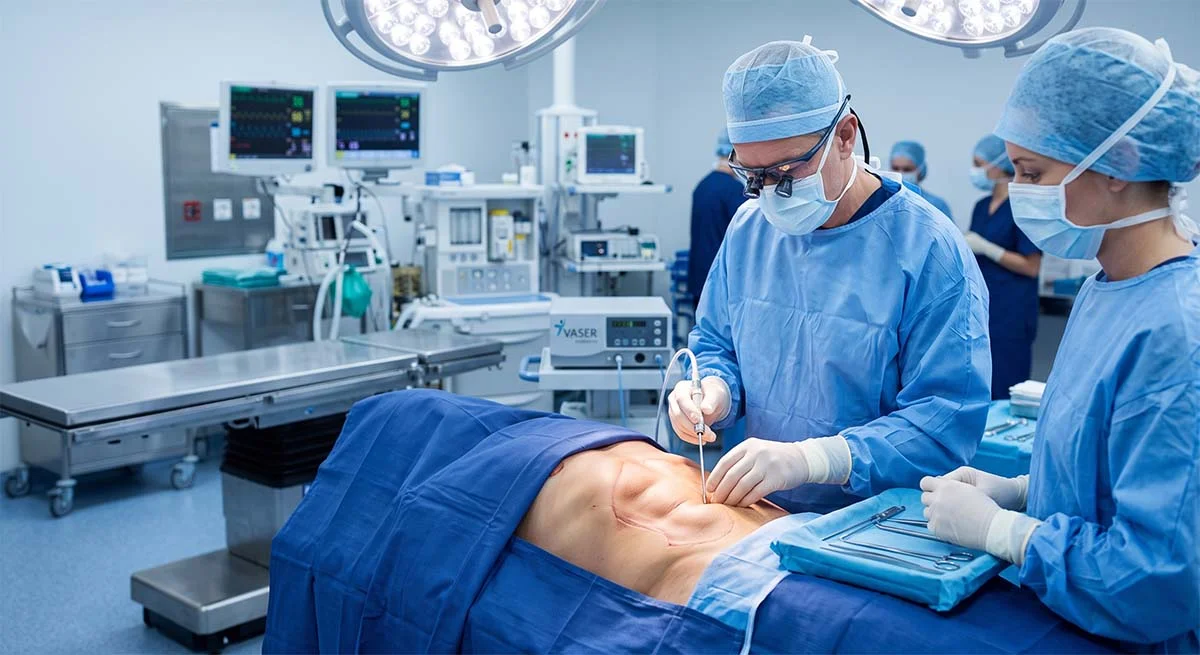
Liposuction is a surgical procedure that reshapes the body by removing, through thin tubes (cannulas), the fat under the skin that stays in certain areas despite diet and exercise. The aim is not to lose weight on the scales but to achieve a more balanced, proportionate look in areas such as the abdomen, waist, back, arms, thighs or under the chin. Below you will find who liposuction is suitable for, how it is planned for each area, options such as ultrasound-assisted and 360 liposuction, what happens on the day of surgery, how the compression garment is used, what recovery involves, the risks and the factors that determine the fee.
 The results of any surgical or interventional procedure vary from person to person. You are advised to get your physician’s detailed opinion before the procedure.
Liposuction at a Glance: Timings and Key Facts
| Topic | General information |
|---|---|
| Suitable candidates | People close to their ideal weight, whose weight has been stable for a few months, who have elastic skin and who are bothered by localised fat |
| Operation time | Usually 1–4 hours; varies with the number of areas and the technique |
| Anaesthesia | Decided with the anaesthesia team, according to the extent of the procedure |
| Hospital stay | One night in most plans, under nursing supervision |
| Incisions | Entry points a few millimetres long |
| Compression garment | Usually 4–6 weeks; day and night in the first weeks |
| Return to desk work | About a week for most patients |
| Bruising | Mostly gone within 2–3 weeks |
| Strenuous exercise | Usually after 4–6 weeks, with your doctor’s approval |
| Final appearance | Usually emerges within 3–6 months |
The times in the table are a general guide; your personal plan is made at the examination, and results vary from person to person.
What Is Liposuction?
Liposuction removes fat from under the skin using thin cannulas, inserted through incisions a few millimetres long, and controlled suction. Many people simply call it “lipo”. A good result does not come from removing a certain amount of fat alone, but from smoothing the transitions between areas to create a silhouette that suits your own build. Planning therefore takes your fat distribution, skin quality and body proportions into account together.
What Liposuction Is Not
- It is not a weight-loss method. It is not used to treat obesity or general excess weight; weight is controlled through diet and regular activity.
- It does not remove the fat inside the abdomen. Liposuction reaches only the fat under the skin; the internal fat that builds up around the organs (visceral fat) cannot be reduced with this method.
- It does not remove loose skin. When excess skin that has lost its elasticity needs to be removed, a tummy tuck, an arm lift or a thigh lift comes into consideration.
- It is not a treatment for cellulite. The orange-peel look of the skin does not improve with liposuction.
Fat-dissolving injections and device treatments that use cooling, heat or ultrasound energy, promoted as “non-surgical liposuction” or “fat melting”, are not the same as surgical liposuction. They may slim small, limited fat deposits to some extent, but their effect is more limited and varies from person to person, several sessions are often needed, and they do not correct loose skin. The information on this page is about surgical liposuction.
Who Is a Good Candidate for Liposuction?
Good candidates for liposuction are usually people whose weight is stable but who are bothered by fat in particular areas. Suitability is assessed at the examination; in general, the following are looked for:
- Being close to your ideal weight, with a weight that has been stable for a few months.
- Localised fat deposits that do not shrink despite diet and exercise.
- Skin that is elastic enough to adapt to the new contour once the fat has been removed.
- No uncontrolled illness that would rule out surgery and anaesthesia.
- If you smoke, being able to stop for a while before and after surgery.
- Realistic expectations: liposuction refines your body contours, but it does not change your bone structure or overall body type.
Who Is Liposuction Not Suitable For?
In the following situations liposuction is not recommended, is postponed or requires a detailed assessment:
- Pregnancy and breastfeeding, or plans for a pregnancy in the near future.
- Plans to lose a lot of weight soon: reaching your weight goal first gives a more predictable result.
- Uncontrolled diabetes, heart or lung disease, or bleeding and clotting disorders.
- A history of deep vein thrombosis or pulmonary embolism.
- Marked skin sagging: in this case, lift operations that remove excess skin are considered instead of liposuction alone.
Lipoedema is a medical condition in which fat builds up disproportionately, and often painfully, in the legs and arms and does not reduce noticeably with diet. In lipoedema, liposuction requires different planning and is often spread over more than one session; this is assessed separately at the examination.
Which Areas Can Be Treated with Liposuction?
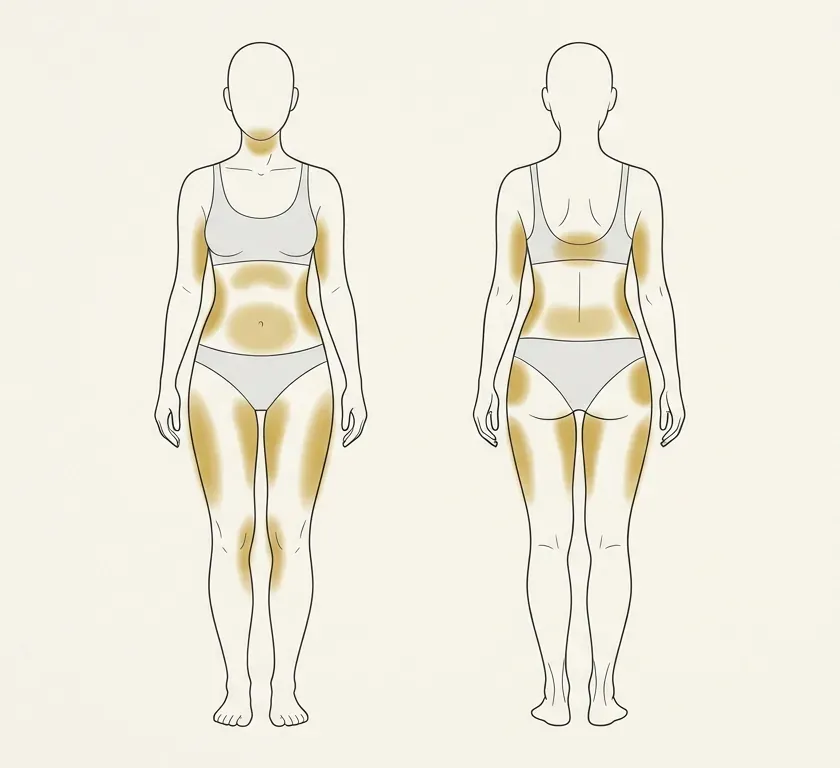
Liposuction can be used in many areas where fat builds up under the skin. Commonly treated areas include:
- Abdomen: fat above and below the belly button.
- Waist and flanks: fat around the waist, commonly known as “love handles”.
- Back: fat along the bra line and above the waist.
- Hips, thighs and knees: the outer and inner thighs and the inner knees.
- Arms: fat on the back of the upper arms.
- Double chin: fat under the chin and in the upper neck.
 The results of any surgical or interventional procedure vary from person to person. You are advised to get your physician’s detailed opinion before the procedure.
Several areas can be treated in the same session. How many areas are treated together is decided not by preference but by the total amount of fat, your general health and the length of the operation. Plans that go beyond what can safely be done in one session are split into stages.
Abdomen and Waist (Belly Fat Liposuction)
The abdomen and waist are areas where liposuction is often requested. In suitable candidates, the part of what people call belly fat or stomach fat that lies under the skin can be removed with liposuction. The areas above and below the belly button are usually planned together; treating only one part can leave a stepped look where the two meet. Fat on the waist and flanks, the so-called love handles, is usually treated in the same session too; bringing out the curve of the waist depends largely on treating this area as well.
In people whose abdomen is firm and sticks out but whose layer of fat that can be pinched under the skin is thin, this appearance usually comes from the internal fat around the organs. Internal fat cannot be removed with liposuction; in this case the priority is weight control through diet and regular activity.
If there is sagging skin below the belly button, or separation of the abdominal muscles, after childbirth or significant weight loss, liposuction does not correct these; the sagging may even become more noticeable. In this case a tummy tuck, or both procedures together, is considered instead of liposuction alone; the comparison table below summarises the difference between the two.
360 Liposuction (Abdomen, Waist and Back)
360 liposuction is a way of planning that treats the torso all the way round rather than from one side only: the abdomen, the waist and flanks, and the back are treated together in the same session. In people whose fat is spread all around the torso, removing fat from the abdomen alone may not bring out the curve of the waist enough. The aim of 360 planning is a more balanced waistline, achieved by refining the transitions at the front and back together.
360 liposuction is not a separate device or technique; it can be done with traditional or ultrasound-assisted liposuction. During the operation your position is changed so that the front and back can be reached. Because a larger area is treated, the operation takes longer, swelling and tiredness in the first weeks may be more noticeable, and a compression garment that covers the whole torso is used.
Back
On the back, fat mostly builds up along the bra line and above the waist, towards the sides. In patients who are planning a breast reduction, fat along the bra line can, where appropriate, be treated with liposuction within the same plan. Liposuction does not, however, remove marked excess skin.
Arms and Underarms
On the arm, fat mostly builds up on the back of the upper arm. In people with elastic skin and no sagging, liposuction alone may be enough; the aim is to slim the arm and refine its contour. Fat that collects in front of the armpit, between the arm and the chest, can also be treated in the same session as the arms or back; in women, fullness in this area sometimes comes not from fat but from breast tissue extending into the armpit, so the two are told apart at the examination. If there is excess skin that hangs down when the arm is raised, removing fat alone does not correct this and may even make the sagging more noticeable. In that case an arm lift comes into consideration, and if needed, liposuction is done as part of the same operation.
Hips and Thighs (Leg Liposuction)
The hips (the outer thighs), the inner thighs and the inner knees are areas where fat often builds up, and they are usually planned together. In people with elastic skin, liposuction aims to give the legs a more balanced outline. Because the skin of the inner thigh is thin and prone to laxity, fat is removed there in moderation and with care. If there is marked skin sagging, a thigh lift is considered, and liposuction is also done during that operation when needed. If the fat on the legs is disproportionate and painful, whether this is lipoedema is assessed separately.
Double Chin (Under the Chin)
Double chin liposuction uses thin cannulas to remove the fat that collects under the chin and define the jaw and neckline. An incision of a few millimetres is used, usually placed in the natural crease just under the chin. In people with elastic skin and no marked laxity of the neck muscles, it may be enough on its own; if the neck skin sags or folds, or there are prominent muscle bands, a neck lift comes into consideration. Who it suits, the day of surgery, the chin strap and recovery are described in detail on the double chin liposuction page.
Liposuction of the Face: Cheeks and Jawline
On the face, apart from the area under the chin and the neck described above, liposuction is usually applied only along the jawline, to a limited area and with care. Removing fat from the cheeks with a cannula is usually avoided: this area contains fine nerves and blood vessels, facial fat already decreases with age, and removing too much can make the face look hollow and older than it is. If the fullness in the cheeks comes from the fat pads deep in the cheek (the buccal fat pads, also called Bichat’s fat pads), this fat is reduced not with liposuction but with buccal fat removal, performed from inside the mouth. If fullness along the jawline is caused by age-related sagging, removing fat does not correct it; in this case facelift options are considered.
Liposuction for Men
Liposuction is also performed on men, and the criteria are the same: a stable weight, localised fat that does not shrink despite diet and exercise, and elastic skin. In men, fat mostly collects on the abdomen, the waist and flanks, the back and under the chin; the aim is usually a flatter abdomen and a more defined torso.
Fullness of the chest can come not only from fat but also from enlarged breast gland tissue (gynecomastia). Fullness that is mainly fat can be reduced with liposuction, while gland tissue is usually removed through a small incision. You will find the details on the gynecomastia surgery (male breast reduction) page.
Which Technique Is Used? Ultrasound-Assisted and Other Methods
Whatever technique is used, the basis of liposuction is the same: a special fluid that helps reduce bleeding and prepares the fat tissue for suction is first introduced into the area, and the fat is then removed through thin cannulas. The methods differ in how the fat tissue is loosened before or during removal. The technique is chosen at the examination according to the area, the nature of the fat tissue and your skin quality.
Traditional Liposuction
The fat tissue is removed with controlled movements of the cannula and suction. This is the basic method, and it is sufficient for many areas. Motor-assisted systems that make the cannula vibrate (power-assisted liposuction, PAL) or cannulas that use laser energy can be used to support the procedure when needed.
Ultrasound-Assisted Liposuction
In ultrasound-assisted liposuction, the fat tissue is loosened with ultrasonic energy before suction and then removed, again with a cannula and suction. This preparation may allow gentler work around the surrounding blood vessels and connective tissue, and it can make things easier for the surgeon in areas that need fine sculpting, such as around the waist. It may also be preferred in areas with denser (fibrous) fat tissue, such as the back.
The difference between ultrasound-assisted and traditional liposuction is not that “more” fat is removed or that the result is “more permanent”, but the way the fat is prepared before it is removed. Because ultrasound energy is used, measures are taken to protect the skin and the incision sites from heat. This method is not suitable for every patient or every area; what determines the result is not the device alone but the right patient selection and planning.
High-Definition (HD) Sculpting, Fat Transfer and Skin Tightening
High-definition (HD) work, which aims to bring out the lines of the abdominal muscles, requires separate planning for people who are close to their ideal weight and exercise regularly; you will find the details on the abdominal etching (six-pack surgery) page. In suitable patients, the fat removed by liposuction can be purified and transferred to the buttocks; the fat is placed only under the skin, not into the muscle. This combined procedure is described on the Brazilian butt lift (BBL) and buttock surgery page. In some patients with mild to moderate skin laxity, plasma energy applied under the skin in the same session may help the skin tighten; with marked excess skin, however, it is no substitute for a lift operation.
Liposuction or Tummy Tuck: What Is the Difference?
Tummy tuck or liposuction? Many people who are unhappy with their abdomen find themselves choosing between these two options. The decision is determined not by personal preference but by your skin elasticity and the condition of your abdominal muscles. At the examination, how far your skin can tighten up, whether there is excess skin below the belly button and whether your abdominal muscles have separated (diastasis) are assessed.
| Feature | Liposuction | Tummy tuck |
|---|---|---|
| What does it correct? | Localised excess fat under the skin | Loose, excess skin and separated abdominal muscles |
| Who is it suitable for? | People with elastic skin and a stable weight | People with excess skin after childbirth or significant weight loss |
| Incisions and scars | Incisions a few millimetres long | A horizontal incision along the pubic line; in a full tummy tuck, also an incision around the belly button |
| Muscle repair | Not done | If needed, separated muscles are repaired with stitches |
| Recovery | Usually shorter | Usually longer; strenuous exercise is resumed later |
The two procedures are also often planned together: liposuction of the waist and flanks during a tummy tuck allows the torso to be contoured as a whole. Planning that addresses post-pregnancy changes in the abdomen, waist and breasts together is done as a mommy makeover.
How Is Liposuction Performed? The Day of Surgery
- Examination and planning: your fat distribution, skin elasticity and expectations are assessed, and the areas to be treated and the technique are decided together.
- Preparation before surgery: blood tests, an ECG and an anaesthesia assessment are done. You are asked to stop smoking and, with your doctor’s knowledge, to stop any medicines or herbal supplements with a blood-thinning effect.
- Markings: the areas are marked while you are standing, because fat distribution and body contours look different when you stand.
- Anaesthesia and the procedure: the operation is performed with an anaesthesia team in a fully equipped hospital licensed by the Ministry of Health; the type of anaesthesia is chosen according to the extent of the procedure. Fluid is introduced into the area through incisions a few millimetres long, the fat tissue is loosened with ultrasound if needed, and the fat is removed through cannulas.
- Compression garment: when the procedure is finished, while you are still in the operating theatre, a medical compression garment suited to the area is put on.
- Observation and discharge: in most plans you spend the night after surgery in hospital under nursing supervision. Before you are discharged, you are told how to wear the compression garment, how pain will be controlled and when your check-ups are.
The length of the operation depends on the number of areas treated and the technique; it is usually between 1 and 4 hours. Single-area procedures are shorter, and extensive plans such as 360 liposuction take longer.
Recovery After Liposuction
Recovery varies from person to person and with the size of the area treated. The timeline below is a general guide; you are given your own timeline when you are discharged.
- First 2–3 days: tightness, pain and swelling are more noticeable during these days; pain is controlled with prescribed medication. Some fluid leaking from the incisions for a while is normal. Short walks begin on the day of surgery or the day after.
- Week 1: bruising starts to fade. Most patients can return to desk work towards the end of this week; after extensive procedures it may take a little longer.
- Weeks 2–3: most of the bruising disappears, and swelling decreases markedly. Daily activities are increased gradually.
- Weeks 4–6: the compression garment is usually worn less and then stopped during this period. Strenuous exercise and heavy lifting are resumed with your doctor’s approval.
- Months 3–6: the remaining swelling resolves, the skin settles onto the new contour, and the final appearance usually emerges during this period.
In the first weeks, swelling can make the area look fuller than it really is, or feel firm in places; this is usually temporary, and it is important not to judge the result too early. Where your doctor recommends it, lymphatic drainage massage can help reduce swelling. You are advised to stay away from hot environments such as saunas, Turkish baths and sunbeds for a few weeks.
Wearing the Compression Garment
The compression garment should be seen as part of the operation: it helps reduce swelling and fluid collecting under the skin, and helps the skin adapt to its new contour. In the first weeks it is worn day and night and taken off only for short periods, such as to shower; after that, the time you wear it each day is reduced according to the schedule your doctor sets. The total period is usually 4 to 6 weeks, but it may vary with the size of the area treated and how healing progresses.
Symptoms to Report to the Doctor Straight Away
- Sudden shortness of breath, chest pain or palpitations.
- Swelling, pain and redness in one leg.
- A high temperature; increasing redness or warmth at the incision sites, or a foul-smelling discharge.
- Pain that keeps getting worse and does not respond to medication, or swelling that grows quickly on one side.
With symptoms such as shortness of breath or chest pain, go to the nearest emergency department without delay.
Liposuction Risks
Like any surgical procedure, liposuction has risks. The right patient selection, planning matched to the total amount of fat and working in a hospital setting reduce these risks, but they do not eliminate them completely.
- Expected, temporary effects: swelling, bruising, pain and numbness or altered sensation in the area, which is usually temporary.
- Contour irregularities: rippling, dents or asymmetry between the two sides; in some cases a corrective procedure may be needed.
- Fluid or blood collection: a seroma or haematoma under the skin, which may need to be drained.
- Infection, wound healing and scarring: infection at the incision sites, delayed healing, a noticeable scar or skin discolouration.
- More visible skin laxity: if the skin is not elastic enough, sagging can become more visible after the fat is removed.
- Heat-related skin damage: can rarely occur with methods that use energy, such as ultrasound.
- Rare but serious risks: deep vein thrombosis and pulmonary embolism, fat embolism, injury to internal organs, disturbance of the body’s fluid balance, and complications related to the anaesthesia or to the medicines introduced into the area.
The risk rises as the amount of fat removed and the number of procedures done in the same session increase. For this reason, the amount to be removed in one session and the procedures to be combined are decided by the surgeon and the anaesthesia team according to your health. Early walking, wearing the compression garment and, when needed, measures to prevent blood clots are important parts of recovery.
What Determines the Cost of Liposuction?
The fee for liposuction is not the same for everyone, because each plan differs according to your fat distribution and needs. The main factors that determine the fee are:
- The number and size of the areas to be treated, and whether it is a single area or an extensive plan such as 360 liposuction.
- The amount of fat to be removed and the operating time that goes with it.
- The technique: traditional liposuction or supporting methods such as ultrasound assistance.
- Whether it is combined with another procedure, such as fat transfer or a tummy tuck.
- The type of anaesthesia, the length of the hospital stay and supplies such as the compression garment.
For this reason, the fee is given once your personal plan has been finalised at the examination. Prices seen online often refer to procedures of different scope; when comparing, ask which areas, which technique and which services are included in the fee.
Travelling to Istanbul, Turkey, for Liposuction
Before you travel, you can send photos on WhatsApp for a preliminary assessment and receive your plan in writing; to begin, contact us. The examination and the final operation plan are made in person in Istanbul, and the operation takes place in a fully equipped hospital licensed by the Ministry of Health. For liposuction, plan to stay in Istanbul for at least 7 nights; you fly home only when the doctor confirms that you are fit to travel. After you return home, follow-up continues with photo reviews on WhatsApp, and your medical records are given to you in English.
Frequently Asked Questions about Liposuction
How much weight will I lose with liposuction?
Liposuction is not a weight-loss method; the change on the scales is usually limited to a few kilograms. Part of the fluid removed is fluid that was given during the procedure, and because of swelling you may see no drop on the scales in the first weeks. The real difference shows in your measurements, in how your clothes fit and in your body contours.
What do I need to weigh to have liposuction?
There is no single weight limit that applies to everyone. What matters is less the number on the scales than whether your weight is close to ideal and has been stable for a few months, and whether the fat is concentrated in particular areas. For people who are generally overweight, losing weight first is recommended; liposuction is not a slimming method. Suitability is decided at the examination, taking your height-to-weight ratio, fat distribution and general health into account together.
How much fat can be removed in one session?
The amount that can be removed in one session is not the same for everyone; it is decided by the surgeon and the anaesthesia team according to your weight, your general health, the number of areas treated and the length of the operation. In the medical literature, procedures in which the total amount removed (fat and fluid) exceeds 5 litres are defined as large-volume liposuction and require closer monitoring; the amount that is right for you is determined at the examination.
Is liposuction a hard operation? Is it painful?
Liposuction is a surgical procedure performed under anaesthesia; the fact that it is done through small incisions does not mean it can be taken lightly. In the first 2–3 days after the operation, tightness, pain and swelling are more noticeable; pain is controlled with prescribed medication. Short walks begin on the day of surgery or the day after. The larger the area treated, and the more areas done together, the more demanding the first days can be.
Does the fat come back after liposuction?
The fat cells removed by liposuction do not grow back. However, the fat cells that remain in the area can get bigger if you gain weight, and weight you gain can also be stored in other parts of the body. Keeping the result therefore depends on maintaining your weight, a balanced diet and regular activity.
How long do I need to wear a compression garment after liposuction?
The compression garment is usually worn for 4 to 6 weeks. In the first weeks it is worn day and night; after that, the time you wear it each day is reduced according to the schedule your doctor sets. This period may be longer if a large area was treated or the swelling is slow to settle.
What happens if I don’t wear the compression garment?
The compression garment helps reduce swelling and fluid collecting under the skin, and helps the skin adapt to its new contour. If it is not worn as recommended, swelling may last longer, the risk of fluid collection (seroma) may increase and contour irregularities may become more likely. Ask your doctor before you stop wearing it.
How long does it take to recover from liposuction?
Most patients return to desk work within about a week; after extensive procedures this may take a little longer. Most of the bruising fades within 2–3 weeks, while swelling decreases gradually over the weeks. Strenuous exercise and heavy lifting are usually resumed after 4–6 weeks, with your doctor’s approval.
When will I see my new shape after liposuction?
Although the change is noticeable straight after surgery, swelling hides the real contour in the first weeks. Most of the swelling goes down in the first few weeks; it usually takes 3 to 6 months for the skin to settle onto the new contour and for the final appearance to become clear. You need to wait this long before judging the result.
Is it dangerous to have belly fat removed?
In suitable candidates, the fat under the skin around the belly button can be removed with liposuction. As with any operation, there are risks; if there is a hernia or there are scars from previous operations, the abdominal wall is assessed separately before surgery. The internal fat that builds up around the organs, however, cannot be removed with liposuction.
Can liposuction cause lasting harm?
Most of the swelling, bruising, pain and numbness after liposuction is temporary. Contour irregularities such as rippling or dents, a noticeable scar and altered sensation, however, may be permanent in some people and may need a corrective procedure. Serious complications such as blood clots or fat embolism are uncommon, but in rare cases they can cause lasting damage. The risks specific to you are discussed in detail at the examination.
Will my abdomen sag after liposuction?
In people with elastic skin, the skin usually adapts to the new contour after the fat has been removed, and the compression garment helps with this. If the skin has lost its elasticity, especially after childbirth or significant weight loss, laxity below the belly button may become more visible once the fat has been removed. This is why the examination assesses how far your skin can tighten up; if there is marked excess skin, a tummy tuck, or a tummy tuck combined with liposuction, is planned.
Is double chin liposuction different from liposuction on the body?
The principle is the same: excess fat under the skin is removed through thin cannulas. Because the area under the chin is small and close to important structures, finer cannulas are used and the work is done with particular care; an elastic chin strap is used instead of a compression garment. In most patients, swelling and bruising decrease markedly within the first two weeks; the final appearance of the jawline becomes clear over the months.
Will liposuction leave scars?
Liposuction is done through incisions a few millimetres long, placed as far as possible in natural creases or in areas covered by underwear. These scars fade considerably over time but may not disappear completely; how scars form varies from person to person, depending on skin type.
Which doctor performs liposuction?
Liposuction is a surgical procedure and one of the operations covered by specialist training in plastic, reconstructive and aesthetic surgery. It is important that the operation is performed with an anaesthesia team in a fully equipped hospital licensed by the Ministry of Health. At the examination, asking about the surgeon’s specialty, where and with what anaesthesia plan the operation will be done, and how follow-up after surgery will work will help you decide.
Is liposuction done in Turkish state hospitals, and does SGK (Turkish public insurance) cover it?
For patients insured in Türkiye: cosmetic liposuction is not covered by SGK, the Turkish public health insurance, whether it is done in a state or a private institution. For a medical condition such as lipoedema, coverage may be assessed separately; for the current rules, check with SGK, your private insurer and the institution where you would be treated.
Consultation and Appointments
At the examination, your fat distribution, skin elasticity and general health are assessed, and we discuss whether liposuction, a lift operation or both together would suit you. Results vary from person to person; the purpose of the examination is to make clear whether surgery is the right option for you. Op. Dr. Ayberk Akçay is a specialist in plastic, reconstructive and aesthetic surgery, a Fellow of the European Board of Plastic, Reconstructive and Aesthetic Surgery (EBOPRAS) and a full member of the Turkish Society of Plastic, Reconstructive and Aesthetic Surgeons. His practice is in Teşvikiye, Şişli, Istanbul; you can read about his training and memberships on the About Dr. Akçay page. To book a consultation, reach us through the contact page.