Male rhinoplasty (a nose job for men) is rhinoplasty planned around the anatomy of the male face. The surgical techniques are the same as for women; the difference lies in the nose shape that is aimed for and in the planning criteria. The goal is a nose that keeps the strong lines of a man’s face, does not look operated on and lets you breathe comfortably. A small, narrow nose with a markedly upturned tip may suit a woman’s face, but on a man’s face it can look artificial and feminine.
What Is Male Rhinoplasty?
Rhinoplasty reshapes the bone and cartilage framework of the nose so that it is in harmony with the face. In men, planning takes into account nasal skin that is mostly thicker, a bone and cartilage framework that is generally stronger, prominent brow ridges and a strong jawline. A hump on the bridge, a drooping or wide tip, a nose that is crooked after an old injury and difficulty breathing are among the concerns men often bring to the consultation. For the general stages and techniques of the operation, see our rhinoplasty (nose job) page.
Who Is a Good Candidate for Male Rhinoplasty?
Rhinoplasty may be an option for men who are unhappy with the way their nose looks or who cannot breathe comfortably through it. Suitability generally depends on the following conditions:
- The nose and the facial skeleton have finished developing; in men this is usually after the age of 18.
- Your health does not rule out general anaesthesia and surgery.
- Your expectations are realistic, and the decision is your own rather than the result of pressure from others.
In some situations it is more appropriate to wait. If you have recently injured your nose, an examination comes first to decide the timing of surgery. For competitive athletes, the date of surgery can be planned around the season, allowing for the time needed before returning to contact sports. Other situations that may call for postponing surgery, such as an uncontrolled illness or an active infection, are covered in the rhinoplasty suitability criteria.
Should I Have a Nose Job? What to Consider When Deciding
There is no answer to this question that applies to everyone; the decision is personal and should be based on accurate information. These questions can guide you:
- What really bothers you? Is it only the appearance, difficulty breathing, or both? A breathing problem can be treated in the same operation as the cosmetic correction.
- How much change do you want? In men, a measured change is usually the goal: the aim is not to erase the character of the nose but to bring it into balance with the face.
- How much time can you take off work and training? The time needed before you can return to desk work, heavy training and contact sports differs; the details are in the recovery section below.
- Are you prepared to wait for the result? The nose takes months to reach its final shape, and with thick skin this can take even longer.
Results vary from person to person. At the examination, what can and cannot change about your nose is discussed openly; deciding not to have surgery is also one of the possible outcomes of this assessment.
What Should a Man’s Nose Look Like? Natural Male Nose Shapes
There is no single template for the ideal male nose. Instead of relying on the ready-made examples shared online as “male nose job styles”, the assessment looks at your nose together with the forehead, cheekbones, lips and chin, both from the front and in profile. Even so, most noses that look natural and masculine on a man’s face share certain features.
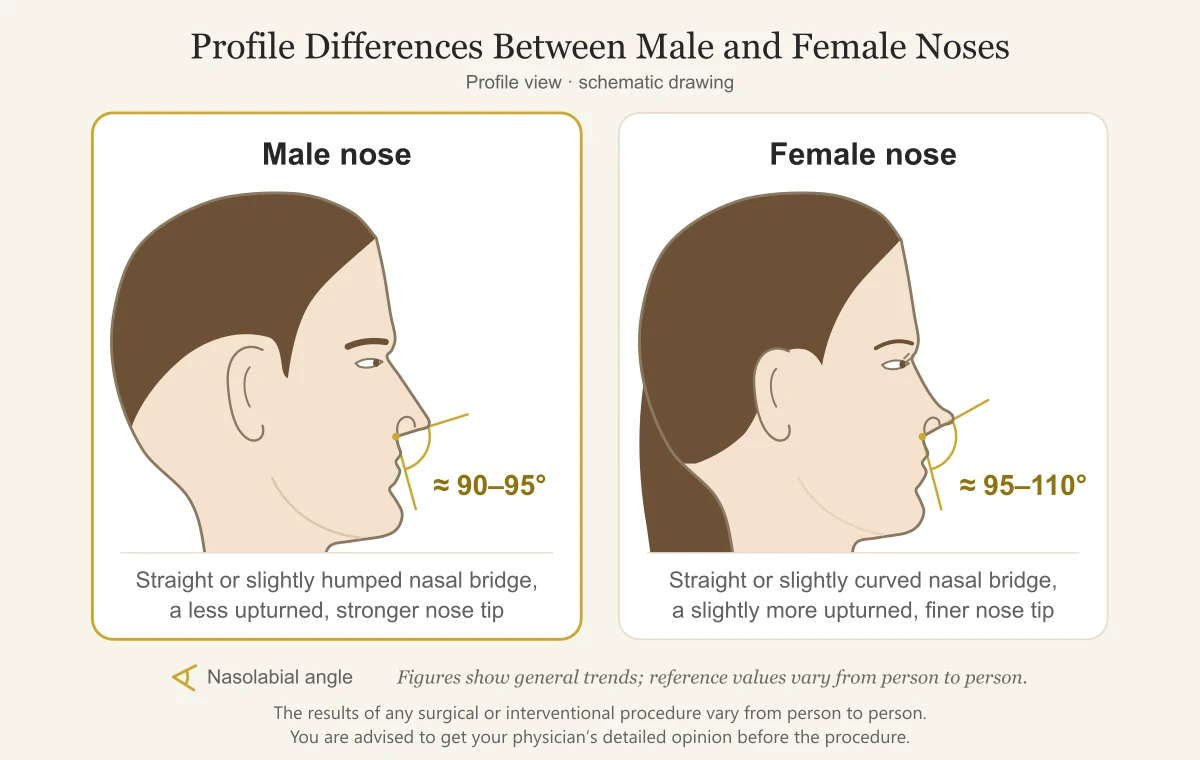 The results of any surgical or interventional procedure vary from person to person. You are advised to get your physician’s detailed opinion before the procedure.
The Bridge: Straight or Slightly Humped
In men, a bridge that looks straight in profile, or one on which a slight hump is kept, usually suits the face. Rasping the hump away completely and leaving the bridge scooped can give a male profile a feminine look. Seen from the front, the lines that run from the eyebrows to the tip are called the dorsal aesthetic lines; in men, it is preferable for them to be straighter, parallel to each other and set slightly further apart than in a woman’s nose.
The Tip and the Nose–Lip Angle
In a male nose the tip is turned up less than in a female nose. The angle between the nose and the upper lip (the nasolabial angle) is usually planned at around 90–95 degrees in men and somewhat wider in women. The tip should be defined but not over-refined: a pointed tip, or the slight dip just above the tip that is often preferred in women (the supratip break), is usually not wanted on a man’s face.
Balance with the Whole Face
On a face with a strong chin and prominent brow ridges, a nose that has been made too small can look out of proportion. For this reason, the length, projection and width of the nose are considered together with the transition from forehead to nose, the chin and the beard line. The aim is not a small nose for its own sake, but a nose in balance with the rest of the face.
| Feature | Usually in men | Usually in women |
|---|---|---|
| Bridge | Straight; a slight hump can be kept | Straight or very slightly curved |
| Upward rotation of the tip | Less; the tip is not lifted too far | A little more rotation is acceptable |
| Nose–lip (nasolabial) angle | About 90–95 degrees | About 95–110 degrees |
| Tip | Strong and full; not over-refined | Finer, more defined lines |
| Supratip break | Usually not wanted, or very slight | A slight break is often preferred |
| Nasal skin | Mostly thicker and oilier | More variable, often thinner |
The values in the table are general tendencies; the proportions that suit you are determined through facial analysis at the examination.
The General Approach for Each Type of Nose
The approach is not picked from a ready-made “male nose style” but determined by the structure of your nose. The nose types commonly seen in men, and the approach usually taken for each, can be summarised as follows:
| Nose type | Common concern | What is usually done |
|---|---|---|
| Humped nose | A noticeable bump in profile | The hump is reduced only as much as needed, and a slight hump can be kept; in suitable noses, an approach that preserves the bridge (preservation rhinoplasty) is considered. |
| Drooping or wide tip | A tip that looks long or round | A drooping tip is repositioned and, where needed, supported with the patient’s own cartilage; a wide tip is refined in moderation. The tip is not lifted too far or made pointed. |
| Crooked nose after an injury | Crookedness, often with difficulty breathing | The bones and the septum are realigned together (septorhinoplasty). |
| Thick-skinned nose | A tip that looks full and poorly defined | The framework is not over-reduced; the tip is given definition with cartilage support. |
| Nose that is large for the face | The nose dominates the face | The size is reduced in moderation; the goal is a nose in balance with the rest of the face. |
Most noses combine several of these features, and the plan takes all of them into account. Options that address only the tip are described separately on the tip rhinoplasty (nose tip surgery) page.
How Can a Feminine-Looking Nose Be Avoided?
A common worry among men is that their nose will look feminine after surgery, or that it will be obvious they have had an operation. This look is mostly caused by the following changes:
- Making the nose too small for the face
- Lifting the tip more than necessary, so that the nostrils show too much from the front
- Rasping the bridge down too far, which leaves a scooped profile
- Over-narrowing the tip and making it pointed
- In a thick-skinned nose, reducing the framework more than the skin can adapt to
Instead, the aim is a measured change: the hump is reduced only as much as needed, the tip is supported and positioned, and the character of the nose is preserved. Photographs taken during planning and a digital simulation make it easier to discuss the intended change; a simulation, however, is an image of the goal and does not mean that the result will be identical to it.
Rhinoplasty for Thick Skin
In men, the skin of the nose is often thicker and rich in oil glands. Thick skin directly affects both the surgical plan and the recovery time: it hides fine detail, it does not settle onto a reduced bone and cartilage framework as easily as thin skin does, and it holds swelling for longer. If the framework is reduced more than the skin can accommodate, the space in between can fill with swelling and scar tissue, which may leave an unwanted fullness above the tip and a poorly defined tip.
How Can I Tell If My Nose Has Thick Skin?
Oily skin with visible pores, a round tip in which the outline of the cartilage cannot be made out from the outside, and skin that feels thick between the fingers can all be signs of thick skin. The thickness and elasticity of the skin are assessed at the examination by feeling the nose.
How Is Surgery Planned for Thick Skin?
- The framework is not over-reduced; changes are planned within what the skin can adapt to.
- Where needed, the tip is supported with grafts prepared from the patient’s own cartilage; definition at the tip comes from firm support rather than from reduction.
- After the splint comes off, the recommended taping and regular check-ups help to monitor the swelling; if swelling persists, whether any additional treatment is needed is decided at a follow-up examination.
- The tip takes months to reach its final form; with thick skin, patience is part of the process.
Breathing Problems and Septorhinoplasty
In men, a cosmetic concern is often accompanied by difficulty breathing. A deviated septum (a bend in the wall that divides the nose), enlarged turbinates (turbinate hypertrophy) and crookedness caused by a past blow during sport, a fall or an accident can be treated in the same session as the cosmetic correction. This operation, which combines cosmetic and functional correction, is called septorhinoplasty. In noses that have become crooked after an injury, the bones and the septum may need to be realigned together.
Male rhinoplasty is not a separate surgical technique. The operation can be performed with the open technique or with the closed rhinoplasty technique. Either can be combined with piezo (ultrasonic) rhinoplasty for shaping the bones and, in suitable noses, with preservation rhinoplasty, which keeps the natural structure of the bridge. Which methods are used depends on the structure of the nose, the size of the hump and the source of the breathing problem; this decision is made at the examination.
Snoring and Blocked Breathing During Exercise
Complaints such as a blocked nose at night, snoring or not being able to breathe well enough through your nose while training can be caused by a structural problem inside the nose, such as a deviated septum or enlarged turbinates. These problems can be corrected in the same operation as the rhinoplasty. Snoring can also have causes outside the nose, however, so the operation cannot be expected to stop snoring in every patient; whether the complaint comes from the nose is assessed at the examination, and causes outside the nose may need a separate assessment.
How Is the Operation Planned and Performed?
At the first consultation, your concerns and expectations are discussed; the inside of the nose, the septum, skin thickness and cartilage support are assessed, and photographs are taken from different angles. Before the operation, blood tests and an anaesthetic assessment are carried out. The operation is performed under general anaesthesia in a fully equipped hospital licensed by the Ministry of Health. Depending on the extent of the procedure, it usually takes 2–4 hours, and patients mostly stay one night for observation. At the end of the operation a protective splint is placed on the bridge and, if needed, soft silicone packs with a central channel that lets some air through are placed inside the nose.
Preparing for Surgery: Work, Training and Supplements
- At the examination, mention any breathing complaints, past injuries to your nose and any operations you have had.
- Tell your doctor about all the medicines, herbal products and sports supplements you take; any that can increase the risk of bleeding are adjusted before surgery on the doctor’s advice.
- If you smoke, you are advised to stop for at least a few weeks before and after surgery.
- Plan your time off work and your training schedule in advance, using the recovery timeline below.
Recovery After Male Rhinoplasty
The first weeks of recovery are similar for men and women; the difference is that swelling lasts longer with thick skin. The timings below are a general guide and vary from person to person:
- First week: Swelling and bruising are noticeable. The splint stays in place; you sleep with your head raised and apply cold compresses around the eyes.
- Days 5–7: The splint, the packs and, if necessary, the stitches are removed; the nose may be taped for a while.
- Weeks 1–2: Most patients can return to desk work during this period. For physically demanding work, a wait of 3–4 weeks is usual.
- Weeks 2–4: Most of the bruising and visible swelling fades, and getting back to social life becomes easier.
- Months 3–6: Most of the swelling resolves, and the nose comes close to its final shape.
- Months 6–12 and beyond: The last fine swelling in the tip resolves. In thick-skinned noses this can take 12–18 months, and sometimes longer.
For aftercare advice, how swelling evolves and what to watch out for, read our rhinoplasty recovery guide.
When Can I Return to Sport and Weight Training?
Sport is something men often ask about during recovery. Heavy exertion raises blood pressure and can increase swelling and the risk of bleeding, while a blow to the nose can shift bone and cartilage that have not yet finished healing. The general framework is as follows:
- First 2 weeks: No exercise apart from short, gentle walks; avoid movements that involve bending forward or straining.
- Weeks 3–4: If your surgeon agrees, you can start light cardio such as brisk walking or a stationary bike.
- After 4–6 weeks: Return to weight training gradually, with light loads; heavy lifts and high-intensity sessions are usually left until after week 6.
- Contact sports: Sports in which the nose could take a blow, such as football, basketball and combat sports, are usually not advised until 2–3 months have passed; for combat sports this period may be longer.
- Pool, sea and sauna: Swimming in a pool or the sea usually has to wait 3–4 weeks; saunas, steam rooms and direct sun are not advised for the first month.
For competitive athletes and anyone who trains regularly, the return plan should be discussed before surgery, according to the sport. If your nose takes a knock during recovery, let your surgeon know even if you have no obvious symptoms; if you notice bleeding, increasing swelling, a change in the shape of your nose or difficulty breathing, get in touch without delay.
Shaving, Glasses and Daily Life
While the splint is in place and for the first two weeks, take care not to press on the nose or the upper lip when you shave; once the splint is off, you gradually return to your usual routine, following the advice given at the check-up. Because glasses put weight on the healing nasal bones, they are usually not rested directly on the bridge for the first 2–3 months; contact lenses may be preferable during this time. In the first weeks, rubbing the nose hard, blowing your nose and smoking can all hinder healing.
How Will My Nose Change After Surgery?
This website does not show photographs of patients’ results. Turkish rules on the advertising of health services place strict conditions on the use of patient images; more importantly, another patient’s result cannot show what will happen to your nose. The structure of the nose, skin thickness and the healing process vary from person to person.
In men, the changes are mostly planned in these areas: the line of the bridge in profile, the position and support of the tip, how straight the nose sits on the midline of the face when seen from the front and, where needed, the airway. These changes do not appear all at once but over months, as the swelling resolves; the stages are described in the recovery section above.
The way to understand what is possible for you is to talk about your own nose: at the examination, photographs of your nose taken from different angles are used to assess together what can change and how your skin type may limit the result.
Risks and Realistic Expectations
Like any surgical procedure, this operation carries risks. They include risks related to anaesthesia, bleeding or a haematoma (a collection of blood) and infection; temporarily reduced sensation in the skin of the nose and in the upper lip, a temporarily reduced sense of smell and temporary nasal blockage; and minor asymmetries. With the open technique there is a small scar on the columella (the strip of tissue between the nostrils), which usually fades over time. Rarely, a hole in the septum (perforation) can develop in patients who have had septum correction, and, rarely, a lasting breathing problem can occur. With thick skin, swelling can last longer and the tip takes time to become well defined. Results vary from person to person, and some patients may need a minor correction once healing is complete. For patients who have had nose surgery before and are unhappy with the result, the process is described on our revision rhinoplasty page.
Travelling to Istanbul, Turkey, for Male Rhinoplasty
Before you travel, you can send photos of your nose on WhatsApp for a preliminary assessment and receive the plan in writing; to start, contact the practice. You are examined and your operation plan is finalised in person in Istanbul, the operation is performed in a fully equipped hospital licensed by the Ministry of Health, and your surgeon decides when you are fit to fly home. For rhinoplasty, a stay of about 6–7 nights is typical. After you return home, follow-up continues with photo reviews on WhatsApp, and your medical records are given to you in English.
Frequently Asked Questions about Male Rhinoplasty
At what age can a man have rhinoplasty?
There is no single ideal age for male rhinoplasty; it is generally recommended after the age of 18, because the nose and the facial skeleton are expected to have finished developing by then. Before this age the nose may still be growing, so cosmetic surgery is mostly postponed; medical situations such as a severe breathing problem or an injury are assessed separately at the examination. There is no fixed upper age limit; the deciding factors are your general health and the anaesthetic assessment.
What is the difference between male and female rhinoplasty?
The surgical techniques are the same; the difference lies in the nose shape that is aimed for. In male rhinoplasty the bridge is usually left straight or with a slight hump, and the tip is lifted less and not over-refined; the angle between the nose and the upper lip is usually planned at around 90–95 degrees. Men’s nasal skin is also mostly thicker, which affects both the plan and how long the swelling takes to resolve.
Does rhinoplasty change a man’s face?
The aim is not to change the character of your face but to bring the nose into balance with it. Changes are planned in moderation; reducing a hump or supporting the tip can make the profile look more balanced while preserving your facial expression. How much to change is discussed together at the examination, using photographs.
Will people be able to tell I have had surgery?
In the first weeks, the operation may be noticeable because of swelling and bruising; most of the bruising and visible swelling usually fades within 2–4 weeks. Planning aims for a nose that suits a man’s face and does not look operated on, so the nose is not made too small and the tip is not lifted more than necessary. If the open technique was used, the scar from the small incision on the columella usually fades over time. Results vary from person to person.
Should the hump be removed completely in male rhinoplasty?
Not always. In a male profile, a slight hump often looks natural and suits the face, whereas removing the hump completely and leaving the bridge scooped can create a feminine look. How much the hump is reduced is decided by assessing it together with the forehead, the tip and the chin.
Will my nose tip drop after surgery?
During the operation the tip is positioned and, where needed, supported with grafts prepared from the patient’s own cartilage; the purpose of this support is to hold the tip in its new position. The final position of the tip becomes clear as the swelling resolves, usually at 6–12 months, or at 12–18 months with thick skin. Small changes can still occur during healing and over the years, which is why follow-up examinations matter.
Does recovery from rhinoplasty take longer for men?
The early stages, such as splint removal and returning to social life, are similar for men and women. Because men’s nasal skin is mostly thicker, it can take longer for the swelling to resolve completely and for the tip to become well defined; in thick-skinned noses the final shape can take 12–18 months to settle.
Can I have rhinoplasty if I have thick skin?
Yes. Thick skin does not rule out surgery, but it changes the plan and what you can expect. With thick skin the framework is not over-reduced, the tip is strengthened with cartilage support, and you have to wait longer for the swelling to resolve. Fine detail may show less clearly through thick skin; this is discussed openly at the examination.
How much smaller can a man’s nose be made?
There is no fixed amount. How much the nose is reduced depends on its proportion to the face, the structure of the hump and the tip, and the thickness of the skin. On a man’s face, a nose that has been reduced too much can look out of proportion and feminine; with thick skin, the skin may not settle well over an over-reduced framework. So the goal is not the smallest possible nose but one that is in balance with the face.
Can I have rhinoplasty if I have broken my nose before?
Yes. Crookedness and breathing difficulty caused by an old fracture can be treated in the same session as the cosmetic correction, with septorhinoplasty. If you have recently injured your nose, you are advised to have it examined without delay; the timing of rhinoplasty is decided once the swelling has gone down and the condition of the bones has been assessed.
When can I shave after rhinoplasty?
While the splint is in place and for the first two weeks, take care not to press on the nose or the upper lip when you shave. Because the tip of the nose and the upper lip may be temporarily numb, it is important to be careful in this area. After the splint comes off, you gradually return to your usual shaving and skincare routine, following the advice given at the follow-up examination.
How much does male rhinoplasty cost, and what does the fee depend on?
Being a man does not in itself determine the fee. It depends on whether the operation is purely cosmetic or also treats a breathing problem (septorhinoplasty), whether it is a first operation or a revision, whether cartilage grafts are needed, the length of the operation and the length of the hospital stay. For this reason, the fee becomes clear once your personal plan has been set after the examination. For details, see our rhinoplasty cost page.
Consultation and Appointments
The plan that suits you is made once your face and nose have been assessed in person. Asking these questions at the consultation can make your decision easier:
- Which technique is planned for my nose, and why?
- If I have a breathing problem, will the septum and the turbinates be treated in the same operation?
- How will the thickness of my skin affect the result and the recovery time?
- When can I go back to work, training and contact sports?
- If a minor correction is needed later, how does that work?
Op. Dr. Ayberk Akçay is a specialist in plastic, reconstructive and aesthetic surgery, a Fellow of the European Board of Plastic, Reconstructive and Aesthetic Surgery (EBOPRAS) and a full member of the Turkish Society of Plastic, Reconstructive and Aesthetic Surgeons. You can read more about his training and memberships. To arrange a consultation at the practice in Teşvikiye, Şişli, Istanbul, request an appointment through our contact page.