
A thread lift is a non-surgical (minimally invasive) treatment for facial tissues that have begun to sag: threads placed under the skin, which dissolve over time, aim to lift these tissues a little and support them. The threads are inserted without any incision, under local anaesthesia, through needle entry points; small cones or barbs along them grip the tissue under the skin. The effect is limited and temporary: it can give support for a while when sagging is mild and at an early stage, but when sagging is marked it is no substitute for a facelift.
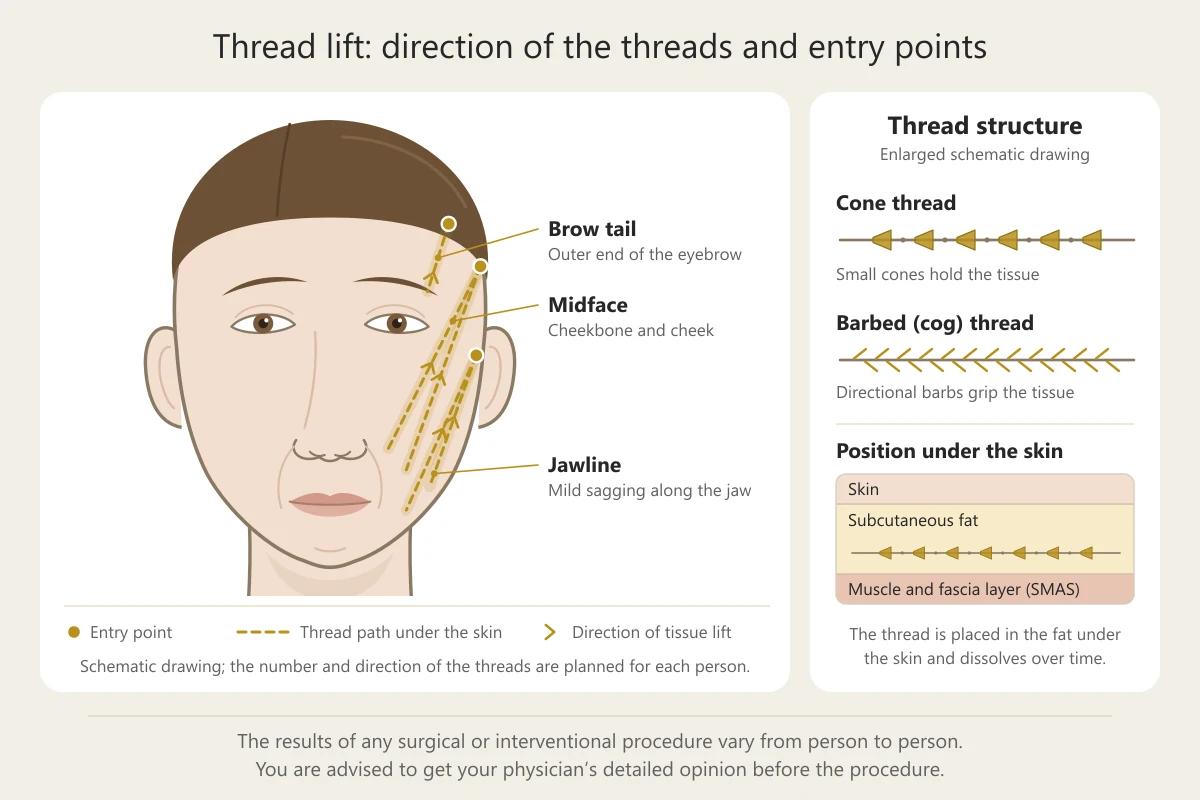 The results of any surgical or interventional procedure vary from person to person. You are advised to get your physician’s detailed opinion before the procedure.
What is a thread lift?
With age, the supporting tissues of the face loosen and the soft tissues of the cheek slide downwards: the fullness over the cheekbone decreases, the nasolabial fold (the line from the nose to the corner of the mouth) deepens and mild sagging begins along the jawline. In a thread lift, these tissues are supported upwards and backwards with fine threads that start inside the hairline at the temple or in front of the ear. The thread is placed in the fat layer under the skin; its cones or directional barbs (notches) grip the surrounding tissue, and when the thread is gently tightened, the tissue moves a little in the planned direction. Over the following weeks, a thin layer of connective tissue forms around the thread and helps to hold it in place.
Lifting threads are made from materials that the body gradually dissolves, such as polydioxanone (PDO), polylactic acid or polycaprolactone; polydioxanone is also used in dissolving surgical stitches. How long a thread takes to dissolve depends on its material and structure; once it has fully dissolved, no foreign material is left in the tissue. There are also fine threads with a smooth surface and no cones or barbs; these do not lift tissue and are used mainly in treatments aimed at skin quality. For a lift, threads with cones or barbs that can grip the tissue are used.
In Turkey, the name “French lift” or “French thread lift” is also widely used. It is not a medical term or the name of a single method: some clinics use it for dissolving threads with small cones, others for lifting methods that use non-dissolving, permanent threads. So rather than going by the name, it is better to ask which thread will be used (dissolving or permanent, with cones or with barbs) and why it has been chosen. The information on this page is about thread lifts with dissolving threads.
A thread lift does not remove skin, does not add volume to the face and does not get rid of fine lines or blemishes on the surface of the skin.
Thread lift, fillers or a facelift: what is the difference?
A thread lift, volume replacement with fillers and a surgical facelift are often confused. All three aim to make the face look more rested, but they address different problems; which one suits you depends on whether volume loss or laxity is the main issue in your face, and on how far the sagging has progressed. The table below compares the three methods in broad terms.
| Feature | Thread lift | Volume replacement with fillers | Facelift surgery |
|---|---|---|---|
| What does it do? | Lifts loosened tissue to a degree with dissolving threads and supports it | Replaces lost volume | Repositions the sagging deep tissues and removes excess skin |
| What does it not do? | Does not add volume or remove skin; does not correct marked sagging | Does not remove sagging skin or lift tissues | Does not, on its own, correct volume loss or fine lines on the surface of the skin |
| Anaesthesia | Local anaesthesia | Numbing cream | General anaesthesia |
| Incisions and scars | No incisions; the needle entry points close within a few days | No incisions | Incisions within the hair-bearing scalp and around the ear; the scar is permanent and becomes less noticeable over time |
| Treatment time | Usually 30–60 minutes | Usually 30–60 minutes | Usually 4–6 hours; 1–2 days in hospital |
| Recovery | Swelling, bruising and tightness; most people return to their daily routine within a few days | Mild swelling and bruising; most people return to their daily routine the same day | Return to desk work and social life usually at the end of the 2nd week; final appearance at 3–6 months |
| How long the effect lasts | The visible lift usually fades within a few months to about 1 year | Usually a few months to 1.5 years, depending on the area and the product | Can last for many years; ageing continues |
| Main risks | Bruising, dimpling and puckering, the thread being felt or working its way out, infection | Swelling, irregularities; rare but serious blockage of a blood vessel | Bleeding (haematoma), weakness of facial nerve branches (mostly temporary), scarring, risks related to anaesthesia |
| Who is it considered for? | Mild, early sagging; good skin quality | Limited volume loss | Marked sagging; laxity along the jawline and in the neck |
How the deep tissues are repositioned in a facelift, the recovery timeline and the risks are explained on the deep plane facelift page. Our guide to what a facelift involves, which looks at the difference between surgical and non-surgical treatments, can also help before you decide.
Which areas can a thread lift treat?
The number and direction of the threads are planned according to where the sagging is and the structure of the face; the same plan is not used for every face. Commonly treated areas are:
- Midface: cheek tissue that has descended below the cheekbone is supported with threads running from the temple towards the cheek. This support can soften the depth of the nasolabial fold to a degree; if the fold is caused mainly by volume loss, a thread lift alone is not enough.
- Jawline: where mild sagging is starting along the edge of the jaw (jowls), threads running from in front of the ear or from the temple can support the tissue and help the jawline look more defined.
- Tail of the brow: short threads inserted inside the hairline at the temple can support the outer end of the eyebrow slightly upwards and outwards. The thread treatment known as the “fox eye”, which aims to give the outer corner of the eye an upswept look, is also done in this area; its effect is temporary and it does not change the structure of the eye corner. Surgical options that can be considered for this look are described on the almond eye surgery page.
Who is a good candidate for a thread lift?
Suitable candidates are usually people who:
- Have mild sagging that has only recently started in the cheeks, along the jawline or at the outer end of the eyebrow.
- Have good skin quality, with skin and underlying tissue that are neither very thin nor very thick and heavy.
- Do not want surgery, or for whom now is not a suitable time for an operation, and are looking for an option with a short recovery.
- Have realistic expectations: they understand that the effect is limited and temporary, that it may need repeating over time and that results vary from person to person.
Who should wait, and who should not have a thread lift?
In the following situations, the treatment is postponed, another option is considered or a detailed assessment is needed first:
- Marked sagging and excess skin: there is more tissue than threads can hold; in this case a facelift is considered.
- Very thin skin with little tissue beneath it: the thread may be felt or seen under the skin, and dimpling and irregularities become more likely.
- Very thick, heavy tissues: a thread cannot hold heavy tissue for long; the change may be small and short-lived.
- Ongoing weight loss: with significant weight loss, the facial tissues become thinner and threads that could not be felt before may become palpable; it is better to wait until your weight is stable.
- Active infection: if there is inflamed acne or another skin infection in the treatment area, the treatment is postponed.
- Pregnancy and breastfeeding.
- A tendency to bleed: bleeding or clotting disorders; blood-thinning medicines and some herbal supplements. These medicines make bleeding and bruising more likely, but they should not be stopped without consulting your doctor.
- Certain general health problems: uncontrolled diabetes, treatments that suppress the immune system, some autoimmune diseases in an active phase and a tendency to form thick, raised scars (keloids); a known allergy to the thread material or to local anaesthetics.
- Permanent filler or implants in the area: permanent fillers or fillers of unknown content injected into the face in the past, as well as facial implants, can change the plan.
How is a thread lift done?
- Examination and planning: the face is assessed at rest and in motion; the degree of sagging, skin thickness, volume loss and differences between the two sides are examined. At this stage it is decided whether a thread lift is suitable, how many threads will be placed in which areas and in which direction they will run.
- Preparation: medicines and supplements with a blood-thinning effect are adjusted with your doctor’s knowledge. On the day, make-up is removed, and the entry points and the lines the threads will follow are marked on the skin while you are sitting up. The skin is cleaned with an antiseptic solution and the treatment is carried out under sterile conditions.
- Local anaesthesia: the entry points and the paths of the threads are numbed with a local anaesthetic given through a fine needle.
- Placing the threads: a fine needle or cannula is passed from the entry point through the fat layer under the skin; when the cannula is withdrawn, the thread stays in the tissue. After the threads have been tightened, the two sides are compared and the excess end of each thread is trimmed so that it stays below the surface of the skin.
- Finishing: the entry points are very small and usually need no stitches. After a short period of observation, you go home the same day.
- Check-up: the first check-up usually takes place within 1–2 weeks; once the swelling has gone down, the two sides are assessed again.
Depending on the areas and the number of threads, the treatment usually takes 30–60 minutes. During the treatment you feel pressure and pulling rather than pain.
What is recovery like after a thread lift?
Recovery depends on the person, the areas treated and the number of threads. Swelling is usually at its most noticeable in the first 2–3 days and, in most people, largely settles within 1–2 weeks. The table below gives a general outline; advice specific to you is explained separately after the treatment.
| Period | What usually happens? | Daily life |
|---|---|---|
| First 1–3 days | Tightness, a pulling sensation and swelling; small scabs at the entry points. Some people bruise. | Rest, cold compresses at intervals and soft foods. Most people return to desk work within 1–3 days. |
| First week | Swelling goes down noticeably; any bruising starts to fade. | Remaining bruises can be covered with make-up, as long as it is not applied to the entry points. |
| Weeks 2–3 | Bruises have mostly gone; the tissues settle into their new position and the feeling of tightness eases. | Exercise is resumed gradually; wait for your doctor’s approval before using a sauna or Turkish bath (hammam). |
| From week 4 | The tissue that forms around the threads holds them in place; the appearance has largely settled. | Dental treatment, facial massage and facials are resumed with your doctor’s approval. |
| The following months | The threads continue to dissolve and the lifting effect gradually fades. | At a follow-up examination, you discuss how the effect is holding up and, if needed, a new plan. |
Precautions in the first weeks
- Avoid opening your mouth wide: for the first 2–3 weeks, the threads have not yet fully anchored. During this time, avoid large mouthfuls, hard foods or foods that need a lot of chewing, chewing gum and exaggerated facial expressions. Planned dental treatment is usually postponed for 3–4 weeks; if you have an urgent dental problem, let your doctor know.
- No pressing or massage: unless your doctor specifically advises it, the face is not massaged for the first 3–4 weeks; massage devices, professional facials and treatments that put pressure on the face are postponed. When washing your face and applying creams, use gentle movements without pressing.
- Sleep on your back: for the first week, sleep on your back with your head slightly raised, and avoid putting pressure on your face by sleeping face down or on your side.
- Sport, saunas and heat: strenuous exercise is usually paused for 1–2 weeks; gentle walking is fine from the first days. Saunas, Turkish baths, sunbeds and very hot environments are usually avoided for 2 weeks.
- Entry points: do not pick off the small scabs; keep these points clean and do not put make-up on them until the scabs have fallen off.
- Other skin treatments: for treatments that use heat or energy, such as laser and radiofrequency, wait for your doctor’s approval; this is usually a few weeks.
- Alcohol and smoking: in the first days, alcohol can increase swelling and bruising; smoking slows healing.
Symptoms to report to your doctor
- Pain, redness, warmth or swelling that gets worse over the days instead of easing; discharge from an entry point; fever.
- Rapidly increasing, tense and painful swelling on one side of the face.
- The end of a thread coming through the skin or pushing against it.
- Swelling in front of the ear or in the cheek that increases when you eat.
- Newly noticed weakness or drooping of the face when you raise your eyebrows, smile or speak.
If you notice any of these symptoms, contact the doctor who performed the treatment without delay; early treatment helps to stop the problem from getting worse.
How long does a thread lift last?
The effect of a thread lift is not permanent and is usually measured in months rather than years. The lift is visible straight after the treatment; in the first weeks it may look more pronounced than it really is because of swelling and slight overcorrection, so the result is judged once the tissues have settled. As the threads dissolve, the support decreases too: in most people, the visible lift gradually fades over a period of a few months to about a year. Depending on the type of thread, the area treated, skin quality and the degree of sagging, it may last a shorter time in some people and a little longer in others.
The time a thread takes to dissolve in the body is not the same as the time the lift lasts: even while the thread is still in place, the support it gives can gradually weaken. The tissue reaction that forms around the threads is thought to support the skin for a while longer, but there are few long-term scientific studies showing how long this effect lasts. The face also continues to age during this time.
Is a thread lift harmful? Side effects and risks
With a dissolving thread lift, most problems are mild and temporary; even so, like any invasive procedure, it carries risks. Planning that respects facial anatomy, sterile conditions and following the aftercare advice reduce these risks, but do not eliminate them completely.
Common and mostly temporary effects
- Bruising, swelling and tenderness: these are expected; any bruising usually fades within 1–2 weeks.
- Pain when chewing and yawning: a pulling sensation or pain along the line of the thread; it usually eases within days, sometimes over a few weeks.
- Dimpling, puckering and rippling: small depressions and ripples can appear along the path of the thread or at the entry point.
- Asymmetry: a difference between the two sides in the first days is usually due to swelling and diminishes; for a lasting difference, a correction can be attempted with an additional thread or an adjustment.
- Feeling or seeing the thread: particularly in people with thin skin, the thread or its cones may be felt under the skin and, rarely, seen.
- Temporary numbness and changes in sensation.
Uncommon and rare problems
- The thread moving or working its way out: a thread can shift over time, or its end can come out through the skin; in that case the thread is shortened or removed.
- Infection: this shows itself through redness, warmth, pain and discharge; it needs treatment with medication, and if it does not clear up, the thread is removed. Infections needing long treatment have been reported after treatments performed in non-sterile settings.
- Bleeding and haematoma: if a blood vessel along the thread’s path is injured, blood can collect under the skin.
- Tissue reaction: small lumps that can be felt, or an inflammatory reaction (granuloma), can develop around the thread.
- Scarring and hair loss at the entry point: a small scar or a change in skin colour may remain at the entry point; rarely, hair loss can occur around an entry point at the temple.
- Nerve and salivary gland problems: rarely, weakness (usually temporary) can occur if branches of the facial nerve are affected, or swelling and fluid build-up if the salivary gland in front of the ear (the parotid gland) or its duct is injured; these conditions may need further treatment.
- An effect that falls short of expectations or does not last long.
Many early irregularities resolve on their own as the tissues settle. Persistent dimpling, a thread that can be felt or has moved, or an infection that does not respond to medication may, however, require part or all of the thread to be removed. Once a thread has anchored in the tissue, it cannot always be removed completely, so it is important to show any unexpected change to your doctor early on.
What does the cost of a thread lift depend on?
The fee is different for each person and is set at the examination, once your individual plan is clear. The main factors that affect it are:
- The number of threads to be used.
- The type of thread: whether it has cones or barbs, its material and its length.
- The number of areas to be treated (midface, jawline, tail of the brow).
- Any treatments planned alongside it, such as fillers or botulinum toxin.
- Follow-up examinations and, if needed, an additional correction.
To find out which plan suits you and what the fee will be, you can book an examination through the contact page.
Travelling to Istanbul, Turkey, for a thread lift
A thread lift is an in-office treatment: it is carried out at the practice in Teşvikiye, Şişli, Istanbul, once the examination and the treatment plan have been made in person. Before you travel, you can send photos on WhatsApp for a preliminary assessment, and the plan is given to you in writing; the length of your stay depends on the procedure and is confirmed in your written plan before you book flights. After you return home, follow-up continues with photo reviews on WhatsApp, and your medical records are given to you in English. To plan your visit, please contact us.
Frequently Asked Questions about Thread Lifts
Does a thread lift hurt?
Because the treatment is done under local anaesthesia, the most noticeable discomfort is usually the brief sting and burning of the numbing injections; if needed, a numbing cream can also be applied beforehand. How much pain you feel varies from person to person. For the tightness and tenderness of the following days, the painkillers your doctor recommends are usually enough; you may be asked not to take certain painkillers during this period because they can make bruising more likely.
Will my face look saggier than before once the threads dissolve?
Dissolving threads are not expected to leave the face saggier than it was before the treatment: as the effect of the lift wears off, the face returns towards how it looked beforehand. However, because ageing continues in the meantime, the face may look slightly different from how it did before the first treatment; this difference comes from the natural course of ageing, not from the thread lift.
Wouldn’t permanent (non-dissolving) threads last longer?
There are also lifting methods that use non-dissolving threads, and their lifting effect may last somewhat longer. On the other hand, because a foreign material stays in the tissue permanently, problems such as the thread being felt, the thread working its way out through the skin, and infections or inflammatory reactions that can develop even years later have been reported more often; removing these threads when necessary can also be more difficult. A thread staying in the body does not mean that the effect will last indefinitely either; the face continues to age. For these reasons, dissolving threads are mostly preferred for thread lifts today.
Can a thread lift be done in the same session as fillers or botulinum toxin?
In suitable people, yes. Changes in the face often have more than one cause: mild sagging may be accompanied by volume loss and expression lines. In that case, a thread lift, fillers and botulinum toxin can be combined in a single plan. The treatments can be done in the same session or a few weeks apart; the order and timing are decided at the examination, depending on the areas to be treated.
Can a thread lift be used for a sagging neck?
Threads can be used for mild laxity in the neck, but the effect there is usually more limited and shorter-lived than in the face. Prominent vertical muscle bands in the neck, excess skin and fat under the chin cannot be corrected with threads. In these cases, options such as a neck lift, or double chin liposuction for fat under the chin, are considered.
At what age can a thread lift be done?
There is no fixed upper age limit; the decision is based on the condition of the tissues, not on age. A thread lift is most often considered by people in their 30s and 40s, when mild sagging starts to become noticeable; as a cosmetic treatment it is planned for adults, usually after the age of 18. In later life, if the skin has thinned and the sagging has become marked, the expected change is smaller, and it is also taken into account that problems such as dimpling are reported more often in this situation.
Is a thread lift also done for men?
Yes. In men, the skin is usually thicker and the tissues heavier, which can limit the change that threads are able to achieve. Planning follows the lines of the male face: the focus is on the definition of the jawline, and thread directions that would lift the midface too far and make the cheeks look feminine, or give the eyebrow a pronounced arch, are avoided.
What should I do if I notice dimpling or rippling after a thread lift?
Small dimples and ripples in the first days are common; most soften as the swelling goes down and with normal facial movement, usually within 1–2 weeks. During this period, do not massage or press on the area yourself, as the thread could shift. Show your doctor any dimple that has not improved after a few weeks, becomes more noticeable or comes with pain and redness; if needed, the doctor will treat the area.
Can a thread lift be repeated once the effect wears off?
Yes. When the effect has faded, a new thread lift can be planned; before a new treatment the face is assessed again, and usually the previous threads are expected to have largely dissolved. If the sagging has progressed in the meantime, another option such as fillers or surgery may be more suitable than another thread lift. How often it needs repeating varies from person to person.
Consultation and appointments
At the examination, the doctor assesses whether the changes in your face come from sagging or from volume loss, and how marked the sagging is; whether a thread lift, fillers or an operation is right for you is then discussed. It can be useful to ask these questions at the consultation:
- Is a thread lift, filler or surgery more suitable for my face, and why?
- How many threads will be placed, and in which areas? Are they dissolving threads, and do they have cones or barbs?
- How long is the effect expected to last in my face?
- When can I go back to work, sport and dental treatment?
- How can I reach you if a problem such as dimpling, a palpable thread or an infection occurs?
It helps the assessment if you bring details of any fillers, threads or operations you have had on your face, and a list of the medicines and supplements you take. Results vary from person to person; the purpose of the examination is to establish whether this treatment is the right option for you.
Op. Dr. Ayberk Akçay is a plastic, reconstructive and aesthetic surgeon, a Fellow of the European Board of Plastic, Reconstructive and Aesthetic Surgery (EBOPRAS) and a full member of the Turkish Society of Plastic, Reconstructive and Aesthetic Surgeons; his practice is in Teşvikiye, Şişli, Istanbul. To book an examination in Istanbul, please get in touch through the contact page.