
Closed rhinoplasty (also called endonasal rhinoplasty, or a closed nose job) is a technique of nose surgery in which all the incisions are made inside the nostrils. No incision is made on the columella, the strip of tissue between the nostrils; the hump, the bony framework, the tip and, if needed, the septum are all shaped from inside the nose. Because the surgeon’s view is narrower than in the open technique, this method is an option for people whose anatomy, and the change they would like, are suited to it.
On this page you will find who the closed technique suits, its limits, how it differs from the open technique and what is distinctive about recovery. For an overview of the operation, who is a candidate and the other techniques, see the rhinoplasty (nose job) page. Which technique suits you is decided after the inner and outer structure of your nose has been assessed at a face-to-face examination.
What Is Closed Rhinoplasty?
In rhinoplasty, there are two ways to reach the bone and cartilage framework of the nose. In the open technique, a small incision across the columella is joined to incisions inside the nose, the skin of the nose is lifted, and the structures are shaped under direct vision. In the closed technique, the incisions lie only on the inner surface of the nostrils; the skin is not lifted off completely, and the surgeon works in a narrow space created under the skin.
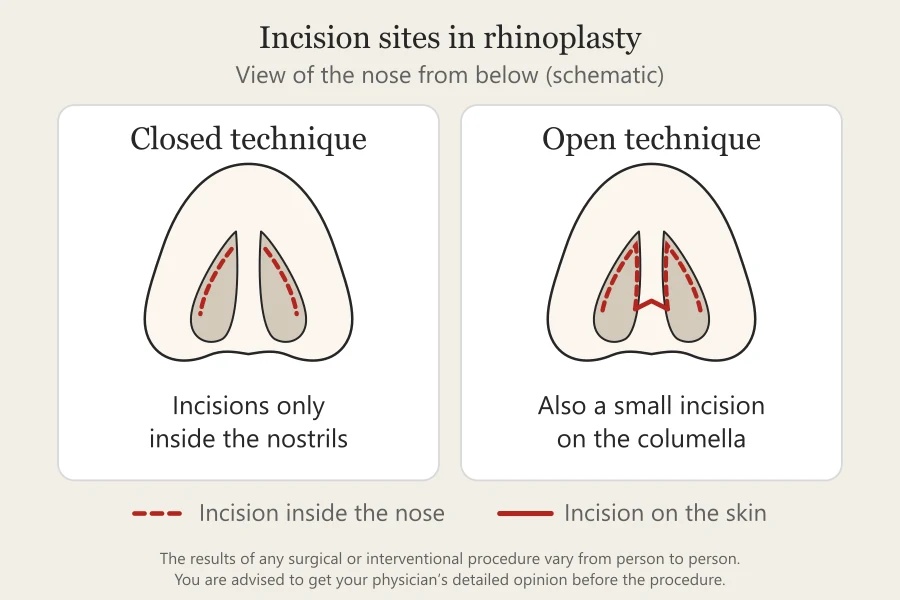 The results of any surgical or interventional procedure vary from person to person. You are advised to get your physician’s detailed opinion before the procedure.
The word “closed” describes only where the incisions are, not how much is done, so closed rhinoplasty is not a non-surgical treatment. It is an operation performed under general anaesthesia, and it can involve work on the bone, the cartilage or the septum.
What Can Be Corrected with the Closed Technique?
Where the anatomy is suitable, the main procedures that can be planned with this approach are:
- Reducing a hump: lowering the bony and cartilaginous bump on the bridge of the nose to straighten the profile.
- Narrowing the bridge: reshaping a bony framework that looks wide so that it is in proportion with the face.
- Limited tip corrections: lifting a slightly drooping tip or refining a slightly wide one. Surgery on the tip alone is described separately on the nose tip surgery (tipplasty) page.
- Easier breathing: correcting problems that make breathing difficult, such as a deviated septum or enlarged turbinates, in the same operation. An operation that combines cosmetic and functional correction in this way is called septorhinoplasty.
In suitable cases, approaches that preserve the bridge (preservation rhinoplasty) and shaping the bones with a piezo device can also be planned together with the closed technique. Which procedures you need, and whether they can be done with this technique, become clear at the examination.
Who Is a Good Candidate for Closed Rhinoplasty?
The closed technique is usually considered for people whose nose has a mild to moderate irregularity of shape and whose tip does not need to be rebuilt. The following can make it a suitable option:
- The bone and cartilage of your nose have finished developing (usually at the age of 17–18 or older)
- Your main concern involves limited changes, such as a hump or a slightly drooping or slightly wide tip
- The structure of your tip cartilages can largely be preserved
- If you have a breathing problem, its cause (a deviated septum or enlarged turbinates) can be corrected from inside the nose in the same operation
- You would rather not have an incision on the columella, and your anatomy allows this
- Your general health allows surgery, and your expectations are realistic
Skin thickness, the strength of the cartilage and the inner structure of the nose directly affect the choice of technique. That is why, of two people who come with similar concerns, the closed technique may suit one while the open technique may be the more appropriate choice for the other.
Disadvantages and Limits of Closed Rhinoplasty
Not needing an incision on the columella is an important advantage of this technique, but the approach also has limits that you should be aware of:
- Limited view: the tip cartilages cannot be seen in full in their natural position, as they can with the open technique; they are shaped through a limited opening. This makes fine adjustments to the symmetry of the tip more difficult.
- Less scope for extensive corrections: when the tip has to be rebuilt, when a lot of cartilage support (grafts) is needed, and in a markedly crooked nose or significant asymmetry, the open technique usually gives more control.
- Complex revisions: in noses that have been operated on before, the open technique is often preferred because of scar tissue and altered anatomy. You can find the details on the revision rhinoplasty page.
- Technical experience required: because it means working in a narrow space without seeing some of the structures, the result depends closely on the surgeon’s experience with this approach.
Whichever technique is chosen, thick nasal skin limits how refined the tip can become and can make the final shape take longer to emerge. If a structure that could not be foreseen at the examination is found during surgery, the plan may need to be extended, for example by switching to the open technique; this possibility is discussed with you before the operation.
Open or Closed Rhinoplasty?
Which technique is better is a question patients often ask, but there is no answer that applies to everyone. Both techniques can give a good result in the right patient; what decides is the structure of the nose, the extent of the change you want and your surgeon’s assessment. A 2022 systematic review of studies comparing the two techniques reported high patient satisfaction with both approaches and found that neither had been shown to be better than the other (Gupta et al., Archives of Plastic Surgery).
- Incision site: with the closed technique, the incisions are inside the nose only; the open technique adds a small incision across the columella.
- Surgeon’s view: limited and indirect with the closed technique; the open technique lets the surgeon see the cartilage and bone directly.
- When each is mainly used: the closed technique is mostly chosen for mild to moderate reshaping, the open technique for complex tip corrections, severely crooked noses and revisions.
- Early recovery: with the closed technique, swelling in the first weeks may be slightly less in some patients; the time it takes for the nose to reach its final shape is similar with both techniques.
You will find a table comparing the two techniques side by side on the rhinoplasty surgery page. Another point that often causes confusion is the piezo method: piezo is not an alternative to the open or closed technique but a way of shaping the bones with an ultrasonic device, and it can be planned together with either approach. For details, see the piezo rhinoplasty page.
How Is Closed Rhinoplasty Performed?
Consultation and Planning
At the first consultation, your concerns and expectations are discussed, and the inside of your nose is examined as well as its outward appearance. Skin thickness, cartilage support, the condition of the septum and the proportions of your face are assessed, and the plan is made using photographs taken from different angles. Before the operation, blood tests and an anaesthetic assessment are completed, and informed consent is obtained once the risks and the recovery have been discussed. At this stage you are asked about the medicines and herbal supplements you take; you may need to stop some of them for a while. Because smoking impairs healing, you are advised to stop for at least 2–3 weeks before and after the operation.
The Day of Surgery
Closed rhinoplasty is performed under general anaesthesia in a fully equipped hospital licensed by the Ministry of Health. Depending on what needs to be done, it usually takes 2–4 hours. The incisions are made inside the nostrils, and the hump, the bony framework, the tip and, if needed, the septum are shaped through them. At the end of the operation, a protective splint is placed over the bridge of the nose and, where needed, soft silicone packs are placed inside the nose. One night of observation in hospital is usually recommended.
Recovery After Closed Rhinoplasty
Recovery after this technique generally follows the same course as after other rhinoplasty operations, but it differs in a few respects. As there is no incision on the columella, there are no stitches to be removed from it and no wound on it to heal. Because less of the skin is lifted, swelling in the first weeks may be slightly less in some patients; the time it takes for the nose to reach its final shape, however, is similar to that of the open technique. The timings below are a general guide and vary from person to person:
- First 48 hours: keeping your head raised and applying cold compresses around the eyes help to reduce swelling. A blocked nose and slight blood-stained oozing are expected. For most patients the pain is mild to moderate and is controlled with the recommended painkillers.
- First week: swelling and bruising increase over the first few days and then begin to subside. The splint stays in place; do not press on it, and as a rule do not blow your nose for the first 2–3 weeks.
- Days 5–7: the splint and any packs inside the nose are usually removed around this time. The stitches inside the nose are mostly the dissolving kind.
- Days 10–14: most people can return to desk work and social life during this period; mild swelling and fading bruises may persist for a while longer.
- First 1–3 months: avoid strenuous exercise, saunas, steam rooms and direct sun for the first month; for contact sports, where the nose could take a knock, you may need to wait longer. Resting glasses on the bridge of the nose is generally not recommended for the first 2–3 months; contact lenses can be worn during this time.
- Months 3–6: most of the swelling goes down, and the nose comes close to its final shape.
- Months 6–18: the final shape usually becomes clear at 6–12 months; the fine swelling at the tip can take 12–18 months to resolve completely, especially with thick skin.
For day-by-day recovery and aftercare advice, see the rhinoplasty recovery guide.
Risks and Possible Complications
Like any surgical procedure, closed rhinoplasty carries risks. With this technique no incision is made on the columella; the risks that relate to the work done inside the nose, however, are broadly similar with both techniques:
- Risks related to anaesthesia, which are reviewed at the anaesthetic assessment before surgery
- Bleeding and, rarely, a collection of blood (haematoma), which may need further treatment
- Infection
- Temporary nasal blockage; rarely, lasting difficulty breathing
- Temporary numbness of the nose tip and upper lip, and a temporarily reduced sense of smell
- Rarely, a hole in the septum (perforation) in patients who have had the septum corrected
- Asymmetry, or a result that does not fully match your expectations
- The need for a second, corrective operation (revision)
Results vary from person to person; the same technique cannot be expected to give the same result in every nose. The risks that apply to you, given your general health, the structure of your nose and the procedures planned, are discussed in detail at the examination.
Travelling to Istanbul, Turkey, for Closed Rhinoplasty
Before you travel, you can send photos of your nose on WhatsApp for a preliminary assessment, and you receive the plan in writing. The examination and the operation plan are then made in person in Istanbul, the operation takes place in a fully equipped hospital licensed by the Ministry of Health, and your surgeon decides when you are fit to fly home; for rhinoplasty, a stay of about 6–7 nights is typical. Once you are home, follow-up continues with photo reviews on WhatsApp, and your medical records are given to you in English. To plan your visit, contact the practice.
Frequently Asked Questions about Closed Rhinoplasty
Does closed rhinoplasty leave a scar?
With the closed technique the incisions are inside the nostrils, so no incision scar forms on the columella or on the outer skin of the nose. The incisions inside the nose heal on the inner surface of the nostril and are usually not noticeable from the outside. There is one exception: if the nostrils are also to be made smaller, the small incisions at the base of the nostrils can leave a fine scar, whichever technique is chosen. These incisions are usually planned so that they are hidden in the natural crease where the nostril meets the face.
Is closed rhinoplasty a difficult operation?
For the patient, the anaesthesia and recovery are similar to those of the open technique, and in some patients the swelling in the first weeks may be a little milder. For the surgeon, however, it is technically more demanding, because it means working in a narrow space without seeing some of the structures directly. What matters most, therefore, is choosing the technique that suits the structure of your nose.
How long does the operation take, and will I need to stay in hospital?
Depending on what needs to be done, the operation usually takes 2–4 hours; it can take longer if work on the septum or turbinates is added. Because it is performed under general anaesthesia, one night of observation in hospital is usually recommended, and you go home the next day.
When does the swelling go down?
Bruising around the eyes and marked swelling mostly subside within the first two weeks. Most of the swelling goes down within 3–6 months; the fine swelling at the tip usually takes 6–12 months to resolve completely, and with thick nasal skin it can take 12–18 months. With the closed technique, early swelling may be a little milder in some patients, but the final shape takes about as long to settle as with the open technique.
Can the nose tip be corrected with the closed technique?
To a limited extent, yes. Lifting a slightly drooping tip or refining a slightly wide one can be planned with the closed technique. When the tip has to be rebuilt, a marked asymmetry corrected or the tip strengthened with cartilage support (grafts), the open technique usually gives more control. The structure of your tip cartilages is assessed at the examination.
Can a breathing problem be corrected at the same time?
If difficulty breathing is caused by a deviated septum or enlarged turbinates, these problems can be corrected from inside the nose in the same operation; an operation that combines cosmetic and functional correction like this is called septorhinoplasty. The cause of the breathing problem is identified by examining the inside of the nose. Some causes, such as allergies, are not corrected by surgery and may need separate treatment.
Will I have nasal packs after surgery?
Depending on the work done, and especially on whether the septum has been corrected, soft silicone packs with a central channel you can breathe through may be placed inside the nose at the end of the operation. They are usually removed together with the splint on days 5–7. While the packs are in place, a blocked feeling in the nose and a dry mouth from breathing through your mouth are normal; drinking plenty of fluids and keeping the air in the room humid make this period easier.
Can revision rhinoplasty be done with the closed technique?
Limited irregularities, such as a small remnant of the hump left after a previous operation, can in some cases be corrected with the closed technique. In complex revisions with extensive scar tissue, or where the tip has to be rebuilt or cartilage support is needed, the open technique is often more suitable. Before a revision is assessed, it is usually advisable to wait until the nose has settled into its final shape, which means at least a year.
What determines the cost of closed rhinoplasty?
The fee depends on the scope of the operation (cosmetic correction alone, or work on the septum and turbinates as well), whether cartilage support is needed, the technique chosen, the length of the operation, the anaesthesia and the length of the hospital stay. The fee is therefore set after the examination, once your personal treatment plan is clear. You can find the factors that affect the fee in detail on the rhinoplasty cost page.
Consultation and Appointments
Whether the closed technique is right for you can only be determined at a face-to-face examination. At his practice in Teşvikiye, Şişli, Istanbul, Op. Dr. Ayberk Akçay, specialist in aesthetic, plastic and reconstructive surgery, assesses the inner and outer structure of your nose and works out with you which technique suits you, what its possible limits are and what your recovery will involve. He is a Fellow of the European Board of Plastic, Reconstructive and Aesthetic Surgery (EBOPRAS) and a full member of the Turkish Society of Plastic, Reconstructive and Aesthetic Surgeons; you can read more about his training and memberships. To book an appointment, get in touch through the contact page.