
“Almond eye surgery”, also called fox eye surgery, is a popular name for procedures that aim to give the eyes a more lifted, almond-shaped appearance by moving the outer corner of the eye and the outer end of the eyebrow (the brow tail) slightly upwards and outwards; in medicine, the name does not refer to a single operation. There are three ways to aim for this look: with dissolvable threads placed under the skin (the effect is temporary); with a temporal lift or brow lift, which raises the brow tail and the tissues of the temple; or with surgery on the outer corner of the eye (lateral canthopexy or canthoplasty). Which of these suits you is decided at the examination, based on the structure of your own eyes and brows; this structure also sets the limit of the change that can be achieved, and results vary from person to person.
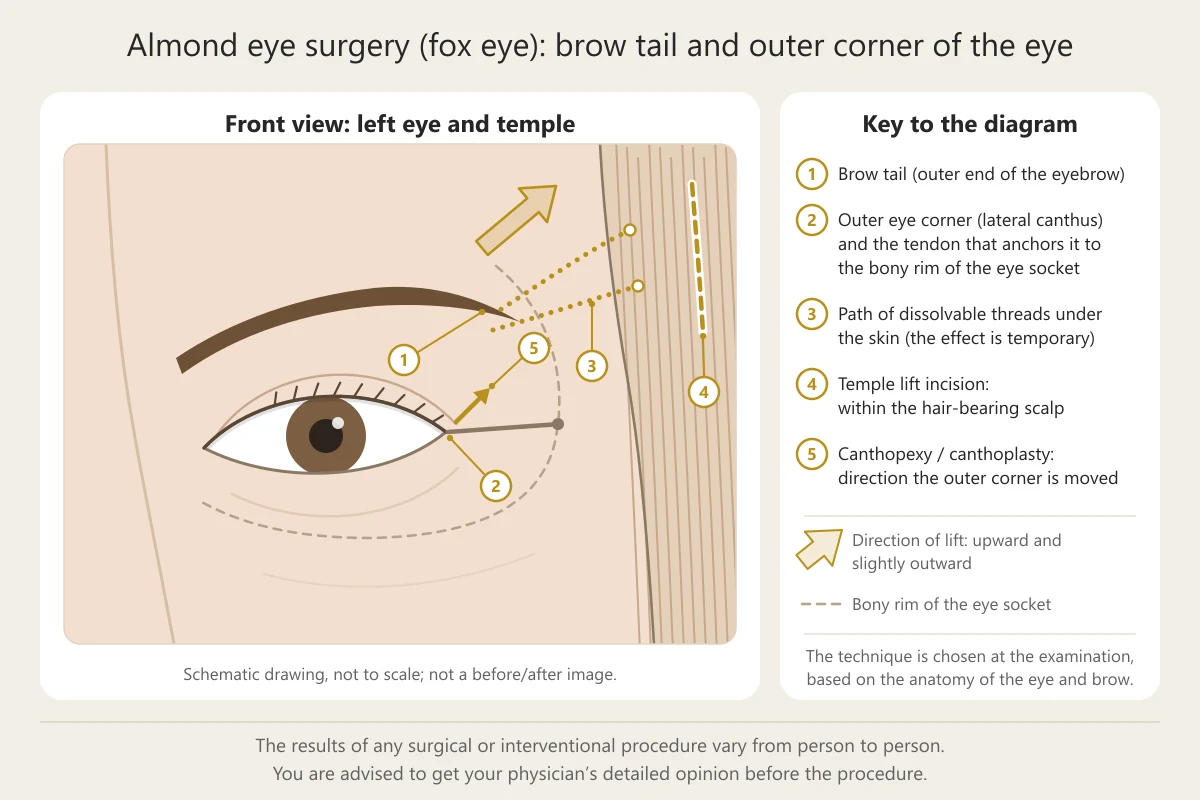 The results of any surgical or interventional procedure vary from person to person. You are advised to get your physician’s detailed opinion before the procedure.
What is almond eye (fox eye) surgery?
“Almond eyes” describes an elongated eye shape that tilts slightly upwards, with the outer corner sitting a little higher than the inner corner; such eyes are also popularly called upturned eyes, cat eyes or fox eyes. The name “fox eye”, which spread on social media, usually describes a look in which not only the eye corner but also the brow tail is lifted towards the temple. The same name is also used for a make-up and eyelash style; this page is about medical procedures on the tissues around the eye.
These procedures target two separate areas: the brow tail and temple, and the outer corner of the eye (the lateral canthus). The outer corner is the point where the upper and lower eyelids meet; it is held in place by a tendon (the lateral canthal tendon) that attaches the eyelids to the bony rim of the eye socket. Methods that lift the brow or the temple do not touch this tendon; they change the look of the eye corner indirectly, by moving the surrounding tissues upwards. Surgery on the outer corner, by contrast, changes the position of this tendon directly.
What is an almond eye shape, and what determines the shape of the eyes?
An almond eye shape is the name given to eyes that resemble an almond: wider in the middle, narrowing towards the inner and outer corners, with the outer corner sitting a little higher than the inner one. The shape of the eye, however, does not depend on a single structure; at the examination, the following features are assessed together:
- The bony structure of the eye socket, and how much the cheekbone supports the area beneath the eye.
- The position of the eyeball within the socket, that is, how far forward the eye sits.
- How firm the eyelids are, and the current height of the outer corner.
- The position of the brow, and how far the brow tail has dropped.
- The thickness and elasticity of the skin.
Eyes that are naturally upturned or round are part of inherited and ethnic features, not a flaw that needs correcting. The aim of these procedures is not to copy someone else’s eye shape, but to make a measured change in line with what you want, while keeping your own facial features.
How is almond eye surgery done? The three approaches compared
Although the three approaches are often mentioned as if they were interchangeable, they act on different structures, and their effects last for different lengths of time. The table below gives a general overview; the details are explained in the sections that follow.
| Feature | Dissolvable threads | Temporal lift / brow lift | Canthopexy / canthoplasty |
|---|---|---|---|
| What does it change? | Gives limited upward support to the brow tail and the tissue at the side of the eye, from beneath the skin | Moves the brow tail (the whole brow in a brow lift) and the temple tissues upwards and slightly outwards; does not touch the structure of the eye corner | Changes the position of the outer eye corner and the support of the lower eyelid; does not lift the brow |
| Anaesthesia | Local anaesthesia | Local anaesthesia with sedation, or general anaesthesia | Usually local anaesthesia with sedation; general anaesthesia when combined with another operation |
| Recovery | Usually a few days | Usually 1–2 weeks | Usually 1–2 weeks |
| How long the effect lasts | Temporary; usually a few months | Usually many years | A long-lasting, structural change |
| Main risks | A thread that can be seen or felt, dimpling of the skin, asymmetry, infection, a thread shifting out of place | Reduced sensation in the scalp, hair loss around the incision, asymmetry, an over-pulled look | The lower eyelid being pulled down, the white of the eye showing along the lower edge, dry eye, a scar or a change of shape at the corner, asymmetry, the need for a correction |
In the look known as “fox eye”, both the brow tail and the outer corner often play a part. That is why the examination first works out which structure creates the look you want; for some people, one approach is enough, while for others, two need to be planned together.
Dissolvable threads (fox eye thread lift)
This non-surgical treatment, known as almond eye threads or the fox eye thread lift, uses fine threads that dissolve over time and carry tiny barbs that help them grip the tissue. After the area has been numbed with local anaesthesia, the threads are placed under the skin through small entry points at the temple or within the hairline and guided towards the brow tail; the tissues are then lifted gently in the planned direction, and the two sides are compared. No incision is made; the entry points usually do not need stitches, and the treatment usually takes 30–60 minutes. Thread lifts in other areas of the face are explained on the thread lift (thread facelift) page.
What threads can and cannot do
- What they can do: Hold a slightly dropped brow tail and the side of the eye higher for a while, giving the eyes a subtle lift.
- What they cannot do: Remove excess eyelid skin, get rid of under-eye bags, correct a markedly drooping brow or change the structure of the outer eye corner.
- They do not replace surgery: They do not give the same effect, or the same duration, as surgical procedures that release the tissues and fix them in their new position.
The effect is temporary. Depending on their type, the threads dissolve within months; the lifting effect, however, often fades before then, usually within a few months. Because the brow and the side of the eye move constantly with the muscles of facial expression, the effect here may not last as long as with thread treatments in the lower part of the face.
Temporal lift and brow lift
What gives the side of the eye a tired or droopy expression is often a brow tail that has dropped. In a temporal lift (temple lift), the tissues are reached through incisions within the hair-bearing scalp of the temple, moved upwards and slightly outwards and fixed in place; the outer end of the brow rises, and the side of the eye may also look more open and slightly lifted. If the whole brow and the forehead have dropped too, a brow lift, which raises the entire brow, is considered.
Because these operations do not touch the eyelids or the structure of the outer corner, a temporal lift on its own may not give the look you expect if the outer corner naturally slopes downwards or the lower eyelid is lax. The steps of each operation and the recovery timeline are explained in detail on the linked pages.
Canthoplasty and canthopexy: surgery on the outer corner of the eye
When people talk about “almond eye surgery” or “cat eye surgery”, this is usually the operation they mean. The aim is to fix the tendon that holds the outer corner a little higher on the bony rim of the eye socket, so that the outer end of the eye opening tilts slightly upwards. The same techniques are not used only for cosmetic reasons: they are also used to support a lower eyelid that has become lax or been pulled down, and as part of lower eyelid surgery.
Canthopexy vs canthoplasty: what is the difference?
- Canthopexy: The tendon at the outer corner is tightened with stitches, without being detached, and anchored higher up to the membrane covering the bone (periosteum). The change is more limited; the natural angle of the corner is largely preserved.
- Canthoplasty: The tendon is released from where it attaches to the bone, shortened if necessary and fixed again in its new position. A more noticeable change is possible; however, because the corner is reconstructed, risks such as a change in the shape of the corner are also greater.
Which technique is chosen depends on the current position of the outer corner, how firm the lower eyelid is and how much change is intended. Because the two terms are often used interchangeably online, it is a good idea to ask clearly at the examination which one is planned for you.
How is the operation performed?
- Examination and planning: The height of both outer corners, how firm the lower eyelid is, how far forward the eyeball sits, the position of the brow and the health of the eye surface are assessed; photographs are taken from different angles.
- Preparation: Medicines and herbal supplements that thin the blood are stopped under your doctor’s supervision; if you smoke, you are asked to stop at least 2 weeks before the operation. If you wear contact lenses, it is advisable to have glasses ready for the period after surgery.
- Anaesthesia: The operation is performed in a fully equipped hospital licensed by the Ministry of Health. When it is done on its own, local anaesthesia to numb the area is usually combined with sedation (a light sleep); when it is planned together with another operation, general anaesthesia may be preferred.
- Incision: A small incision is made in a natural crease line at the outer corner or at the outer end of the upper eyelid crease; when the operation is combined with lower eyelid surgery, the same incision can be used.
- Fixation: Using the planned technique, the outer corner tendon is anchored to the membrane covering the bone in its new position, usually with non-dissolvable stitches; the two sides are compared to check symmetry.
- Closure and going home: The skin is closed with fine stitches. Most patients go home the same day after a short period of observation; if you had sedation, someone should accompany you home, and you should not drive that day.
On its own, the operation usually takes about 1 hour; it takes longer when combined with another procedure, such as eyelid surgery or a temporal lift.
Realistic expectations: the limit is set by your own eye structure
Whichever method is chosen, how much change is possible is determined by your bone structure, the position of the eyeball and how firm the eyelid tissues are. The change at the outer corner is usually a matter of millimetres; the shape of the eye does not change completely, and the result will not look like someone else’s eyes or a filtered photo.
- An over-pulled look: If the brow tail or the outer corner is lifted more than necessary, the expression can look harsh, surprised or artificial. An exaggerated tilt at the outer corner can create an unnatural “cat eye” look, and by disturbing the way the lower eyelid sits against the eye, it can also put strain on the eye surface.
- How it looks in the first weeks: Because of swelling, and because the tissues have not yet settled, the side of the eye may look more lifted or tighter than intended in the first weeks; you need to wait before judging the final appearance.
- Asymmetry: There are small differences between the two eyes and the two brows even before the procedure; these differences can remain afterwards.
This is why the amount of lift is planned with restraint: the aim is not to change your face but to make a change in keeping with your own features. The same method does not give the same result in two different people; at the examination, what is realistically possible for your face is discussed openly.
Who is a good candidate, and who should wait?
Whether you are suitable is assessed once it has been established which structure lies behind the change you are looking for. These procedures are usually considered for:
- People whose brow tail sits low and who have a tired expression at the side of the eye (mostly a temporal lift or brow lift).
- People whose outer eye corner slopes downwards or whose lower eyelid has become lax (outer corner surgery).
- People who do not want surgery and are happy with a subtle, short-lived change (dissolvable threads, on the understanding that the effect is temporary).
- People whose facial development is complete, whose general health is suitable for the procedure and whose expectations are realistic.
When a detailed assessment or postponement may be needed
- Dry eye: If you are being treated for dry eye, or have recently had laser treatment or another operation on your eyes, the eye surface is assessed first, and an ophthalmologist’s opinion is sought if necessary.
- Previous eyelid surgery: The amount of skin removed in earlier operations and the scar tissue that has formed can make it more likely that the lower eyelid is pulled down; the plan takes this into account.
- A lax lower eyelid and prominent eyes: In people whose lower eyelid is markedly lax, or whose eyeballs are noticeably prominent with the cheekbones set further back, lifting the outer corner can make the lower eyelid slip downwards; for them, a cosmetic lift is planned more cautiously or may not be recommended.
- Thyroid eye disease: While eye symptoms related to Graves’ disease are active, cosmetic procedures around the eyes are postponed; the disease needs to settle first, and the decision is made together with the doctor treating it.
- If the problem is in the eyelids: Excess skin folding over the upper eyelid, or under-eye bags, cannot be corrected with threads or with outer corner surgery; in that case, eyelid surgery (blepharoplasty) is considered.
- Unrealistic expectations: If you are hoping for a change that the structure of your eyes does not allow, or if worries about your appearance noticeably affect your daily life, these issues are discussed in detail before any decision on a procedure.
- General health: Uncontrolled high blood pressure, diabetes or a bleeding or clotting disorder, blood thinners that cannot be stopped and smoking that cannot be given up are assessed separately; cosmetic procedures are postponed during pregnancy and breastfeeding.
Risks and possible complications
Like any surgical or interventional procedure, these methods carry risks, and the risks differ from one method to another. Choosing the right method, measured planning and following the aftercare instructions reduce the risks but do not eliminate them completely.
Risks of dissolvable threads
- Swelling, bruising, tightness and a pulling sensation when you move your face; these usually ease within days.
- A thread that shows through the skin or can be felt with the fingers; this is more likely in thin skin.
- Dimpling or an indentation in the skin; this usually softens in the first weeks.
- Asymmetry between the two sides, or less change than expected.
- Infection; rarely, a firm lump forming around a thread (granuloma).
- A thread shifting out of place, or its end poking out through the skin; in that case, the thread has to be removed.
- Temporary changes in sensation or hair loss at the entry points; rarely, injury to the branch of the facial nerve that crosses the temple, or to blood vessels.
Risks of a temporal lift and brow lift
Swelling, bruising and temporary numbness of the scalp are common. Less common are hair loss around the incision (mostly temporary), asymmetry between the two sides, a brow tail that ends up higher or lower than planned, and an over-pulled look caused by tightening the tissues too much. Bleeding, infection and weakness of the facial nerve branch that moves the forehead (mostly temporary) are also among the rare risks of these operations.
Risks of canthoplasty and canthopexy
- Expected, temporary effects: Swelling, bruising and tightness at the outer corner; a gritty feeling, watering and sensitivity to light in the first weeks.
- A change in the position of the lower eyelid: The edge of the lower eyelid may be pulled down, the white of the eye may become visible along the lower edge (scleral show) or the eyelid may turn outwards. Mild cases can improve with follow-up and care; some need corrective surgery.
- Long-lasting dry eye: Dryness and irritation can last for months in some people, can rarely be permanent and may need long-term treatment with eye drops.
- A change in the shape of the corner: The sharp angle of the outer corner can become rounded, or a thin web of skin can form over the corner; these changes can be difficult to reverse completely.
- Scarring: In some people, the scar at the outer corner can remain more visible than expected, thick or a different colour.
- Asymmetry, under-correction or over-correction: A difference may remain between the two corners; the change may be smaller or greater than expected.
- Need for revision: Some of these problems may need a further operation.
- Rare but serious risks: Bleeding, infection, irritation of or a wound on the surface of the eye (the cornea), complications related to anaesthesia and, very rarely, conditions that can threaten eyesight, such as bleeding collecting behind the eye.
Smoking, uncontrolled chronic illnesses and not following the aftercare instructions can make some of these risks more likely. Your possible risks are assessed individually at the examination and discussed openly with you.
Recovery: what to expect with each method
Recovery varies from person to person and with any procedures done at the same time. The times below are a guide; your personal timeline is given to you after the procedure.
| Topic | Dissolvable threads | Temporal lift | Canthopexy / canthoplasty |
|---|---|---|---|
| Swelling and bruising | Noticeable in the first 2–3 days; usually largely gone within 1–2 weeks | Noticeable in the first 2–3 days; most of it usually settles in weeks 2–3 | Usually reduces markedly within 1–2 weeks; firmness at the outer corner can last a few weeks |
| Stitches | Usually not needed | Usually removed in week 1, or dissolvable stitches are used | Usually removed within the first week, or they dissolve on their own |
| Return to work and social life | Most people return within 1–3 days | Most people return at the end of the first week | Desk work usually within 7–10 days; social life mostly in the second week |
| Sport and strenuous exercise | Usually after 1–2 weeks | With your doctor’s approval, usually after 4–6 weeks | Usually after 4–6 weeks |
| Final appearance | The tightness and the extra lift of the first days ease; the appearance usually settles within 3–4 weeks | The tissues usually settle into place within 1–3 months | Usually becomes clear within 3–6 months |
Aftercare in the first weeks
- Sleep on your back with your head raised on a few pillows; in the first days, apply cold compresses as your doctor has explained.
- Do not rub, press or massage the treated area; after a thread treatment, avoid exaggerated facial expressions for the first 2–3 weeks, and avoid sleeping face down or on your side for the first week.
- After outer corner surgery, use the prescribed drops and ointments regularly; do not wear contact lenses for the first two weeks, and start wearing eye make-up again only with your doctor’s approval, usually after the second week.
- Stay away from hot environments such as saunas, Turkish baths (hammams) and sunbeds for the first weeks; protect the incision sites from the sun, and wear sunglasses outdoors.
- Avoid smoking and alcohol, and do not miss your follow-up appointments.
Symptoms to report to your doctor straight away
- Rapidly increasing swelling or tightness on one side, or pain that does not respond to medication.
- A fever; increasing redness, warmth or discharge at the treated site.
- An eye that does not close fully, together with increasing redness, a gritty feeling or sensitivity to light.
- The end of a thread showing through the skin, or increasing pain and redness along a thread.
Reduced vision, new double vision or severe pain in the eye is an emergency: contact your doctor without delay, and if you cannot reach them, go to the nearest emergency department.
What affects the cost?
The fee is not the same for everyone; it is set once the method and plan that suit you have been confirmed at the examination. The main factors are:
- The method chosen: dissolvable threads, a temporal lift or brow lift, canthopexy or canthoplasty.
- Whether the procedure is done on its own or in the same session as another procedure, such as eyelid surgery.
- The type of anaesthesia (local anaesthesia, sedation or general anaesthesia), the length of the procedure and the hospital setting.
- For a thread treatment, the number of threads used, and the fact that it may need repeating later because the effect is temporary.
- Follow-up visits and the medicines used during recovery.
You can send any questions about the fee through the channels listed on the contact page.
Travelling to Istanbul, Turkey, for almond eye surgery
Before you travel, you can send photos on WhatsApp for a preliminary assessment, and the plan is given to you in writing; to get started, contact the practice. In Istanbul, you are examined in person and the treatment plan is made with you; operations take place in a fully equipped hospital licensed by the Ministry of Health, and your doctor decides when you are fit to fly home. The length of your stay depends on the procedure and is confirmed in your written plan before you book flights. After you return home, follow-up continues with photo reviews on WhatsApp, and your medical records are given to you in English.
Fox Eye and Canthoplasty: Frequently Asked Questions
Is a fox eye lift permanent?
It depends on the method. The lift achieved with dissolvable threads is temporary; a temporal lift and outer corner surgery, on the other hand, give a long-lasting effect because they change the position of the tissues surgically. Even so, no method stops ageing: the tissues around the brows and eyes keep changing over the years, and an outer corner raised by surgery can also drop somewhat over time. How well the effect is maintained varies from person to person, depending on skin type, age and factors such as sun exposure and smoking.
Do the eyes go back to how they were once the threads dissolve?
As the threads dissolve, the lifting effect fades, and the brow tail and the side of the eye gradually move back towards where they were before the treatment; the slight firming the threads leave in the tissue contributes little to the appearance. Once the effect has faded, the treatment can be repeated; the right time for a repeat is decided at an examination. Bear in mind, too, that each repeat carries the same risks, and that scar tissue forming under the skin could make a possible future operation more difficult.
Can botulinum toxin or fillers create a fox eye look?
To a limited extent. Botulinum toxin injected into the outer part of the ring-shaped muscle around the eye, the part that pulls the outer end of the brow down, relaxes this muscle temporarily and can lift the brow tail slightly; the effect lasts a few months, and if the injection points are not planned correctly, it can cause a temporary droop of the brow or eyelid. Filler injected into a hollow temple can support the brow tail indirectly; however, the temple is an area that calls for care because of the risk of a blocked blood vessel, which is rare but can have serious consequences. Both treatments are temporary and do not change the position of the eye corner.
Will there be a scar after surgery?
Any procedure that involves cutting the skin leaves a permanent scar; what matters is where the scar is placed. In a temporal lift and a brow lift, the incisions lie within the hair-bearing scalp, but they can be more visible in people with thin hair. In outer corner surgery, the scar is planned to lie within the natural lines of the corner; it looks pink in the first weeks and, in most people, fades and becomes finer over the months. A thread treatment leaves only needle entry points; these are very small and can, rarely, leave a small scar or a change in skin colour.
Will I feel pain during the procedure?
While the area is being numbed with a fine needle, you may feel a brief stinging and burning; once the numbness has set in, pain is not expected, although you may feel some pulling and pressure. If you think you will be anxious, sedation can put you into a light sleep during surgical procedures. Any tightness and mild pain in the following days usually eases with prescribed painkillers; after a thread treatment in the brow area, this tightness may be felt more strongly than after treatments in the lower part of the face.
At what age can almond eye surgery be done?
As cosmetic procedures, these are planned for adults; 18 is generally accepted as the lower age limit. There is no particular upper age limit; however, because changes such as a drooping brow, lax eyelids and excess eyelid skin are added with age, several procedures may need to be planned together rather than a single method. The decision depends more on the structure of the eye area and on your general health than on age.
Can men have almond eye surgery?
Yes; suitability is assessed by the same criteria in men. In a male face, the brows usually sit flatter and lower; because lifting the brow tail or the outer corner markedly can make the expression look artificial and feminine, the change is planned with more restraint. In men with a receding hairline or thin hair, how visible the temple incisions and the thread entry points would be is also assessed.
Will my eyes feel dry after surgery?
Dryness and a gritty feeling are common, especially in the first weeks after outer corner surgery: when the outer corner is re-anchored, the tension of the eyelids and the way you blink change for a while. These complaints are usually temporary; the lubricating drops and ointments used during this period protect the surface of the eye. In people who had dry eye complaints before surgery, the dryness can last longer or get worse, which is why the eye surface is assessed before a decision on surgery is made.
What if I don’t like the result, or my eyes look too pulled?
First, the tissues are given time to settle; a few months usually need to pass before a correction is decided on. After a thread treatment, if excessive tightness or pulling does not go away, the thread may need to be loosened or removed. After surgery, a further operation can be planned for remaining asymmetry or for too little or too much lift; however, because the tissues have changed after the first operation, a correction is more difficult, and each correction carries its own risks.
Can it be done at the same time as eyelid surgery?
In suitable patients, yes. If the upper eyelid skin folds over the eye or there are bags under the eyes, eyelid surgery, and if the brow tail is also low, a temporal lift, can be planned in the same session as outer corner surgery. In that case, general anaesthesia may be needed; the length of the operation and the recovery timeline are determined by the more extensive procedure. Which procedures are combined is decided at the examination, also taking your general health into account.
Consultation and appointments
At the examination, the structure of your eyes and brows, the health of your eye surface and your expectations are assessed together; you discuss with the doctor which method could achieve the change you want, to what extent, and in which situations a procedure is not advisable. It can be useful to ask these questions at the consultation:
- In my face, is the look I want determined by the brow tail or by the outer corner of the eye?
- Which method do you recommend? If outer corner surgery is planned, is it a canthopexy or a canthoplasty?
- How long will the effect last? Might I need a repeat or an additional procedure?
- What is my risk of dry eye, or of the lower eyelid being pulled down?
- When can I go back to work and sport, and start wearing contact lenses again?
Results vary from person to person; the purpose of the examination is to establish whether one of these procedures is right for you. Op. Dr. Ayberk Akçay is a plastic, reconstructive and aesthetic surgeon, a Fellow of the European Board of Plastic, Reconstructive and Aesthetic Surgery (EBOPRAS) and a full member of the Turkish Society of Plastic, Reconstructive and Aesthetic Surgeons; his practice is in Teşvikiye, Şişli, Istanbul. You can read about his training and memberships, and to book an appointment at the practice in Istanbul, please get in touch through the contact page.