
Tip rhinoplasty (tipplasty) is an operation that aims to change only the shape, direction and support of the nose tip, without touching the nasal bones or the bridge of the nose. The cartilages that form the tip are reshaped with stitches and, where needed, supported with small pieces of the patient’s own cartilage (grafts). The operation can be planned to lift a drooping tip, to refine a wide or round tip and to reduce asymmetry. It is also widely known as nose tip surgery or a nose tip lift.
On this page you will find when surgery on the tip alone is enough, what is usually done for each concern, what recovery involves and the possible risks. Results vary from person to person; the plan that is right for you is decided after a face-to-face examination.
What Is Tip Rhinoplasty (Tipplasty)?
The upper third of the nose is made of bone and the lower part of cartilage. The shape of the tip comes largely from the two tip cartilages, one on each side (the lower lateral cartilages). The part of each cartilage that curves round at the tip determines how wide and how defined the tip is; the outer part, which extends into the sides of the nostrils, affects the volume of the tip and supports the entrance to the nostrils; and the part inside the columella (the strip of tissue between the nostrils) contributes significantly to supporting the tip. The front edge of the septum (the wall that divides the inside of the nose in two) and the skin that covers the tip also affect how it looks.
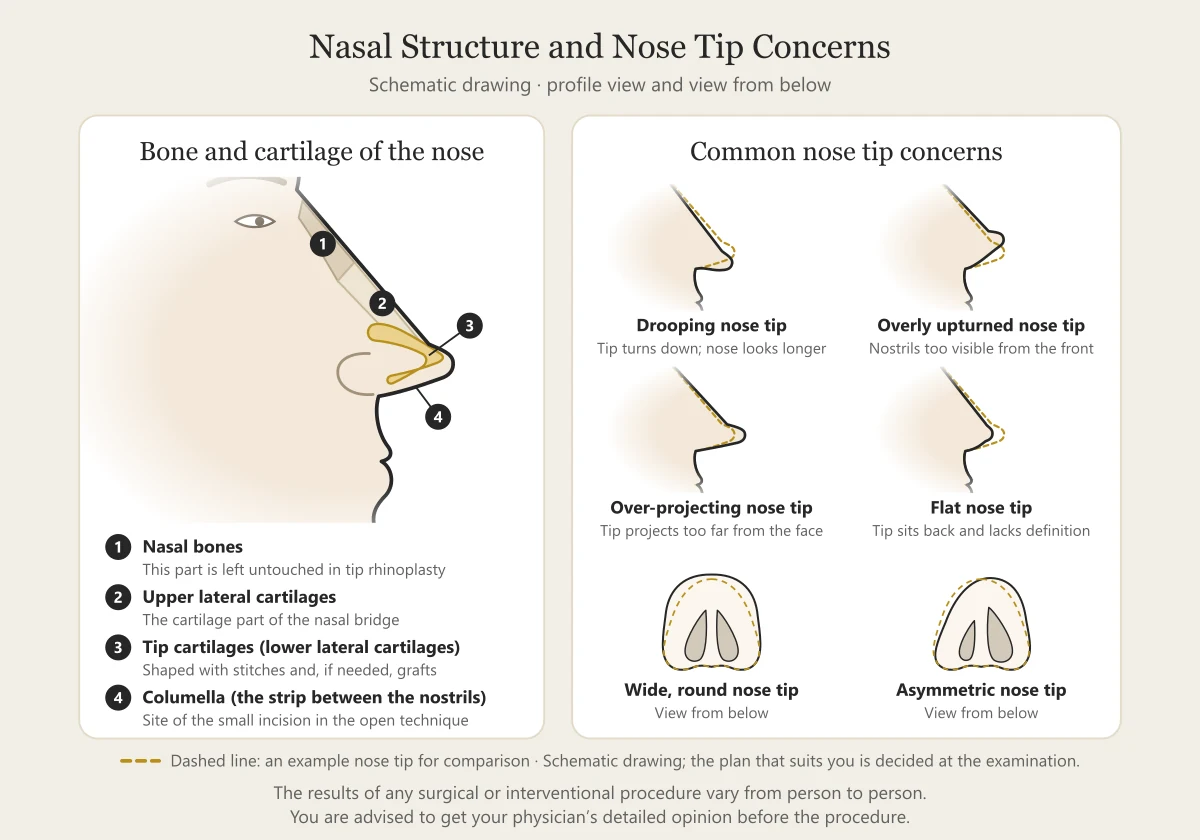 The results of any surgical or interventional procedure vary from person to person. You are advised to get your physician’s detailed opinion before the procedure.
In tip rhinoplasty the bones are not touched; the changes are made to these cartilages and the soft tissue around them. The operation can change how upturned the tip is (its rotation), how far it projects from the face, how wide it is and how defined it looks, and it can improve the balance between the two sides. The planning follows the same principles as a rhinoplasty of the whole nose.
Tip Only or the Whole Nose: Which Do I Need?
Tip surgery can be enough for people whose concern lies only in the lower part of the nose, while the bridge and the bony upper part of the nose already suit the face. In the following situations, however, a rhinoplasty that covers the whole nose is often needed:
- A noticeable hump on the bridge of the nose
- Wide nasal bones, or nasal bones that have become crooked after an injury
- A nose that, as a whole, looks too large or too long for the face
A deviated septum or enlarged turbinates (the ridges of tissue on the inner walls of the nose) that make breathing difficult can be corrected in the same session as the tip; if the deviated septum also makes the nose look crooked from the outside, the whole nose is often treated. The tip and the bridge also affect each other’s appearance. A drooping or flat tip can give the impression of a bigger hump on the bridge than there really is, and this impression may lessen once the tip is supported. Sometimes, on the other hand, a small adjustment to the bridge is needed so that the change at the tip looks in harmony with the face. For this reason, the extent of the operation is decided after the nose has been assessed from the front, from the side and from below. For surgery on the whole nose, see the rhinoplasty (nose job) page.
Which Nose Tip Problems Can Be Corrected?
The table below summarises common concerns and what is usually done for each; most noses have more than one of these at the same time.
| Concern | Common causes | What is usually done? |
|---|---|---|
| Drooping (sagging) tip | Weak cartilage support, long cartilages, thick and heavy skin, loss of support with age | The cartilages are repositioned with stitches; if needed, the tip is strengthened with cartilage support (a graft) |
| Tip that drops when you smile | A small muscle that pulls the tip down when you smile, weak tip support | The tip support is strengthened; in suitable cases this muscle is released during the operation |
| Wide or round (“bulbous”) tip | Wide or strongly curved cartilages, thick skin | The cartilages are narrowed with stitches; if needed, a limited amount of cartilage is removed |
| Asymmetric tip | Cartilages that differ in shape or position on the two sides, a bend in the front edge of the septum | The cartilages are balanced; any deviation of the septum is corrected in the same operation |
| Over-projecting tip (sticks out too far) | Long cartilages, a long front section of the septum | The tip is set back by shortening the cartilages and the front edge of the septum |
| Flat, poorly defined tip | Small or weak cartilages, thick skin | The tip is given more definition with cartilage supports (grafts) |
| Overly upturned tip | A naturally short nose, or a previous nose operation | The tip is turned downwards, usually with the open technique and strong cartilage supports; if it follows a previous operation, it is planned as a revision |
The approaches in the table are general tendencies; which steps you need is decided at the examination.
Why Does the Nose Tip Droop?
A drooping tip is one that turns downwards, which makes the nose look longer in profile. In some people this is due to cartilages that are long or weak from birth. With age, the ligaments and cartilage support that hold the tip up become weaker, and thick, heavy skin can also pull the tip down over time. In people who have had nose surgery before, the tip can droop if its support is insufficient. In the first weeks after an operation, on the other hand, the tip is expected to look more upturned because of swelling and to settle into place as the swelling goes down; this is not the same as drooping.
Why Does My Nose Tip Drop When I Smile?
In some people the tip moves noticeably downwards when they smile, and the upper lip shortens. The main cause is a small muscle that runs from the upper lip area to the base of the columella (the depressor septi nasi); weak tip support makes this movement more visible. This is why the tip is assessed at the examination both at rest and while you smile. If needed, this muscle is released or repositioned during the operation and the tip support is strengthened. The movement does not always disappear completely; the aim is to reduce the drop noticeably.
How Is Tip Rhinoplasty Performed?
Consultation and Planning
At the first consultation, your concerns and expectations are discussed, your nose is examined from the front, from the side and from below, and photographs are taken from different angles. Planning looks particularly at the following points:
- Skin thickness: With thick, oily skin there is a limit to how much the tip can be refined, and swelling lasts longer. With thin skin, on the other hand, small irregularities in the cartilage may become visible from the outside over time.
- Cartilage strength: Pressing gently on the tip shows how strong its support is; the size and shape of the cartilages and any differences between the two sides are also examined. If the tip is weak, the possible need for a graft is discussed.
- Breathing: The septum and the turbinates are examined. A deviation that narrows the airway can be corrected in the same operation; the septum is also the main source of the cartilage used for grafts.
- Harmony with the face: How much the tip is lifted is decided according to the angle between the nose and the upper lip (the nasolabial angle), the lips and the chin. This angle is usually planned at around 90–95 degrees in men and slightly wider in women; lifting the tip more than necessary can leave the nostrils too visible from the front.
The nose must have finished growing; this point is usually reached at around 17–18 in women and around 18 in men. A digital simulation makes it easier to talk about the goal, but it is not an exact preview of the result. Before the operation, blood tests and an anaesthetic assessment are carried out, and you are advised to stop smoking for at least a few weeks before and after surgery. If you have ever had filler injected into your nose, mention this at the examination.
Reshaping and Supporting the Cartilages
The principle of tip rhinoplasty is to reshape and support the cartilages rather than remove large amounts of them:
- Suture techniques: The cartilages are narrowed and repositioned with special stitches and fixed to each other or to the septum. Lifting a drooping tip and refining a wide tip are mostly done in this way.
- Limited cartilage reduction: In a very wide tip, part of the cartilage can be trimmed, but enough is left to carry the tip. Removing too much cartilage can, over time, cause the tip to collapse, give it a pinched look and make breathing difficult.
- Cartilage support (grafts): Small pieces prepared from the patient’s own cartilage are used to strengthen the tip, give it more definition or hold it in its new position. The graft is mostly taken from the septum; if the septum does not provide enough, ear cartilage may be considered.
- Additional steps: Releasing the muscle that pulls the tip down when you smile, correcting a deviated septum or narrowing wide nostrils can be added to the same operation when needed.
Because the bones are not touched, the piezo (ultrasonic) instrument used to shape bone is usually not needed either.
Open or Closed Technique?
The tip can be reached through incisions inside the nostrils (closed technique) or, in addition, through a small incision across the columella (open technique). Limited corrections, such as lifting a slightly drooping tip or refining a slightly wide one, can be planned with the closed technique in suitable noses; in that case no incision is made in the outer skin of the nose. When the tip needs to be rebuilt, a marked asymmetry corrected or the tip strengthened with grafts, the open technique, which lets the surgeon see the cartilages directly, usually gives more control. With the open technique, the scar from the small incision on the columella usually becomes inconspicuous within 6–12 months. To find out who the closed technique suits and where its limits lie, see the closed rhinoplasty page.
The Day of Surgery
The operation is performed in a fully equipped hospital licensed by the Ministry of Health, usually under general anaesthesia; the type of anaesthesia is decided together with the anaesthetist, taking into account the extent of the operation and your health. An operation on the tip alone often takes less time than a rhinoplasty that reshapes the whole nose, which usually takes 2–4 hours; taking cartilage from the septum or working on the airway adds to the time. At the end of the operation the tip is protected with tape and, if needed, a small splint; if the septum has been operated on, soft silicone packs with a central channel you can breathe through may be placed inside the nose. After general anaesthesia, one night in hospital for observation is usually recommended.
Non-Surgical Nose Tip Lift: Filler Versus Surgery
For a slight droop, nose filler (non-surgical rhinoplasty) placed at the right points can help the tip look more lifted for a while. Filler only adds volume, though: it cannot make the tip smaller or narrower, cannot reshape the cartilages and does not improve breathing. Its effect is temporary; the body gradually breaks the filler down and the treatment has to be repeated. The nose is an area that calls for particular care with fillers because of the risk of blocking a blood vessel; although rare, skin wounds and tissue loss have been reported and, very rarely, loss of vision. For this reason, the treatment should only be performed by a doctor.
If your tip drops when you smile because of the muscle described above, relaxing it with botulinum toxin may be a temporary option for some people; the effect lasts a few months and has to be repeated. There is no scientific evidence that nose tip lifting devices or exercises change the shape of the cartilages. Whether a non-surgical treatment is suitable for you is also assessed at the examination.
Recovery After Tip Rhinoplasty: What to Expect
When the bones are not touched, bruising around the eyes usually stays more limited than after operations that reshape the whole nose. The tip, however, is where swelling resolves last, so even after tip rhinoplasty the final shape takes time to emerge. The timings below are a general guide and vary from person to person:
- First 48 hours: Keeping your head raised and applying cold compresses around the eyes (not on the nose) help to reduce swelling. A feeling of fullness and blockage in the nose and slight blood-stained oozing are expected.
- Days 5–7: The tape, any splint and the silicone packs are usually removed at the check-up around this time; with the open technique, the stitches on the columella are mostly taken out at this point as well.
- First 2–3 weeks: Do not blow your nose. Most people can return to desk work and social life within 10–14 days.
- First 1–3 months: Avoid saunas, Turkish baths (hammams) and direct sun for the first month; during this period the tip may feel full, firm and numb. Strenuous exercise can usually be resumed after 4–6 weeks, and contact sports, where the nose could take a knock, usually after 2–3 months.
- Months 3–6: Most of the swelling goes down; the tip may look a little fuller in the mornings.
- Months 6–12: The last fine swelling in the tip resolves and the final shape emerges; with thick skin this can take 12–18 months. Reduced sensation in the tip usually improves gradually over a period of months; in some patients it can take up to a year.
When you can wear glasses again depends on whether the bridge and the bones were operated on; your surgeon will tell you at the check-up. For day-to-day care, see the rhinoplasty recovery guide.
Risks and Realistic Expectations
Like any surgical procedure, tip rhinoplasty carries risks:
- Risks related to anaesthesia, bleeding, infection and, rarely, a collection of blood under the skin (haematoma)
- Temporary numbness of the tip and the upper lip
- Prolonged swelling, especially with thick skin, and the tip taking longer than expected to slim down
- Minor asymmetries between the two sides
- Overcorrection (the tip looking too upturned, too narrow or pinched) or undercorrection (less change than expected, or the tip dropping slightly over time)
- A graft becoming visible under the skin or shifting out of place
- If cartilage support is weakened, the sides of the nostrils collapsing inwards when you breathe in
- With the open technique, a small scar on the columella that usually fades over time; when cartilage is taken from the septum, rarely a hole in the septum (perforation)
- If cartilage was taken from the ear, pain, tenderness and a small scar at that site
Some patients may need a minor correction or a second operation once healing is complete; because the nose first has to settle into its final shape, this is usually assessed at least a year after surgery. You will find the details on the revision rhinoplasty page. Results vary from person to person: because of skin thickness, the structure of the cartilages and the way tissues respond, the same technique does not give the same result in every nose. The risks that apply to you are discussed in detail at the examination.
What Determines the Cost of Tip Rhinoplasty?
The fee is not the same for everyone; it is set after the examination, once your personal plan is clear. You may come across a single figure for tip rhinoplasty online, but operations of quite different scope can go by the same name. The main factors are:
- Whether only the tip is treated, or the bridge and the bones as well
- Open or closed technique, whether grafts are needed and where the cartilage will come from
- Whether septum correction or nostril narrowing is added to the same operation
- Whether it is a first operation or a revision
- The type of anaesthesia, the length of the operation and the stay in hospital
For the items a written quote should list, and for what is covered for patients insured under the Turkish social security system (SGK), see the rhinoplasty cost page.
Travelling to Istanbul, Turkey, for Tip Rhinoplasty
Before you travel, you can send photos of your nose on WhatsApp for a preliminary assessment, and you receive the plan in writing; to get started, contact the practice. You are examined and your operation plan is finalised in person in Istanbul, the operation is performed in a fully equipped hospital licensed by the Ministry of Health, and your surgeon decides when you are fit to fly home. For rhinoplasty, a stay of about 6–7 nights is typical. Once you are home, follow-up continues with photo reviews on WhatsApp, and your medical records are given to you in English.
Frequently Asked Questions about Tip Rhinoplasty
Who is a good candidate for tip rhinoplasty?
Tip rhinoplasty is considered for people whose nose tip is drooping, wide, round, asymmetric, over-projecting or flat, while the rest of the nose suits the face. The nose must have finished growing (usually at around 17–18 in women and around 18 in men); candidates under 18 also need the consent of a parent or legal guardian. It is also important that your general health allows surgery and that your expectations are realistic.
How long does the operation take, and can it be done under local anaesthesia?
It depends on what needs to be done. A correction of the tip alone often takes less time than a rhinoplasty of the whole nose (usually 2–4 hours); adding work on the septum or the airway makes it longer. The operation is usually performed under general anaesthesia; for some noses where only a limited correction is planned, local anaesthesia with sedation can also be discussed, and the decision is made together with the anaesthetist.
Is surgery on the nose tip alone a difficult operation?
For the patient, it is usually a more limited operation than a rhinoplasty that reshapes the whole nose, because the bones are not touched, and there is also usually less bruising around the eyes. For the surgeon, however, the tip is an area where even changes of a millimetre affect the appearance. The cartilages have to be reshaped and also supported in a way that lets them hold their new position over the years; so although the operation may look small in scope, its planning is detailed.
How long does it take to recover from tip rhinoplasty?
The tape, any splint and the silicone packs are usually removed at the check-up on days 5–7, and most people return to desk work and social life within 10–14 days. The tip takes longer to reach its final shape: most of the swelling goes down in 3–6 months, while the final shape usually becomes clear at 6–12 months, and with thick skin this can take 12–18 months.
Is tip rhinoplasty permanent, or can the tip drop again?
The aim of the operation is to give the tip a shape and support that can be maintained over the years; for this reason the cartilages are fixed with stitches and, where needed, strengthened with grafts. Unlike filler, its effect does not wear off by itself after a certain time. Even so, the nose continues to change with age: thick, heavy skin, weak cartilage or a blow to the nose can affect the position of the tip over time, and in some patients the tip may drop slightly. How well the result holds up varies from person to person.
Will there be a scar?
With the closed technique, the incisions are inside the nostrils and no incision is made in the outer skin of the nose. With the open technique, the scar from the small incision on the columella (the strip of tissue between the nostrils) usually fades within 6–12 months; how visible it is varies from person to person, depending on skin type. If nostril narrowing is also planned, a fine scar may remain in the natural crease at the base of the nostril.
Will the operation affect my breathing?
In the first weeks your nose may feel blocked because of swelling; this feeling eases as you heal. The tip cartilages also support the entrance to the nostrils, so care is taken to preserve this support while they are reshaped; otherwise the sides of the nostrils could collapse inwards when you breathe in. If there is a problem that makes breathing difficult, such as a deviated septum, it can be corrected in the same operation (septorhinoplasty). The condition of your airway is assessed at the examination, including a look inside the nose.
Consultation and Appointments
Asking these questions at your consultation can make your decision easier:
- Is correcting the tip alone enough, or does the bridge or the septum need work as well?
- Is the open or the closed technique planned, and why?
- Will I need cartilage support, and if so, where will it be taken from?
- How will the thickness of my skin affect the result and the recovery time?
- Does my nose tip drop when I smile, and does this need an additional step?
- When can I go back to work and sport and wear glasses again, and how does it work if a minor correction is needed later on?
At his practice in Teşvikiye, Şişli, Istanbul, Op. Dr. Ayberk Akçay, specialist in plastic, reconstructive and aesthetic surgery, assesses your nose from the front, from the side and from below; he talks through the condition of your tip and your airway with you and draws up the plan that suits you. Dr. Akçay is a Fellow of the European Board of Plastic, Reconstructive and Aesthetic Surgery (EBOPRAS) and a full member of the Turkish Society of Plastic, Reconstructive and Aesthetic Surgeons. To book an appointment, get in touch through the contact page.