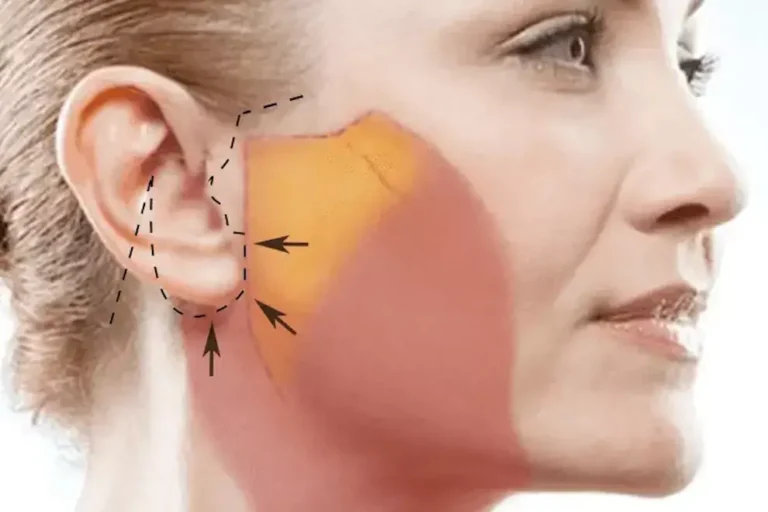
A deep plane facelift is a facelift (rhytidectomy) technique performed beneath the layer of muscle and fascia known as the SMAS. The retaining ligaments that anchor the face to the bone are released, and the skin and SMAS are lifted upwards and backwards as a single unit. The aim is to correct sagging in the midface, cheeks and jawline – together with the neck where needed – without pulling the skin tight.
Ageing is not simply a matter of the skin loosening on the surface. Over the years, under the influence of gravity, loss of elasticity and declining bone density, the supporting ligaments of the face weaken, the fat pads shift downwards and the layers of muscle and fascia begin to sag. These biological changes show up as hollowing of the cheeks, deepening of the folds around the mouth (nasolabial folds and marionette lines), a jawline that loses its definition (jowls) and loosening of the neck. Tightening only the skin, without addressing the deeper anatomical structures of the face, can produce a tight but artificial look.
Deep Plane Facelift at a Glance
| Topic | Usually |
|---|---|
| Anaesthesia | General anaesthesia |
| Length of the operation | 4–6 hours; additional procedures in the same session make it longer |
| Hospital stay | 1–2 days |
| Stitch removal | Days 7–10 |
| Back to desk work and social life | End of week 2 |
| Final appearance | 3–6 months |
| Scars | In the hair-bearing skin of the temple, in the natural creases in front of the ear and behind the ear; they become less noticeable within 6–12 months |
| Age | Mostly 40–70; the decision depends on the degree of sagging and your health, not on your age |
Timings vary from person to person and with the extent of the planned procedures; you will find the details in the sections below.
 The results of any surgical or interventional procedure vary from person to person. You are advised to get your physician’s detailed opinion before the procedure.
What Is a Deep Plane Facelift? The Anatomy Behind It
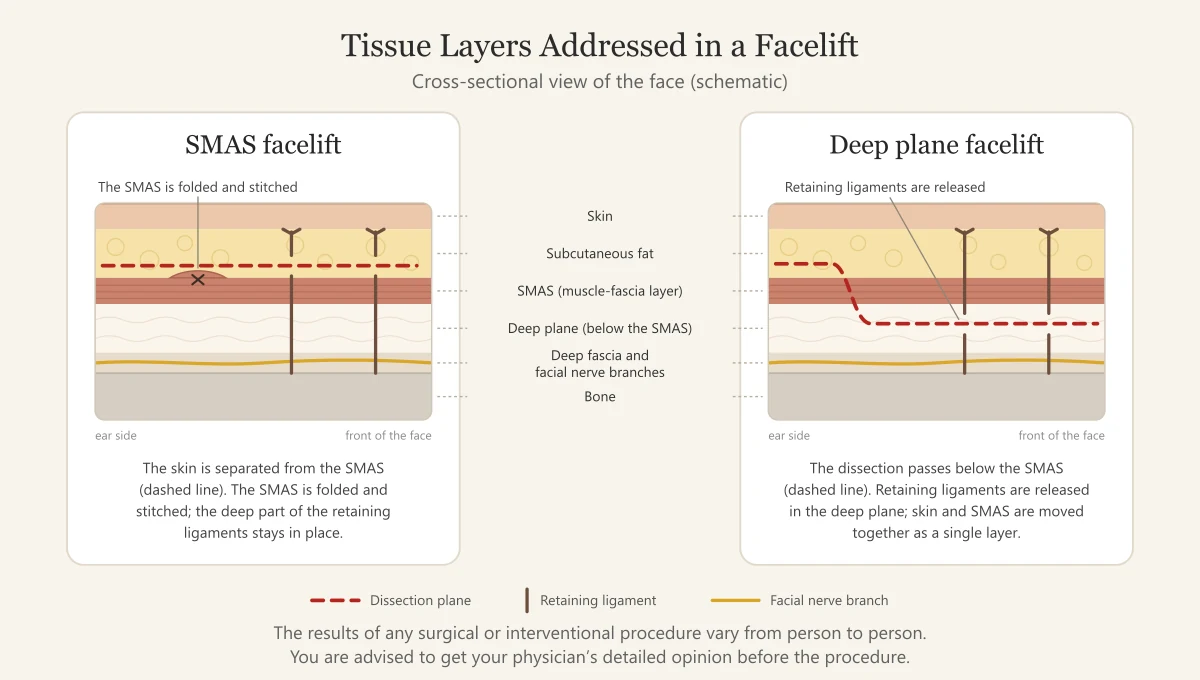
The face is built in layers: the skin on the surface, the fat beneath the skin, a supporting layer of muscle and fascia called the SMAS (superficial musculoaponeurotic system), the deep retaining ligaments and the bony framework. Traditional facelift techniques mostly lift the skin layer, or fold and stitch the SMAS superficially.
In a deep plane facelift, by contrast, the surgery goes down to the deep plane beneath the SMAS (the sub-SMAS space). Here the main retaining ligaments that tie the face to the bone – the zygomatic and mandibular ligaments – are released. Once the ligaments are free, the midface, the cheek fat pads and the SMAS can be moved as one unit back to the anatomical position they have drifted from (upwards and backwards), without stretching the skin.
Because the skin and SMAS are moved together as a block, without being separated from each other, no extra load or tension is placed on the skin. This helps facial expressions stay natural and reduces the risk of an artificial, overstretched (“windblown”) look after surgery.
How Does a Deep Plane Facelift Differ from a Traditional Facelift?
The difference between traditional methods and the deep plane technique is the point that most often confuses patients who are considering a facelift. The main differences between the two techniques are as follows:
Criterion | Traditional (superficial) facelift | Deep plane facelift |
Layer operated on | The skin and the superficial SMAS layer | Beneath the SMAS (sub-SMAS) and the deep connective tissue layer |
Lifting the midface and cheeks | Limited effect; the midface is not treated directly | The midface and the cheek fat pads are lifted as one unit |
Softening the nasolabial folds | Limited effect, because the tension is superficial | Because the deep ligaments are released, the folds can be smoothed more noticeably and more naturally |
Natural appearance | Risk of a pulled, artificial expression if the skin is over-tightened | Because the skin is not stretched, the aim is to preserve a natural, dynamic expression |
How long the effect lasts | Varies from person to person; when the tension is carried mainly by the skin, the effect may fade sooner | Varies from person to person; because the tension is carried by the deep tissues, the aim is a long-lasting effect |
Blood supply and healing | The skin is lifted over a wide area, so the risk to its blood supply is greater | Because the skin and SMAS stay connected, the skin’s blood supply is less affected |
Deep Plane vs SMAS Facelift: Which Suits Whom?
The term “SMAS facelift” is generally used for methods in which the skin is lifted off the surface of the SMAS and the SMAS layer is tightened by folding and stitching it. In these methods, the deep part of the retaining ligaments that anchor the face to the bone is left in place. In a deep plane facelift, the surgeon goes beneath the SMAS, releases the retaining ligaments and repositions the skin and SMAS as a single layer, without separating them. In short, the difference between the two methods is not whether the SMAS is treated, but which plane the surgeon works in and whether the retaining ligaments are released.
 The results of any surgical or interventional procedure vary from person to person. You are advised to get your physician’s detailed opinion before the procedure.
Large scientific reviews show that the two approaches have broadly similar safety results and that the deep plane technique may offer an advantage, particularly in the midface and cheeks, but that studies comparing the two methods directly are still limited. So no single technique can be said to be right for everyone.
The choice of technique depends on where, and in which layer, the sagging is concentrated, how far the midface has descended, the thickness and elasticity of your skin, any previous facial surgery and your expectations. The method that suits you is planned together with you once your facial structure has been assessed at the examination.
What Are the Advantages of a Deep Plane Facelift?
In suitable candidates, the deep plane approach offers several notable clinical advantages. They have a direct bearing on both the quality of the aesthetic result and the patient’s comfort.
- Preserving a natural expression: The skin is not stretched on its own; it is moved together with the supporting tissues beneath it. The aim is to avoid unwanted artificial effects such as a pulled look at the corners of the mouth or a change in the shape of the eyes.
- Effective rejuvenation of the midface: Releasing the zygomatic (cheekbone) ligaments allows the descended cheek tissue to be moved back to its former, fuller and higher position, with the aim of restoring the natural fullness over the cheekbones.
- A clearer jawline and neck contour: Releasing the mandibular ligaments corrects the sagging over the jawbone (jowls), with the aim of giving the jawline a clearer, more youthful contour.
- Protecting the skin’s blood supply: Because the microscopic network of blood vessels between the skin and the SMAS is largely preserved, the skin’s circulation is supported. This helps reduce the risk of skin healing problems; how long bruising and swelling last varies from person to person.
- How long the results last: Releasing the retaining ligaments makes it easier to move the tissues to their new position as one unit, and the tension is carried by the sturdier deep tissues rather than by the skin. As a result, the rejuvenating effect can be maintained for many years, while ageing continues on its natural course.
Who Is a Good Candidate for a Deep Plane Facelift?
In facial aesthetic surgery, a good result starts with matching the right technique to the right patient. So who may be considered for a deep plane facelift?
- Patients generally aged between 40 and 70, although, depending on skin and tissue quality, the operation can also be done earlier or later in life
- People with marked sagging of the cheeks and loss of volume in the midface
- People whose nasolabial folds (running from the side of the nose to the corner of the mouth) and marionette lines (running from the mouth down to the chin) have deepened
- People whose jawline (jowl line) has become blurred and who have tissue gathering under the chin
- Patients who have had a superficial facelift in the past but were not satisfied with the result, or who are showing signs of ageing again
- People whose general health does not rule out general anaesthesia and who have realistic expectations of the result
Who Is It Not Suitable For?
In some situations, the operation may need to be postponed, further medical assessment may be required, or a different method may be worth considering:
- People who cannot stop smoking for the recommended period before and after surgery: smoking impairs the skin’s blood supply and increases the risk of wound-healing problems and skin loss.
- People with uncontrolled high blood pressure, diabetes or a bleeding or clotting disorder: these conditions raise the risk of bleeding and healing problems, so their treatment needs to be adjusted first.
- People who cannot safely stop blood-thinning medication for medical reasons: this is assessed together with the doctor who manages the medication.
- People with serious heart or lung disease that significantly increases the risks of general anaesthesia.
- People who are still losing weight: waiting until your weight is stable makes the result more predictable.
- Women who are pregnant or breastfeeding.
- People who hope for an entirely different face or expect an exact, certain result: the aim is a more rested look within your own facial features.
Age alone is not an obstacle; what matters is your general health, your tissue quality and your expectations. Whether you are suitable is decided after a detailed examination and, where needed, further tests.
Assessment and Planning before Surgery
When Op. Dr. Ayberk Akçay performs a deep plane facelift, the first and most important step is a thorough aesthetic analysis. At the examination, the bone structure of your face, the thickness of your skin, the elasticity of your tissues and the anatomical layer in which ageing is most pronounced are assessed in detail.
Every face has its own anatomical architecture and its own pattern of ageing. Successful facial rejuvenation surgery depends not on template techniques but on an individual surgical plan that preserves the patient’s own facial proportions.
Before surgery, your medical history is reviewed. Because smoking harms tissue healing and the microscopic blood circulation, you are advised to stop at least 3–4 weeks before the operation. Blood-thinning medicines and supplements are adjusted under medical supervision before surgery.
How Is a Deep Plane Facelift Performed?
The operation is performed under general anaesthesia in a fully equipped hospital licensed by the Ministry of Health and usually takes 4 to 6 hours; additional procedures in the same session can make it longer. Step by step, the operation goes like this:
- Incision design: The incisions start within the hair-bearing scalp at the temple, follow the natural creases in front of the ear (behind the tragus) and continue from behind the earlobe into the hair-bearing scalp. This design aims to keep the scars within the hair and the natural creases around the ear; the scar is permanent, but once healing is complete it usually becomes much less noticeable.
- Entering the deep plane: After passing through the superficial layer beneath the skin, the surgeon enters directly beneath the SMAS (the sub-SMAS plane).
- Releasing the ligaments: The zygomatic and mandibular retaining ligaments that contribute to facial sagging are carefully released. Because this step is carried out close to the nerves that move the face, it calls for considerable surgical experience and precision.
- Repositioning the tissues: The released midface, cheek fat pads and muscle layer are moved vertically, against the pull of gravity (along a planned vector), back to their original position and secured to the deep tissues with strong stitches.
- Redraping the skin and closing: Because the tissues have been moved in the deep plane, the skin is laid over the new facial contour without being overstretched. Excess skin is trimmed away without tension, and the incisions are closed with fine cosmetic stitches.
Deep Plane Face and Neck Lift: How Are the Midface, Lower Face and Neck Planned Together?
In a deep plane facelift, the middle and lower parts of the face are treated in the same operation, through the same incisions, and the neck is added to the plan if needed. What will be done in which area is decided at the examination, according to where the sagging is concentrated.
Midface Lift: Cheeks and Nasolabial Folds
With the deep plane technique, the midface is lifted as part of the facelift, in the same operation. When the retaining ligaments in the cheekbone (zygomatic) area are released, the descended cheek fat pads and midface tissues are lifted as one unit. The aim is to restore fullness over the cheekbones and to soften the lines running from the sides of the nose to the corners of the mouth. Bags of fat under the eyes, however, are not corrected by a facelift; for these, eye bag surgery can be considered separately or in the same session. If hollow cheeks are caused more by volume loss than by sagging, replacing the lost volume with fillers or fat injections may be more appropriate than lifting the tissues.
Lower Face: Jawline and the Corners of the Mouth
Releasing the retaining ligaments that run along the jawbone (the mandibular ligaments) corrects the sagging over the jawline (jowls); the aim is to soften the marionette lines that run from the corners of the mouth down to the chin and to give the jawline a clearer contour.
When Is the Neck Added to the Plan?
If there is loose skin under the chin and on the neck, prominent vertical muscle bands or fat under the chin, the facelift is planned together with a neck lift. If the neck shows no marked laxity, it may not need separate treatment. If the only problem is fat under the chin and the skin is elastic, double chin liposuction alone may be enough. Every additional step on the neck lengthens the operation; which steps are needed is decided at the examination.
Recovery after a Deep Plane Facelift
Because the tissues are moved in the deep plane and the circulation beneath the skin is preserved, recovery after a deep plane facelift follows a steady course in most patients; even so, how long it takes and how comfortable it is vary from person to person.
Week-by-Week Recovery Timeline
The table below gives a general outline; your personal timeline is given to you at discharge and at your follow-up visits.
| When | What usually happens | What to keep in mind |
|---|---|---|
| First 1–2 days | Rest in hospital may be recommended; a facial bandage is applied, and if a drain was used, it is removed on day 1 or 2 | Rest with your head raised; cold compresses |
| First week | Swelling, bruising and a feeling of tightness; pain is usually mild | Short walks; wear the facial bandage for as long as advised; do not bend your neck suddenly |
| Days 7–10 | The stitches are removed | Attend your follow-up visit |
| End of week 2 | Most of the bruising has faded; most people return to desk work and social life | Wait for your surgeon’s approval before strenuous exercise, bending over and heavy lifting (usually a few weeks); avoid saunas, Turkish baths and sunbathing |
| End of month 1 | The swelling has gone down noticeably, and the overall shape of the face emerges | Do not judge the early appearance as the final result |
| Months 3–6 | The tissues settle; the face approaches its final appearance | Keep attending your follow-up visits |
| Months 6–12 | The scars mature and fade towards your natural skin tone | Protect the incision areas from the sun |
| Up to 1 year | In some people, mild swelling and changes in sensation can last this long | While sensation is reduced, use hot appliances such as hairdryers and curling tongs with care |
Results and the speed of recovery vary from person to person.
The First Week
Rest in hospital may be recommended for the first 1–2 days after surgery. A special compression bandage is applied to the face to keep any swelling and bruising under control. Drains, placed to stop fluid from collecting in the tissues, are usually removed on day 1 or 2. Keeping your head raised and applying cold compresses for the first few days helps the swelling go down faster. Pain is usually mild and is controlled with the painkillers your surgeon recommends.
Weeks 2 to 4
The stitches are usually removed between days 7 and 10. From then on, most of the bruising fades and the swelling goes down noticeably. Patients can usually return comfortably to social life and desk work by the end of week 2. The numbness in the face gradually begins to ease during this period.
Months 3 to 6
By the end of the first month, the overall shape of the face becomes visible. However, it usually takes 3 to 6 months for the tissues to settle completely and for healing in the deep plane to be complete; the scars take 6 to 12 months, and in some people longer, to mature and fade towards the colour of the surrounding skin. The aim at the end of this process is a fresh, natural-looking face with nothing artificial about it; results vary from person to person.
Aftercare: What to Keep in Mind during Recovery
A smooth recovery depends to a large extent on following your aftercare instructions. You will receive advice specific to you at discharge and at your follow-up visits; in general, the main points are:
- Sleeping position: For the first few days, and for as long as your surgeon advises, sleep on your back with your head raised on several pillows; avoid putting pressure on your face and ears.
- Neck movements and clothing: Do not bend or turn your neck suddenly; in the first few days, choose clothes that button up at the front rather than ones you have to pull over your head.
- Bandage and follow-up visits: Wear the facial bandage for as long as advised; do not miss your follow-up visits for dressing changes and stitch removal.
- Incision care and hair: Keep the incisions clean and dry; wait until the time your surgeon recommends before showering and washing your hair; postpone chemical treatments such as hair colouring until the incisions have fully healed.
- While your skin is numb: When sensation around the cheeks and ears is reduced, you may not feel heat properly, so use hairdryers, curling tongs and anything hot with care.
- Activity and exercise: Take short walks from the first days onwards; avoid bending over, heavy lifting and strenuous exercise that raises your blood pressure until your surgeon approves, which is usually a few weeks.
- Smoking, alcohol and heat: Stay away from smoking and alcohol; in the first weeks, avoid saunas, Turkish baths and sunbathing, which can increase swelling.
- Sun protection: Protect the incision areas from the sun until the scars have matured, usually for 6 to 12 months.
Contact your surgeon without delay if you notice rapidly increasing swelling or tightness on one side of the face, pain that keeps getting worse, a fever, discharge from an incision, darkening discolouration of the skin or a painful swelling in the leg. These can be signs of bleeding (haematoma), infection, poor blood supply to the skin or a blood clot, all of which need prompt treatment. Sudden shortness of breath or chest pain is an emergency: call the emergency services immediately (112 in Turkey) or go to the nearest emergency department.
How Long Does a Deep Plane Facelift Last? Are the Results Permanent?
A deep plane facelift aims to give a younger, more rested appearance by correcting facial sagging, but it does not stop ageing. So the word “permanent” does not mean that your face will never change over the years.
The effect of a comprehensive facelift is reported to remain noticeable, usually for 10 years or more. In the deep plane technique, the fact that the tension is carried by the deep tissues rather than the skin is thought to help the result last. However, long-term studies comparing the deep plane with other techniques are limited, and this period varies considerably from person to person.
The main factors that affect how long the result lasts are:
- Skin quality, elasticity and genetics
- Your age at the time of surgery and how much sagging there was beforehand
- Sun exposure and regular sun protection
- Smoking
- Significant weight gain or loss after surgery
If laxity becomes noticeable again over the years, additional procedures or a second facelift may be considered in the future. Such a decision is, again, made after your facial structure has been reassessed.
Is a Facelift Risky? Possible Complications
Like any surgical procedure, a deep plane facelift carries risks. Although the great majority of patients recover without any serious problem, it is important to know about the possible complications before surgery:
- Bleeding and haematoma: A collection of blood under the skin is the most common early complication after a facelift and usually appears within the first 24 hours. It shows itself as rapidly increasing swelling and pain on one side; a further operation may be needed to drain the blood. High blood pressure, blood-thinning medication and being male increase this risk.
- Weakness of facial nerve branches: After surgery, there may be temporary weakness when raising the eyebrows, smiling or moving the lower lip; this mostly recovers within weeks to months. Permanent nerve damage is rare.
- Numbness: Reduced sensation around the cheeks and ears is expected and usually improves gradually over a period of months; rarely, it can be permanent.
- Scar problems: In some people, scars can thicken, widen or stay a different colour from the surrounding skin; further treatment may be needed.
- Wound-healing problems: Delayed healing or limited skin loss can occur, especially around the ear; smoking increases this risk considerably.
- Hair loss and changes to the hairline: Temporary or permanent hair loss can occur around the incision line, and the position of the hairline at the temple can change.
- Infection and fluid collection: These are rare, and most resolve with additional treatment.
- Asymmetry: Because every face is naturally asymmetrical, slight differences between the two sides may remain.
- A change in the shape of the earlobe: The earlobe being pulled downwards (a “pixie ear”) is rare and may need correction.
- Anaesthetic risks, blood clots and a result that falls short of expectations: The specific risks of general anaesthesia and rare risks that can occur with any operation, such as a blood clot in the deep veins of the leg (deep vein thrombosis), are discussed separately at the pre-operative assessment. Rarely, an additional procedure may be needed to improve the result.
Large published reviews report a haematoma rate of about 1–3% after a deep plane facelift, and temporary facial nerve weakness in about 1% of patients. These figures are general data from the medical literature; your personal risk is assessed at the examination, based on your health, whether you smoke and the extent of the planned procedure.
Whole-Face Rejuvenation: Combining Procedures
The face works as a whole, and the signs of ageing are usually not confined to a single area. That is why a deep plane facelift is often combined with other aesthetic procedures to achieve a more balanced, harmonious result:
- Deep plane neck lift (deep neck lift): Tightening the platysma muscle of the neck and reshaping the deep fat under the chin aims to create a more defined angle between the chin and the neck (the cervicomental angle). For details, see our neck lift page.
- Eyelid surgery (blepharoplasty): Removing bags and excess skin from the upper and lower eyelids reduces a tired look in the eyes.
- Brow lift / temporal lift: Correcting drooping in the upper face brings it into harmony with the area around the eyes and the forehead.
- Facial fat transfer: While surgery lifts the tissues, volume lost with age is restored by micro-fat injections into the temples, the area around the lips or the cheekbones.
What Affects the Cost of a Deep Plane Facelift?
The fee for a deep plane facelift differs for each patient and is set after the examination, according to your personal plan. The main factors that affect the fee are:
- The degree of sagging and the extent of the operation (midface, lower face and jawline)
- Whether additional procedures such as a neck lift, eyelid surgery, a brow lift or fat transfer are done in the same session
- Whether you have had a facelift before
- The length of the operation, the anaesthesia and the length of the hospital stay
- Follow-up visits and aftercare after the operation
The operation is performed in a fully equipped hospital licensed by the Ministry of Health. The method that suits you and detailed information are shared at the examination.
Travelling to Istanbul, Turkey, for a Deep Plane Facelift
Before you travel, you can send photos on WhatsApp for a preliminary assessment (see contact), and your plan is given to you in writing. The examination and the operation plan are then made in person in Istanbul, and the operation takes place in a fully equipped hospital licensed by the Ministry of Health. A typical stay for a deep plane face and neck lift is about 8–10 nights, and Dr. Akçay decides when you are fit to fly home. Once you are back home, follow-up continues with photo reviews on WhatsApp, and your medical records are given to you in English.
Frequently Asked Questions about the Deep Plane Facelift
What does “deep plane facelift” mean?
“Deep plane facelift” is the English name of the operation called derin plan yüz germe in Turkish, so the two terms mean the same thing. “Deep plane” refers to the fact that the operation is carried out in the plane beneath the layer of muscle and fascia known as the SMAS.
At what age can you have a deep plane facelift?
There is no strict age limit; the decision is based not on age but on the degree of facial sagging, your tissue quality and your general health. A deep plane facelift is usually considered between the ages of 40 and 70. It can be planned earlier for people whose sagging starts early because of genetics or significant weight loss, and later for older people in good general health, after a detailed medical assessment.
How long does recovery take, and when can I go back to work and social life?
Recovery is gradual. The stitches are usually removed between days 7 and 10; most of the bruising fades within two weeks, and most people can return to desk work and social life by the end of the second week. The swelling goes down noticeably during the first month, and it usually takes 3–6 months for the face to reach its final appearance. In some people, mild swelling and changes in sensation take up to a year to disappear completely.
Will my facial expression change after surgery?
The goal is for you to look more rested while keeping your own expression. Because the tension in a deep plane facelift is carried by the deep tissues rather than the skin, the aim is to reduce the risk of a pulled, artificial expression. In the first weeks, swelling and tightness can make facial movements feel restricted for a while; any temporary weakness of the facial nerve branches also mostly recovers within weeks to months. Results vary from person to person.
Is a deep plane facelift riskier than an SMAS facelift?
According to large scientific reviews, deep plane and SMAS facelifts have broadly similar safety profiles: problems with the facial nerve are mostly temporary, and permanent nerve damage is rare. Some studies have reported a slightly higher rate of bleeding (haematoma) with the deep plane technique. Because the deep plane technique works in a plane close to the branches of the facial nerve, a thorough knowledge of the anatomy and careful surgical technique are important. Your personal risk is assessed at the examination.
Does a facelift leave scars?
Yes. Every surgical incision leaves a permanent scar, and a deep plane facelift is no exception. Because the incisions are placed in the hair-bearing skin of the temple, in the natural creases in front of the ear and behind the ear, the scar mostly lies within the hair and the folds of the ear. Scars look pink in the first months; they usually fade and become less noticeable within 6–12 months. In some people a scar can thicken, and additional scar treatment may be needed.
Is a facelift painful?
Because the operation is performed under general anaesthesia, you feel no pain during the procedure. In the first days afterwards there may be a feeling of tightness, pressure and tenderness; the pain is usually mild, moderate in some patients, and is controlled with the painkillers your surgeon recommends. Some numbness around the cheeks and ears for a while is also expected; sensation usually returns gradually over a period of months.
How long does the operation take, and how long will I stay in hospital?
The operation is performed under general anaesthesia and usually takes 4–6 hours; additional procedures such as a neck lift or eyelid surgery can make it longer. A hospital stay of 1–2 days after surgery is usually recommended. If a drain was used, it is mostly removed within the first day or two; your follow-up visits after discharge are planned separately.
Can a facelift and a neck lift be done in the same operation?
Yes. Because sagging of the face is often accompanied by laxity under the chin and in the neck, a deep plane facelift is frequently planned together with a neck lift. The face and neck are then treated as a whole, under the same anaesthesia and with a single recovery period. Which neck steps you need – tightening the muscle, reshaping the fat or removing excess skin – is decided at the examination.
How is a facelift planned for men?
Deep plane facelifts are also performed on men, but the planning differs in some respects. The incisions are designed for the male face so that beard-bearing skin is not pulled onto the small projection in front of the ear canal (the tragus) and the sideburns are preserved. Because facial skin has a richer blood supply in men, the risk of bleeding after surgery is higher than in women; this is why good blood pressure control before and after surgery is especially important.
Can non-surgical treatments such as botulinum toxin and fillers replace a facelift?
Non-surgical treatments such as botulinum toxin (anti-wrinkle injections) and fillers can be considered for some concerns, such as expression lines or limited volume loss, but they do not reposition sagging deep tissues. If there is marked sagging of the cheeks, a blurred jawline or laxity in the neck, surgical options come into consideration. The differences between botulinum toxin, fillers and facelift surgery are covered in detail in our article on how a facelift differs from non-surgical treatments.
Can I have another facelift if I have had one before?
Yes. A second facelift can be planned for people who have had a facelift in the past and whose face has sagged again over time. Because scar tissue from the earlier operation, the position of the previous incisions and the technique that was used all affect the planning, these operations call for a more detailed assessment. Bringing information and documents from your previous operation to the examination makes planning easier.
Deep Plane Facelift in Şişli, Istanbul: Consultation and Planning
If you are considering a deep plane facelift, the first step is a detailed analysis of your face. Dr. Akçay, a specialist in plastic, reconstructive and aesthetic surgery, is a Fellow of the European Board of Plastic, Reconstructive and Aesthetic Surgery (EBOPRAS) and a full member of the Turkish Society of Plastic, Reconstructive and Aesthetic Surgeons. At his practice in Teşvikiye, Şişli, Istanbul, he assesses your face as a whole: where and in which layer the sagging is concentrated, your skin quality, your bone structure, your medical history and your expectations are all considered together. After the examination, you and Dr. Akçay decide together whether a deep plane facelift is right for you, and whether it should be done on its own or combined with procedures for the neck, eyelids or brows.
Patients coming from outside Istanbul are usually advised to stay in Istanbul for 7–10 days, the period in which the first follow-up visits take place and the stitches are removed; the exact length is decided at the examination. For appointments and information, please get in touch through our contact page.
This page is for general information only and does not replace an examination or diagnosis. Results of surgery may vary from person to person.