Breast reduction surgery, known medically as reduction mammoplasty, is an operation in which excess breast tissue, fat and skin are removed from large, heavy breasts and the breast is reshaped to be smaller, lighter and in proportion with your body. How much tissue is removed and which technique is used are planned individually at the examination.
The key facts about the operation are summarised below. The times given are a general guide and vary from person to person.
| Topic | General information |
|---|---|
| Anaesthesia and length of surgery | Under general anaesthesia; usually 2.5 to 4 hours |
| Hospital stay | Usually one night |
| Return to desk work | Usually within 7–10 days |
| Support bra | Worn without interruption for the first 1–2 weeks; use is reduced gradually over the following months |
| Strenuous exercise | Avoided for the first 1–3 months |
| Scars and final appearance | Usually mature within 6 months to 1 year |
| Age and timing | Usually from the age of 18; at least 6 months after breastfeeding has ended |
What is breast reduction surgery, and why is it done?
Having very large, heavy breasts is not only a cosmetic concern; it is a serious health problem that makes everyday life harder. Many physical complaints stem from it: neck, back and shoulder pain, poor posture, deep grooves left on the shoulders by bra straps, and rashes and fungal infections beneath the breasts. For patients who want to ease these complaints and have a more proportionate bust, breast reduction is a surgical solution that aims to improve their quality of life.
The operation does more than reduce volume: it also lifts sagging breast tissue, moves the nipple and areola up to a new, higher position and, if needed, makes an enlarged areola smaller. Breast reduction therefore combines the principles of reconstructive and aesthetic surgery.
Enlargement of the breast tissue in men (gynecomastia) is a different condition; its causes and treatment are explained on the gynecomastia surgery page.
Who is a good candidate for breast reduction?
Anyone who has finished developing physically and whose general health does not rule out surgery can be assessed for this operation. Candidates often include people who:
- Have chronic back, neck and shoulder pain caused by the weight of their breasts
- Have developed a postural problem of the spine (kyphosis, or a rounded upper back) because of the excess load
- Keep getting rashes, irritation or skin infections beneath the breasts
- Have permanent grooves and indentations on their shoulders from bra straps
- Struggle to find the clothes they want and have lost self-confidence because of the size of their breasts
- Have to limit sport or everyday physical activities because of their breast size
Before deciding on surgery, it is important that physical development is complete (usually at the age of 18 or over). However, where there is a medical need, such as severe pain or a deformity of the spine, the operation can also be planned at a younger age after a specialist assessment.
When is surgery postponed?
In the following situations, it may be advisable to postpone the operation until a more suitable time; the aim is to protect both your safety and the durability of the result:
- Pregnancy, breastfeeding or plans for a pregnancy in the near future
- An unstable weight, or significant weight loss that you are planning
- Smoking
- Uncontrolled diabetes or a high body mass index (BMI)
- A finding on the pre-operative mammogram or ultrasound that needs further investigation
Assessment and preparation before surgery
A successful outcome rests on a detailed examination and individual planning before the operation. When we plan a breast reduction at our practice, your general medical history, current physical complaints and aesthetic expectations are analysed in full.
During the examination, the density of the breast tissue, the degree of sagging, skin quality, shoulder width and the shape of the chest wall are assessed. A mammogram or breast ultrasound, depending on your age and risk factors, is always requested before surgery. These tests are essential to check the biological condition of the existing tissue and to provide a reference for future follow-up.
Stopping smoking at least 2–3 weeks before the operation, and stopping blood-thinning medicines or supplements under your doctor’s supervision, are very important for the blood supply to the healing tissue.
How many cup sizes smaller will my breasts be?
In breast reduction, the goal is not a particular bra size but breasts that are easier to carry and in proportion with your height, shoulder width and chest. Because bra sizes vary from brand to brand, it would not be right to name an exact size before surgery. Instead, the current volume of the breasts, the degree of sagging, the position of the nipple and the quality of the skin are assessed at the examination, and the amount of tissue to be removed is planned according to these findings and your expectations.
The following points are considered together in planning:
- Your expectations: We discuss whether you want a marked reduction or a moderate one that keeps your body proportions.
- Blood supply to the nipple: The nipple is moved to its new position together with the tissue beneath it. Preserving the blood supply of this tissue is one of the factors that set the safe limit on how much tissue can be removed.
- The difference between the two breasts: There is often a slight difference in size between the breasts. The tissue to be removed is planned separately for each breast to reduce this difference, but exact symmetry is not always possible.
- Weight and future plans: Whether your weight is stable and whether you are planning a pregnancy in the near future affect how well the result is maintained.
In the first weeks after surgery, the breasts may look fuller than expected because of swelling; the new size and shape become clear over the following months as the swelling goes down.
Breast reduction techniques
The surgical technique is chosen according to the amount of tissue to be removed, the degree of sagging and your skin type. The technique determines where the scars will lie and the details of the operation.
Technique | Scar pattern | When is it preferred? |
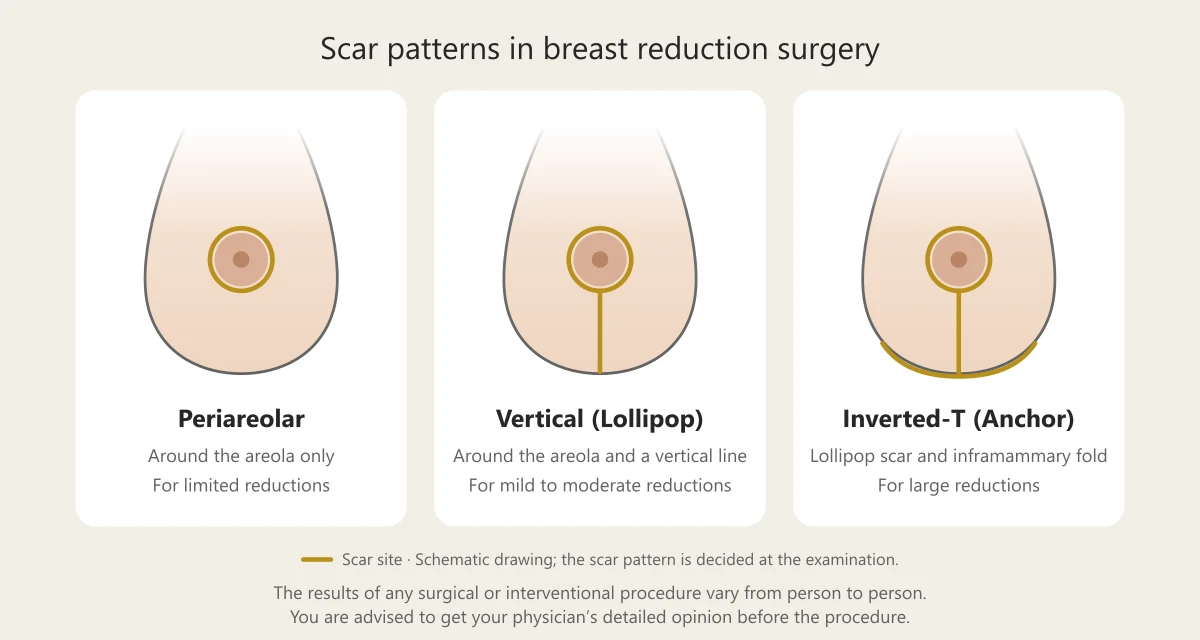
Vertical (lollipop) technique | Around the areola, plus a vertical line running down from it | Preferred for mild to moderate enlargement and moderate sagging. |
Inverted T (anchor) technique | Around the areola, a vertical line and a horizontal line in the crease beneath the breast | Used for very large, heavily sagging breasts from which a lot of tissue has to be removed. |
Periareolar technique | Only a circular line around the areola | Used in a limited number of cases that need only a minimal reduction in volume and slight reshaping. |
The choice of technique is finalised with measurements taken at the consultation before surgery. Surgical scars are permanent, but in most patients they become thinner, fade and come closer to the skin tone over time.
How is breast reduction surgery performed?
The operation is performed under general anaesthesia and usually takes 2.5 to 4 hours, depending on the amount of tissue to be removed and the technique used. The main steps are:
- Marking: Before the operation, the new position of the nipple and the incision lines are marked according to the plan made at the examination.
- Incisions and removal of excess tissue: The incisions are made according to the chosen technique, and the excess breast tissue, fat and skin are removed following the plan drawn beforehand.
- Moving the nipple: The nipple and areola are moved to their new position together with the underlying tissue that carries their nerves and blood vessels (pedicle flap techniques); an enlarged areola is made smaller if needed.
- Shaping and closure: The remaining breast tissue is reshaped and the tissue layers are closed with stitches. Where necessary, a temporary drain is placed to remove any fluid that may collect inside.
- Support bra: Once the dressings are in place, a supportive surgical bra is put on.
Recovery and aftercare after breast reduction
How comfortable the period after surgery is, and how successful the final result is, depend directly on how closely you follow the recovery instructions. Recovery after breast reduction usually goes through these stages:
- First 24–48 hours: A one-night hospital stay is usually enough. If a drain has been placed, it is usually removed on the first or second day. Mild to moderate pain is usually controlled with prescribed painkillers.
- First 1–2 weeks: A special supportive surgical bra should be worn without interruption to help the tissues take shape properly and to reduce swelling. Patients can usually return to desk work or a light social life within 7–10 days.
- 1–3 months: Avoid strenuous exercise, movements that strain your arms upwards and heavy lifting. The swelling in the breasts gradually goes down, the tissues soften and the true shape of the breast begins to emerge. Use of the support bra is reduced gradually during this period.
- 6 months to 1 year: The scars mature, the redness fades and the final shape fully settles.
Because the surgical bra holds the tissues in the correct position while they heal, wearing it is one of the critical factors in the success of a breast reduction.
Daily life after surgery: bras, sleeping, showering and driving
- Bras: When you can switch from the surgical bra to an underwired bra is decided at a follow-up visit.
- Sleeping position: Sleeping on your back is recommended for the first weeks; you will be told at a follow-up visit when you can start sleeping on your side, depending on how you are healing.
- Showering and wound care: When you can have your first shower and how to care for the dressings are explained when you leave hospital or at the first check-up, depending on the condition of the wounds.
- Driving: When you can drive again is decided at a follow-up visit, once your pain has eased and you can move your arms comfortably.
- Sea and swimming pool: Wait until the wounds have fully closed before swimming in a pool or in the sea.
Will breast reduction leave scars?
Yes, breast reduction does leave scars. Because excess skin is removed along with the excess breast tissue, incisions are needed. Where the scars lie and how long they are depend on the technique: the scar may run only around the areola (periareolar); around the areola plus a vertical line down to the crease beneath the breast (lollipop); or, in an inverted T (anchor) pattern, with an additional horizontal line in that crease. Most of the scarring lies in areas covered by a bra or bikini top.
 The results of any surgical or interventional procedure vary from person to person. You are advised to get your physician’s detailed opinion before the procedure.
In the first months, the scars may look pinkish-red and slightly raised. They usually take between 6 months and 1 year to mature, and can take longer in some people. During this time, in most patients the scars become thinner, fade and come closer to the skin tone. How a scar finally looks depends on your skin type, genetic predisposition, how the wound heals and how it is cared for. Some people develop a thick (hypertrophic) scar or a keloid; in that case, scar treatment options may be considered.
For scar care, the usual recommendations are:
- Regular use of the silicone gel or silicone tapes your surgeon recommends, once the wound has fully closed
- Protecting the scars from direct sun for the first year
- Avoiding heavy lifting and strenuous arm movements that stretch the incision lines while you heal
- Not smoking, since smoking delays wound healing
- Keeping all follow-up appointments, and getting in touch straight away if you notice increasing redness, discharge or an opening in the wound
Breastfeeding and pregnancy after breast reduction
Many women can breastfeed after breast reduction surgery; however, breastfeeding may not always be possible, or the amount of milk may not be enough to feed the baby on breast milk alone. The main factor affecting the chance of breastfeeding is how well the connection between the nipple and the milk-producing glandular tissue beneath it is preserved. Studies show that the chance of breastfeeding is higher with techniques in which the nipple is moved together with this tissue. The amount of tissue removed and your own capacity to produce milk also affect the outcome. If you would like to breastfeed in the future, it is important to say so at your first examination; this is taken into account when the technique is chosen.
This operation does not prevent you from becoming pregnant in the future. However, the breasts can enlarge and shrink again during pregnancy and breastfeeding, which can change the shape achieved to some extent or cause sagging. If you are planning a pregnancy in the near future, the timing of the operation is discussed with you at the examination. If you are considering surgery after childbirth and breastfeeding, it is usually recommended to wait at least 6 months after breastfeeding ends, so that the breasts can settle into their final form.
What are the risks of breast reduction?
Like any surgical procedure, this operation has risks. They are discussed in detail before surgery in the light of your health. The main ones are:
- Bleeding and fluid collection: Blood (haematoma) or fluid (seroma) can collect inside the breast; in some cases it needs to be drained.
- Infection and wound-healing problems: The wound may be slow to close, especially where the vertical and horizontal incisions meet; this usually heals with dressings.
- Changes in sensation: There may be reduced sensation or increased sensitivity in the nipple or in parts of the breast. This often improves within months but can be permanent in some patients.
- Problems with the blood supply to the nipple: Impaired blood flow to the nipple is an uncommon but serious complication; it can lead to the loss of part or all of the nipple tissue.
- Fat necrosis: If part of the fatty tissue loses its blood supply, firm lumps that can be felt in the breast may form.
- Asymmetry and differences in shape: Some difference in size, shape or nipple position may remain between the two breasts.
- Scar problems: Scars may become thick or noticeable; small folds of excess skin may remain at the ends of the scars.
- Difficulty breastfeeding: Breastfeeding may be partly or entirely impossible.
- General surgical risks: Risks that apply to any operation, such as those related to anaesthesia, blood clots in the leg veins (deep vein thrombosis) and a clot travelling to the lungs (pulmonary embolism).
Some of these problems may require a minor corrective operation (revision). Smoking, a high body mass index and uncontrolled diabetes increase the risk of complications. After surgery, contact your doctor without delay if you notice rapidly increasing swelling and pain in one breast, a fever, increasing redness or discharge at the incision, darkening or bluish discolouration of the nipple, or a painful swelling in your leg; if you develop sudden shortness of breath or chest pain, go to an emergency department.
What are the benefits of breast reduction?
Once recovery is complete, many patients feel markedly better, both physically and mentally. How much you benefit varies from person to person; the main benefits are:
- As the physical load is lightened, lower back, upper back and neck pain decreases markedly in most patients.
- Less strain on the spine can help improve posture.
- Rashes and irritation beneath the breasts usually become less of a problem.
- Choosing clothes becomes easier.
- Sport and exercise become more comfortable.
- A more positive body image can be reflected in greater self-confidence.
Is breast reduction covered by SGK in Turkey?
This section concerns patients insured under the Turkish social security system (SGK). SGK does not cover breast reduction carried out only to change the appearance of the breasts. Reimbursement requires the medical problems that accompany very large breasts (macromastia), such as neck, back and shoulder pain, recurring skin problems beneath the breasts or poor posture, to be documented in a medical board report that meets the conditions of SGK’s Health Implementation Communiqué (SUT). The details are set out in the SUT, which is updated from time to time, so the conditions can change.
Services at our practice and private doctors’ fees are not covered by SGK, and the way reimbursement and additional charges are applied varies between SGK-contracted institutions. Cover under private health insurance depends on the terms of your policy and on documentation of the medical reason, so please confirm the current conditions with SGK, your insurer and the institution concerned before planning surgery.
Breast reduction, breast lift or breast augmentation: what is the difference?
Breast surgery procedures address different concerns. Because the nipple is also moved upwards in a breast reduction, the operation has a lifting effect as well; however, its main purpose is to reduce volume and weight.
| Operation | Main aim | Who is it considered for? |
|---|---|---|
| Breast reduction | To reduce volume and weight by removing excess breast tissue, fat and skin, and to reshape the breast | People with pain, skin problems or restricted movement caused by large, heavy breasts |
| Breast lift | To reshape a sagging breast by moving it and the nipple upwards; the volume is largely kept | Breasts that have enough volume but have sagged |
| Breast augmentation | To add volume with silicone implants or fat transfer | Breasts that are felt to be small or have lost volume |
For people who have enough volume and whose only concern is sagging, a breast lift on its own may be enough. For those who feel their breasts are small or who have lost volume, breast augmentation needs separate planning. Where the breasts and the tummy have both changed after childbirth and breastfeeding, a breast reduction can be planned as part of a mommy makeover, together with procedures such as a tummy tuck and liposuction. Fullness at the side of the chest that extends towards the armpit, or fat along the bra line on the back, may not be corrected by a reduction alone; in suitable patients these areas can be treated with liposuction as part of the same plan. Which procedures can be combined is decided at the examination, taking into account your general health and the total length of the operation.
Travelling to Istanbul, Turkey, for a breast reduction
Before you travel, you can contact the practice and send photos on WhatsApp for a preliminary assessment; your plan is then given to you in writing. In Istanbul, you are examined in person and the operation is planned with you; operations take place in a fully equipped hospital licensed by the Ministry of Health. For breast surgery, the typical stay is about 6–7 nights, and your surgeon decides when you are fit to fly home. After you return home, follow-up continues with photo reviews on WhatsApp, and your medical records are given to you in English.
Frequently Asked Questions about Breast Reduction Surgery
Is breast reduction a major operation?
Breast reduction is a major operation, performed under general anaesthesia, that requires careful planning. Depending on the amount of tissue to be removed and the technique, it usually takes 2.5 to 4 hours, and most patients stay in hospital for one night. Pain in the first days is usually mild or moderate and is controlled with prescribed painkillers. Pain that keeps getting worse or does not ease with medication is not expected; if this happens, you should let your doctor know.
How long does it take to recover from breast reduction?
Recovery happens in stages and varies from person to person. Most patients can return to desk work and light daily activities within 7–10 days; physically demanding work may need a longer rest. The supportive surgical bra is worn without interruption for the first weeks, and its use is then reduced gradually. The swelling largely goes down within the first 1–3 months, and the true shape of the breast begins to emerge. It usually takes 6 months to 1 year for the scars to mature and for the final appearance to settle.
How much smaller can my breasts be made?
There is no fixed upper limit that applies to everyone. How much tissue can be removed depends on several factors taken together: preserving the blood supply of the tissue that nourishes the nipple, the quality of your skin, your chest and body proportions, and your expectations.
When can I get back to sport?
Short walks are recommended from the day after the operation, as they support your circulation. The length and pace of your walks can be increased gradually after the first few weeks. Running, jumping, weight training and sports that strain the arms upwards are avoided for the first 1–3 months; your return to them is planned gradually, based on the assessment at your follow-up visit, and with a supportive sports bra.
At what age can breast reduction be done?
The operation is usually planned once breast development is complete, at the age of 18 or over. For the result to last, it is important that breast size has not changed for some time. In younger patients with serious complaints such as pain, poor posture or recurring skin problems, the operation may be considered earlier after a detailed assessment; under the age of 18, the consent of a parent or legal guardian is required. There is no particular upper age limit; in older patients, general health and the results of breast imaging are decisive.
Can the breasts grow again after a reduction?
The tissue removed during surgery does not grow back, and the results usually last for many years. However, the remaining breast tissue continues to respond to changes in the body: significant weight gain, pregnancy, breastfeeding and hormonal changes can make the breasts larger again, while ageing and gravity can cause some sagging over time. Keeping your weight stable helps preserve the result.
Will I lose sensation in my nipples?
After the operation, numbness, reduced sensation or, conversely, increased sensitivity may occur in the nipple and in parts of the breast. In most patients these changes improve markedly within months; in some, however, they can be permanent. Preserving the connection between the nipple and the tissue beneath it matters for both its blood supply and its sensation, and this is taken into account in planning.
Can I have mammograms after breast reduction?
Yes. This operation does not prevent breast screening with mammography or ultrasound, and you should continue with the screening appropriate for your age after surgery. Changes such as scar tissue or calcifications may be seen in the breast after the operation; telling the radiologist that you have had a breast reduction helps them interpret the images correctly. Depending on your age and risk profile, a mammogram or breast ultrasound is also requested before the operation.
Can breasts be made smaller without surgery?
Because part of the breast is made up of fat, losing weight can reduce breast size somewhat in people who are overweight; in breasts made up mainly of glandular tissue, however, weight loss has a limited effect. Exercises can strengthen the chest muscles and support posture, but they do not make breast tissue smaller. Creams and pills sold with the claim that they reduce breast size have not been shown scientifically to work. A well-fitting supportive bra and physiotherapy can ease the symptoms; if the breasts are markedly large and sagging, surgery is the method used to reduce their volume. Which approach suits you is assessed at the examination.
What does the cost of breast reduction depend on?
The fee depends on factors such as the technique, the amount of tissue to be removed, the length of the operation and of the hospital stay, the anaesthesia, whether the operation is combined with other procedures such as liposuction, and the follow-up after surgery. For this reason, an accurate fee cannot be given without an examination; the fee is set once your individual plan has been decided at the examination. To book an appointment, you can reach us through our contact page.
Do I need to lose weight before breast reduction?
Ideally, your weight should be close to your target and should have been stable for a few months before the operation. Losing a significant amount of weight after surgery can make the breasts shrink and sag again, and gaining weight can make them larger, changing the result. A high body mass index also increases the risk of complications such as wound-healing problems. If you are planning significant weight loss, completing it before the operation usually gives a more predictable result. If the weight of your breasts makes it difficult for you to exercise, the right timing for you is assessed together at the examination.
Breast reduction in Şişli, Istanbul: examination and planning
Breast reduction is not just a cosmetic change but also a source of medical relief: an important step towards easing the physical and psychological burden you may have carried on your shoulders for years. Relief from neck and back pain, a more active sporting life, an easier choice of clothes and a more positive body image are the main benefits patients hope to gain from this operation; results vary from person to person. As you take this step towards lighter, proportionate breasts that suit your body, careful surgical planning and the surgeon’s experience are important guides. Op. Dr. Ayberk Akçay is a specialist in plastic, reconstructive and aesthetic surgery, a Fellow of the European Board of Plastic, Reconstructive and Aesthetic Surgery (EBOPRAS) and a full member of the Turkish Society of Plastic, Reconstructive and Aesthetic Surgeons. Operations are performed in a fully equipped hospital licensed by the Ministry of Health. If you are considering breast reduction, you can book an appointment at our practice in Teşvikiye, Şişli, Istanbul through our contact page; the plan that suits you is worked out together at the examination.
This page is for general information and does not replace an examination or diagnosis. The results of any surgical or interventional procedure vary from person to person. You are advised to get your physician’s detailed opinion before the procedure.