
A breast implant (silicone breast implant) is a medical device with an outer shell made of silicone, placed behind the breast tissue or the chest muscle to add volume to the breast or to correct its shape. Implants differ in filling, surface, shape, profile and volume; today, most implants used are filled with cohesive silicone gel. They are devices that still need monitoring once they are in place: over the years, capsular contracture, rupture or changes in the breast may mean that they have to be replaced or removed in a new operation. The operation in which the implant is placed, the incision sites and recovery are described on the breast augmentation surgery page; this page covers the implants themselves and their long-term follow-up.
 The results of any surgical or interventional procedure vary from person to person. You are advised to get your physician’s detailed opinion before the procedure.
What Is a Breast Implant?
A breast implant has two main parts: a flexible, multi-layered silicone shell on the outside, and silicone gel or sterile salt water (saline) inside. One of the shell’s layers is designed as a barrier that reduces seepage of the filling through the shell. Implants are used in cosmetic breast augmentation; in a breast lift with implants, where a sagging breast is lifted and volume is added in the same operation; to correct marked differences between the two breasts and developmental shape problems such as tuberous breasts; and to rebuild the breast after breast cancer treatment (reconstruction). This page is about implants used for cosmetic purposes; which operation is considered for which breast concern is summarized on the breast surgery page.
The body forms a thin membrane of connective tissue around any foreign object placed in it; around a breast implant, this membrane (the capsule) develops in the weeks after surgery. Capsule formation is normal and helps keep the implant in place.
Types of Breast Implants
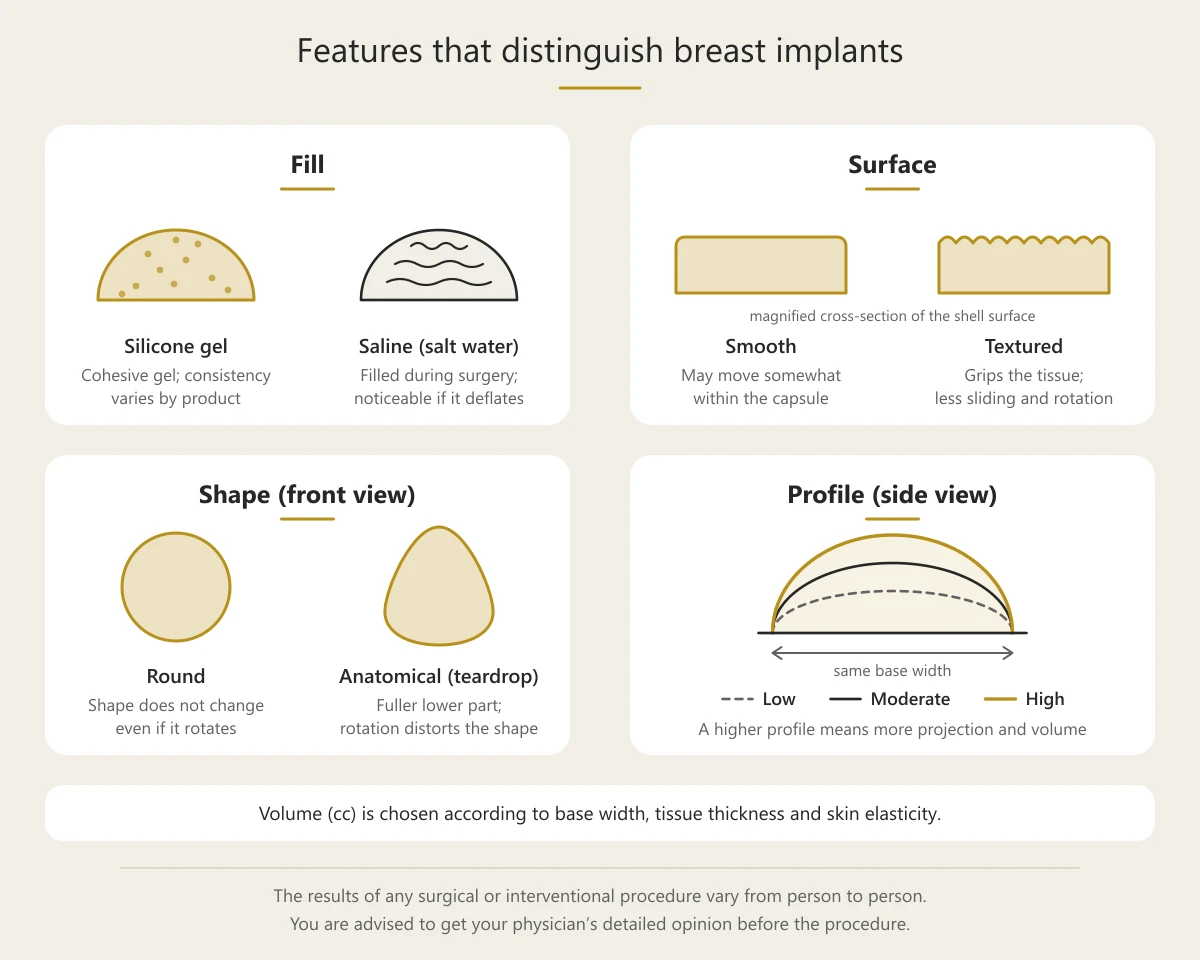
Five basic features distinguish one implant from another: filling, surface, shape, profile and volume. These features are not chosen independently of each other; anatomical (teardrop) implants, for example, are usually made with a textured surface and a firmer gel. The table below summarizes what each feature affects.
| Feature | Options | What does it affect? |
|---|---|---|
| Filling | Silicone gel; saline (sterile salt water) | How the implant feels to the touch, how a rupture is noticed, the length of the incision |
| Surface | Smooth; textured surfaces of varying degrees | How the implant moves within its pocket, its tendency to rotate, its link with BIA-ALCL (a rare lymphoma) |
| Shape | Round; anatomical (teardrop) | How fullness is distributed between the upper and lower parts of the breast; whether the shape is affected if the implant rotates |
| Profile | Low, moderate, high, extra-high | How far the breast projects when seen from the side |
| Volume | Stated in cc (milliliters) | The amount of enlargement; the load placed on the skin and breast tissue |
Filling: Silicone Gel and Saline
In silicone gel implants the gel is cohesive, meaning that it holds together; the aim is for the gel to stay in one piece rather than flow and spread, even if the shell tears. The consistency of the gel varies from product to product: softer gels can feel close to natural breast tissue, while firmer, so-called form-stable gels keep the implant’s shape and are used particularly in anatomical implants. The firmer the gel, the more noticeable the implant can feel to the touch.
Saline implants also have a silicone shell; the implant is inserted empty and filled during the operation. For this reason it can be placed through a shorter incision, and the fill volume can be adjusted to a limited extent during surgery. A leaking saline implant does not go unnoticed: as the salt water is absorbed, the breast visibly deflates.
Surface: Smooth and Textured Implants
Smooth implants can move to some extent within the capsule that forms around them. Textured surfaces were developed so that the surrounding tissue grips the implant surface, reducing slipping and rotation of the implant; anatomical implants depend on this grip to stay in place without rotating. The degree of texturing differs greatly from product to product: there are macro- and micro-textured surfaces, very finely textured (nano) surfaces and polyurethane-coated implants.
The choice of surface is also a safety matter. BIA-ALCL, a rare type of lymphoma associated with implants, has been reported more often with textured implants, particularly heavily textured (macro-textured) ones, than with smooth implants; for this reason, some macro-textured implant models were withdrawn from the market in many countries in 2019. On how surface type affects the risk of capsular contracture, however, study results differ, and long-term data on newly developed surfaces are still limited.
Shape and Profile
Because round implants are symmetrical in every direction, the shape of the breast does not change even if they rotate within the pocket. With anatomical implants, which are fuller in the lower part, it becomes important to create a pocket that does not allow the implant to rotate. The difference in appearance between the two shapes is compared on the breast augmentation page.
Profile describes how far the implant projects forward from the chest wall and is always considered together with base width. With the same base width, a higher profile means more projection and more volume; with the same volume, a higher profile means a narrower base. So “high profile” does not, on its own, mean a bigger implant. Because profile names vary from manufacturer to manufacturer, the consultation focuses on measurements rather than names: base width, projection and volume.
How Is the Right Implant Size Chosen?
Implant size is not set only by the size you would like; the measurements of your breasts and chest wall, the thickness of the tissue that will cover the implant and the elasticity of your skin are decisive. The answer to “How many cc?” also becomes clear only after these measurements. At the consultation, the following are usually assessed:
- Width of the breast base: the base width of the implant is chosen so that it does not exceed your existing breast base and fits your chest wall; the volume is often determined by this measurement.
- Tissue thickness: the thickness of the skin and breast tissue in the upper part of the breast and at the breast crease (inframammary fold) is checked. This shows how much tissue will cover the implant and also influences the choice of implant type and placement.
- Skin elasticity and the distance between the nipple and the breast crease: how far the skin can stretch, together with this distance, shows at what level the implant will sit in the breast and whether the breast crease needs to be lowered.
- Rib cage and asymmetry: differences in the rib cage or between the two breasts are measured; if necessary, implants of different volumes are planned for the two sides.
- Expectations and lifestyle: the look you want, the clothes you like to wear and the sports you do are discussed.
Aids such as trial sizers placed inside a bra or 3D simulation can give an idea of the likely size, but they do not show the result exactly. Nor is there a conversion between volume and bra size that works for everyone: the same implant looks different on different chests, and bra sizes vary from brand to brand. Volumes beyond what the tissue can support can thin the skin and breast tissue over the years and may lead to the implant dropping, its edges becoming visible and the need for another operation.
How Long Do Breast Implants Last, and When Are They Replaced?
How long an implant will last cannot be predicted. Long-term follow-up studies show that the longer an implant stays in the body, the more likely problems such as rupture and capsular contracture become; the US Food and Drug Administration (FDA) also stresses that implants are not devices that last indefinitely. It is therefore important for anyone with implants to know from the outset that at some point in their life they may need another operation to have the implants replaced or removed. On the other hand, the age of an implant is not in itself a reason to replace it: if you have no symptoms and no problem is found at your check-ups, there is no need to replace an implant just because a certain number of years has passed. The main situations that raise the question of replacement or removal are:
| Situation | How is it noticed? | Solution usually considered |
|---|---|---|
| Capsular contracture | Hardening of the breast, a rounder shape, the implant being pulled upwards, sometimes pain | In advanced stages, removal of the capsule and replacement of the implant |
| Rupture of a silicone implant | Often causes no symptoms; detected on check-up imaging | Replacement or removal of the implant, together with the capsule if necessary |
| Deflation of a saline implant | The breast becoming noticeably smaller within days | Replacement of the implant |
| The implant slipping down or to the side, the breasts moving closer together in the middle | The nipple pointing upwards, the implant dropping below the breast crease, a change in the distance between the breasts | Narrowing the stretched pocket with stitches, or creating a new pocket for the implant |
| Rippling, a visible or palpable implant edge | Folds that become more noticeable when leaning forward, especially where the tissue is thin | Supporting the tissue with fat transfer, changing the placement or the implant type |
| Sagging | The breast tissue sliding down in front of the implant | A breast lift together with implant replacement |
| Dissatisfaction with size or shape | Your own assessment | An implant of a different volume or type; a lift may be needed when going smaller |
| Infection | Redness, warmth, increasing pain, fever or discharge | Medication; if this does not clear it, removal of the implant, with a new implant planned once the tissues have healed |
| Fluid build-up months or years later | Persistent swelling, usually in one breast | First, an ultrasound and testing of the fluid around the implant (for BIA-ALCL) |
What Is Capsular Contracture?
Capsular contracture is the thickening, hardening and tightening of the capsule that forms around the implant, which then squeezes the implant. It is one of the common problems seen with breast implants and one of the main reasons for further surgery after implant operations. It can develop in one or both breasts; it usually appears in the first years after surgery but can also occur years later. Its severity is graded with the Baker classification, which is widely used in plastic surgery:
| Grade | Examination and appearance | General approach |
|---|---|---|
| Baker I | The breast is soft and looks natural | No treatment needed |
| Baker II | The breast is slightly firm but looks normal | Usually monitored |
| Baker III | The breast is firm and its shape is distorted | Surgery is considered |
| Baker IV | The breast is hard and painful, with marked distortion | Surgery is considered |
What Causes It?
Why the capsule hardens in some people is not fully understood. One of the most widely accepted explanations is that a thin layer formed by bacteria settling on the implant surface (a biofilm) causes continuous, low-grade inflammation. Blood or fluid collecting around the implant after surgery, infection, rupture of the implant and radiotherapy to the breast area are among the factors that increase the risk. In studies, the implant placement (contracture has been reported more often with placement over the muscle), the incision site and the surface type have also been linked with the risk. Careful control of bleeding during the operation, rinsing the implant pocket with antiseptic or antibiotic solutions and inserting the implant with as little handling as possible are measures aimed at reducing the risk; they do not, however, eliminate it completely.
Symptoms and Treatment
At first, you may only notice that the breast is firmer than before. As the condition progresses, the breast becomes rounder and takes on a “ball-like” look, the implant is pulled upwards and a difference develops between the two breasts; in advanced stages, tightness and pain develop as well. The diagnosis is made by examination; before surgery is planned, the integrity of the implant is assessed with ultrasound or MRI.
In Baker grades III and IV, where there is distortion or pain, treatment is surgical: the thickened capsule is partly or completely removed (capsulectomy) and the implant is replaced with a new one. If needed, a new pocket is created for the implant in a different plane; for example, an implant over the muscle can be moved under the muscle. In selected cases, the capsule can be released by cutting it rather than removing it (capsulotomy). The effect of certain medicines and of non-surgical treatments such as ultrasound is based on limited studies. Capsular contracture that has been corrected surgically can come back; this possibility is discussed when treatment is planned.
Rare but Serious Conditions: BIA-ALCL and Others
BIA-ALCL (breast implant-associated anaplastic large cell lymphoma) is a rare type of lymphoma that develops from cells of the immune system; it is not breast cancer. It mostly arises in the fluid or the capsule around the implant, and most cases have been linked to textured implants. The most common sign is persistent swelling in one breast, caused by fluid collecting around the implant, usually years after surgery; less often, a lump, hardening or pain occurs. In that situation, an ultrasound is done first, and the fluid around the implant is drawn off with a needle and examined with special tests. Once the diagnosis is made, treatment is removal of the implant and the entire capsule around it. While the disease is confined to the capsule, this operation is enough for most patients; in advanced cases diagnosed late, additional treatment such as chemotherapy or radiotherapy may be needed, and the disease can be life-threatening.
Extremely rarely, squamous cell carcinoma and some types of lymphoma other than BIA-ALCL have also been reported to develop from the capsule surrounding the implant. These, too, usually appear years after surgery, with swelling, a lump or pain.
Systemic symptoms attributed to implants: some people describe symptoms such as fatigue, joint and muscle pain, forgetfulness and difficulty concentrating, or rashes after getting implants; this picture is also known as “breast implant illness” (BII). The cause of these symptoms is not yet understood and there is no diagnostic test for them; other causes that could produce similar symptoms are also looked for. Some people whose implants are removed and not replaced report that their symptoms lessen, but this is not an outcome that can be predicted for everyone. The FDA has not found a link between silicone gel-filled implants and connective tissue diseases; research on the subject is ongoing.
Check-ups and Imaging with Breast Implants
Implants should be monitored for as long as they remain in the body. The schedule of check-ups after surgery is set by your surgeon; in later years, too, you should be examined whenever you notice a change in your breasts. Imaging has two separate purposes:
- Checking the integrity of the implant: because ruptures in silicone implants are mostly detected only on imaging, the FDA recommends that people without symptoms have their first ultrasound or MRI 5–6 years after surgery and then one every 2–3 years. If there are symptoms or the ultrasound result is unclear, MRI is preferred; MRI is more sensitive than ultrasound at showing a silent rupture. Saline implants do not need regular imaging for this purpose.
- Breast cancer screening: implants do not replace the screening recommended for your age and risk level. The compression applied to the breast during a mammogram can, rarely, damage the implant shell; so mention that you have implants when you book, and the team will adjust the compression and the technique accordingly.
If you need an MRI for another reason, breast implants are usually not an obstacle. If your implant contains a microchip that carries product information, or if you have a tissue expander with metal parts of the kind used in breast reconstruction, tell the MRI team before the scan.
Implant Card and Records
After surgery, you are given an implant card showing the manufacturer, model, volume and serial or lot number of your implants. Keeping this card and your operation report means that your implants can be identified quickly if a check-up, a replacement operation or a product safety notice comes up in the future.
Changes That Need Prompt Examination
- Swelling in one breast that develops quickly or does not go away
- A newly noticed lump in the breast or armpit
- Redness, warmth, increasing pain or fever
- Hardening of the breast, or a change in its shape or size
- The incision opening, the skin thinning or the implant becoming visible under the skin
How Is Breast Implant Replacement Performed?
Breast implant replacement (implant exchange) is an operation in which the existing implants are removed and new ones are put in their place; often, the capsule and the pocket around the implant are also adjusted in the same session. For this reason, each replacement operation is planned individually, according to the reason for the replacement. The operation is usually performed under general anesthesia, in a fully equipped hospital licensed by the Turkish Ministry of Health, and consists mainly of the following steps:
- Incision: the scar from the previous operation is often used. When the capsule is to be removed or the pocket reshaped, an incision in the breast crease can give a wider working area.
- Removing the implant: the old implant is removed and checked for integrity; if silicone gel has escaped outside the capsule, the surrounding tissues are cleaned as thoroughly as possible.
- Assessing the capsule: a thin, soft capsule can be left in place. If there is capsular contracture, rupture or calcification in the capsule, part or all of the capsule is removed. If BIA-ALCL has been diagnosed, the capsule is removed together with the implant, in one piece if possible, and the removed tissue is sent for pathological examination.
- Adjusting the pocket: if the implant has slipped down or to the side, the stretched pocket is narrowed with stitches placed in the capsule; if this will not be enough, the implant is moved into a new pocket created in a different tissue layer.
- Placing the new implant: the type and volume of the new implant are chosen according to the thickness of your tissue, the condition of the pocket and your expectations; once the implants are in, the two sides are checked for symmetry.
- A lift if needed: if the breast has sagged, a breast lift (mastopexy) can be carried out together with the implant replacement; depending on the condition of the tissue, the two procedures can also be planned in separate sessions.
- Closure: when the capsule has been removed, a drain is often placed for a short time to prevent fluid from collecting; after the wound has been stitched, you are fitted with a surgical bra that supports the breast.
The length of the operation depends on what needs to be done: an operation in which only the implant is replaced often takes about as long as the original augmentation, while capsule removal, pocket adjustment or a lift makes it longer. Most patients stay in the hospital for one night.
Recovery After Implant Replacement or Removal
The table below is a general guide; additional procedures such as capsule removal or a lift lengthen recovery. Your personal timetable is given at discharge and at your follow-up visits.
| Period | What usually happens? | Recommendations |
|---|---|---|
| First 2–3 days | Tightness, swelling and mild to moderate pain; if the capsule was removed, the swelling can be more noticeable. | Pain is usually controlled with the medication prescribed; short walks start in the first days. If a drain was placed, it is removed within a few days, once the fluid decreases. |
| Week 1 | Pain eases considerably. | Return to desk work is usually at the end of the first week; if the capsule was removed or a lift was added, usually within 7–10 days. |
| Weeks 2–6 | Swelling continues to go down; the implant begins to settle into place. | The surgical bra is usually worn day and night for the first month (usually 4–6 weeks if a lift was added). Avoid heavy lifting and movements that strain the arms. |
| Weeks 6–8 | Daily life largely returns to normal. | Strenuous sports can usually be resumed after at least 6–8 weeks, depending on the assessment at your follow-up visit. |
| Months 3–6 | The remaining swelling resolves; the breast begins to take on its final shape. | The final appearance is usually assessed during this period; in breasts whose implants have been removed, the tissues can take months to recover. |
| 6 months – 1 year | The scar matures; in most people it becomes thinner and fades. | Protect the scar from direct sun throughout the first year. |
Risks of Implant Replacement
Replacement and removal operations carry risks similar to those of the first operation: bleeding and a collection of blood, a collection of fluid, infection, delayed wound healing, a noticeable scar, a difference between the two sides and changes in nipple sensation. In tissue thinned by previous operations, implant edges can become noticeable more easily and rippling can occur; capsular contracture can develop again, and some people may need a further correction. Removing the entire capsule is a more extensive procedure; where the capsule is attached to the ribs, an injury involving the membrane around the lung (pneumothorax) can rarely occur. The risks that apply to you are discussed in detail at your consultation and during the informed consent process before the operation.
Breast Implant Removal
Implants may be removed because of a complication, because of symptoms attributed to them, or because the person no longer wants to have implants. Removal surgery is similar to a replacement operation without a new implant; however, because the breast will take shape again without the volume the implant provided, the plan is made with this in mind. The main options are:
- Removing the implant only: a capsule that is causing no problems may be left alone; this keeps the surgery limited and lowers the likelihood of local problems such as bleeding.
- Removal together with the capsule: the situations that call for removing part or all of the capsule are the same as those listed for replacement surgery. Whether a capsule without problems should always be removed is debated; the decision is based on the findings.
- Combined with a lift: skin that has been stretched by the implant can look empty and saggy after the implant is removed. In this case, a breast lift can be done in the same session or after waiting a few months for the tissues to recover.
- Combined with fat transfer: to replace part of the lost volume, fat taken by liposuction from an area such as the abdomen or thighs can be injected into the breast. Because part of the injected fat is absorbed, the gain in volume is limited and a second session may be needed.
How the breast looks after its implant has been removed depends on the size of the implant, how long it was in place, the thickness of the breast tissue and the elasticity of the skin. The breast may look smaller and looser than before the removal; wrinkling or dimpling of the skin, or a slight hollowing of the chest wall, may be noticeable. Some of these changes lessen over the following months. Before the operation, these possibilities and which option suits you are assessed together.
What Affects the Cost of Breast Implant Surgery?
The fee for breast implant surgery varies from person to person and is set once your personal plan has been finalized at the consultation. The main factors that affect the fee are:
- The type of operation: placing implants for the first time, replacing implants or removing them
- Additional procedures such as capsule removal, pocket adjustment, a lift or fat transfer
- The type of implant to be used
- The type of anesthesia, the length of the operation and the hospital stay
- Tests and imaging before the operation (ultrasound or MRI) and, if needed, pathological examination
- Supplies such as the surgical bra, and follow-up visits
An examination is needed before a fee can be given; to arrange a day and time for your consultation, please use our contact details.
Traveling to Istanbul, Turkey, for Breast Implant Surgery
Before you travel, you can send photos on WhatsApp for a preliminary assessment and receive your plan in writing; to begin, contact us. The examination and the operation plan are made in person in Istanbul, and the operation takes place in a fully equipped hospital licensed by the Turkish Ministry of Health. For breast surgery, plan to stay in Istanbul for about 6–7 nights; your surgeon decides when you are fit to fly home. Back home, follow-up continues with photo reviews on WhatsApp, and your medical records are given to you in English.
Frequently Asked Questions about Breast Implants
What happens if a silicone implant ruptures?
When the shell tears, the cohesive gel usually stays inside the capsule around the implant (intracapsular rupture), and the appearance of the breast may not change. If the gel escapes outside the capsule, small firm lumps in the breast or armpit, a change in shape, pain or altered sensation can occur. A rupture is not an emergency; once it has been confirmed by MRI, replacement or removal of the implant is planned.
When will my implants soften and settle into place?
In the first weeks after surgery, implants can sit higher and feel firmer than they should, because of swelling and the tightness of the skin and chest muscle. As the tissues relax, the implant settles downwards, the breast softens and its lower part becomes fuller; this process is completed over a period of months and can take longer with implants placed under the muscle. The two sides may not settle at the same pace; if one implant still sits clearly higher and feels firm after several months, it should be assessed at a follow-up visit.
Can massage get rid of capsular contracture?
There is no strong evidence that established capsular contracture regresses with massage. Some surgeons recommend gentle massage in the first months, particularly after smooth implants; with textured implants, massage is usually not recommended, because the aim is for the tissue to grip the implant surface. Ask your surgeon whether you should massage and, if so, how. The old method of breaking the capsule by squeezing the breast forcefully from the outside (closed capsulotomy) is not recommended, because of the risk of implant rupture and bleeding.
Can silicone implants be seen or felt?
That depends on the size and profile of the implant, the plane it is placed in, the thickness of the tissue covering it and your skin type. In people who have enough breast tissue and an implant sized to suit that tissue, the implant is often not noticeable from the outside; in slim people and with large implants, the edges can be felt, and rippling can appear when leaning forward or lying down. To the touch, a breast with an implant can feel slightly firmer and rounder than one without. Because the result varies from person to person, exactly how it will look cannot be predicted in advance.
How much does an implant weigh, and will it make my breasts feel heavy?
Because silicone gel has a density close to that of water, an implant’s weight in grams is roughly equal to its volume in cc; as a rough guide, you can count about 100 grams for every 100 cc. With moderate volumes, most people do not notice this weight in daily life once healing is complete. The larger the volume, the heavier the implant; over the years, this extra load can contribute to stretching of the skin and sagging of the breast.
I don’t know the type or size of my implants. What should I do?
First, you can ask the institution where you had the operation for your operation report and the product details of the implants used; if your implant card has been lost, this information is often in the institution’s records. If the information cannot be found, an examination with ultrasound or MRI gives an idea of the implants’ integrity, approximate size and placement, but it does not always show the model and the surface type. Knowing the surface type also helps in planning follow-up with regard to BIA-ALCL; if a replacement is planned, the implant is identified during the operation.
Can the size be changed when implants are replaced?
Yes; in a replacement operation, a smaller, larger or differently shaped implant can be chosen. When you move to a smaller implant, the skin and the pocket may be too loose for the new volume, so the pocket is tightened and a lift is added if necessary. A larger implant is planned only if the skin and breast tissue can carry the new volume; tissues that have held implants for a long time may have become thinner. The new size is determined by the current condition of the breast rather than by the measurements of the old implant.
I have textured implants. Should I have them removed because of the lymphoma risk?
For people without symptoms, the FDA does not recommend removing implants solely because of the risk of BIA-ALCL; this also applies to people who have one of the models withdrawn from the market. What matters is to be examined without delay if you notice a change in your breast, and to keep up with your check-ups. If you remain worried, you can discuss the options of replacing or removing the implants, together with the risks of those operations, at your consultation.
Consultation and Appointments
If you have had implant surgery before, bringing your implant card, your operation report and any recent ultrasound, MRI or mammogram results to the consultation makes the assessment easier. You may find it helpful to ask these questions at the appointment:
- Which implant surface, shape and profile do you recommend for me, and why?
- What volume can my tissue carry?
- What check-up and imaging schedule is right for my implants?
- Is there a problem with my current implants? Do they need replacing or removing?
- Will I need capsule removal, a change of pocket or a lift?
- When can I return to work, sports and my daily routine?
- What does the fee include?
Results vary from person to person; the aim of the consultation is to work out together whether there is an option that suits you and, if so, which one. Op. Dr. Ayberk Akçay is a plastic, reconstructive and aesthetic surgeon, a Fellow of the European Board of Plastic, Reconstructive and Aesthetic Surgery (EBOPRAS) and a full member of the Turkish Society of Plastic, Reconstructive and Aesthetic Surgeons; his practice is in Teşvikiye, Şişli, Istanbul. You can read about his training and memberships and reach us through the contact page to book an appointment at the practice in Istanbul.