
A lip lift is an operation that shortens the distance between the base of the nose and the upper lip: a thin strip of skin is removed from just below the nose and the upper lip is lifted. The aim is for more of the red part of the upper lip (the vermilion) to show, so that the lip looks fuller and turns up slightly. In the most commonly used method, the incision is placed in the natural crease at the base of the nose; because of its shape, this incision line is called the “bullhorn”. The procedure is usually done under local anaesthesia and leaves a permanent scar at the base of the nose.
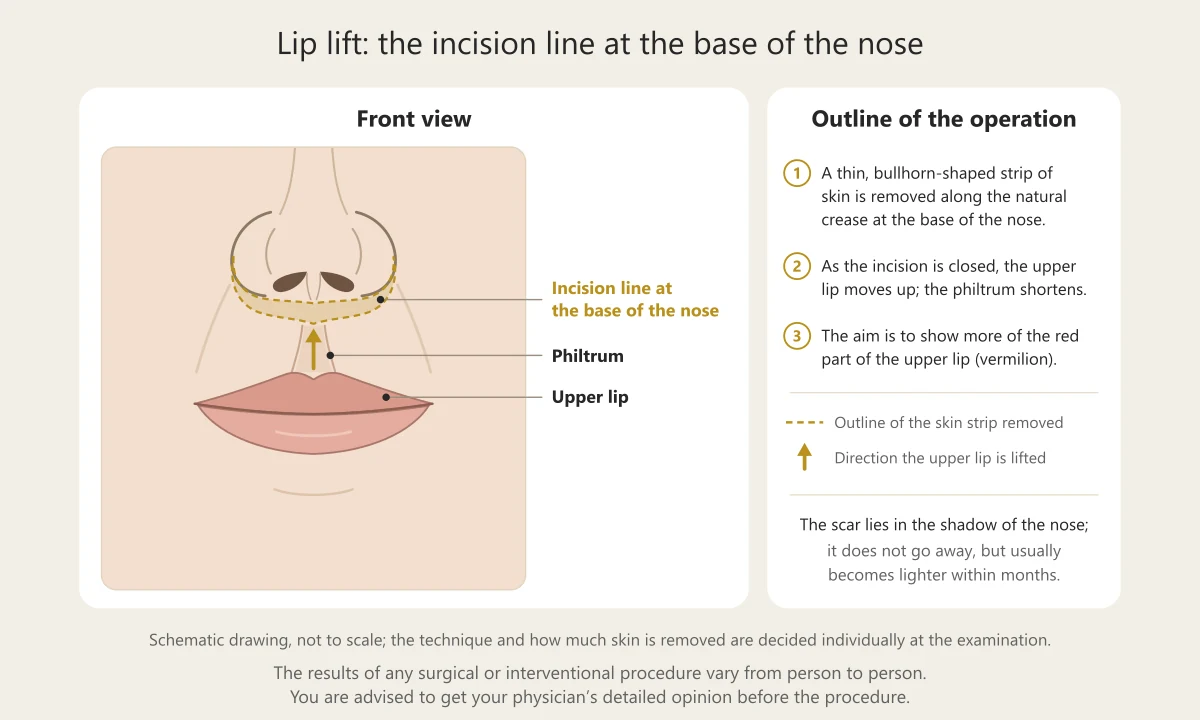 The results of any surgical or interventional procedure vary from person to person. You are advised to get your physician’s detailed opinion before the procedure.
What is a lip lift?
The philtrum is the groove between two fine ridges in the middle of the skin that runs from the base of the nose down to the red part of the upper lip. A lip lift is a cosmetic facial operation that shortens the vertical length of this area; it is also known as an upper lip lift or upper lip shortening. When the skin under the nose is shortened, the upper lip is lifted, and its red part, which had curled inwards, turns slightly outwards and shows more. The amount of the upper front teeth that shows at rest usually increases a little as well.
No filler or other substance is added to the lip during the operation. The lip looks fuller not because its volume increases but because more of its red part shows.
Why does the upper lip get longer?
In some people, a long distance between the nose and the lip is a facial feature they are born with. In most people, however, this distance lengthens with age: the skin loses its elasticity, the muscle and fat around the lips become thinner, and the support that the upper jawbone gives the lip decreases over the years. As a result, the upper lip drops and thins, and its red part curls inwards; at rest, less of the upper teeth and more of the lower teeth start to show. These changes can give the face a tired look or make it look older than it is.
Which techniques are used?
- Lift from below the nose (subnasal lip lift, bullhorn technique): this is the most commonly used method. The incision follows the natural crease that runs from the base of one nostril wing to the other, so that the scar stays in the shadow of the base of the nose. The central and side parts of the lip are lifted together.
- Corner lip lift: in people whose mouth corners turn downwards, making the face look sad or tired, a small piece of skin is removed just above each corner of the mouth and the corners are lifted. It does not shorten the distance between the nose and the lip; it can be planned on its own or together with a subnasal lift.
There are also less commonly used techniques, such as the direct lift along the border of the lip (the gull-wing technique) and the method known as the “Italian” lip lift, which uses just two small incisions below the nostrils. Which technique suits you is decided at the examination, based on the structure of your lip and the base of your nose.
Who is a good candidate for a lip lift?
This operation is considered when the lip looks thin because the upper lip is long, not because it lacks volume. Suitable candidates usually have:
- A long distance between the nose and the lip compared with the other proportions of the face; it may have lengthened with age or been long from birth.
- An upper lip that looks thin, with its red part curled inwards, especially when adding volume with filler has made the lip look heavy or pushed forward, or has not given the look they hoped for.
- Very little or none of the upper teeth showing at rest and when speaking.
- A decision made in the knowledge that a permanent scar will remain at the base of the nose.
Who is a lip lift not suitable for, and who needs extra caution?
- A short philtrum: in people whose nose-to-lip distance is already short, shortening the lip further can look unnatural and leave the lips unable to close without effort.
- A gummy smile: in people whose gums show noticeably when they smile, lifting the lip can make the gums show even more.
- Teeth and jaw structure: the reason the upper teeth show little may lie not in the lip but in worn or short teeth, ill-fitting dentures or the structure of the upper jaw. In that case, a lip lift alone may not give the expected effect; if necessary, a dentist’s or orthodontist’s opinion is sought, and if dental treatment is planned, the order of the treatments is discussed together.
- Smoking: smoking impairs the blood supply to the incision line and wound healing, and makes poor scar healing more likely. Stopping smoking for at least a few weeks before and after the operation is recommended.
- Scarring tendency and general health: a history of thick scars or keloids, uncontrolled diabetes, bleeding or clotting disorders and frequently recurring cold sores are assessed separately before surgery. Cosmetic operations are postponed during pregnancy and breastfeeding.
- Unrealistic expectations: the operation does not significantly increase the volume of the lip and does not change the overall structure of the face; the intended look is planned according to your own facial proportions.
Lip lift or lip filler?
The two treatments address different problems: lip filler increases the volume of the lip, while a lip lift shortens the distance between the nose and the lip. Filler alone in a long upper lip does not change this distance; repeated, heavy filling can make the lip look heavy and pushed forward. On the other hand, someone whose upper lip is of normal length and who simply wants a fuller lip may not need surgery.
| Feature | Lip lift | Lip filler |
|---|---|---|
| What does it change? | The length of the upper lip, that is, the distance between the nose and the lip | The volume and contour of the lip |
| How is it done? | Surgery: a thin strip of skin is removed through an incision at the base of the nose; usually under local anaesthesia | Injection with a fine needle or cannula; no incision is made |
| How often is it done? | Usually a single operation | Treatments are repeated as the effect wears off |
| Scar | A permanent line in the crease at the base of the nose | No surgical scar, as no incision is made |
| How long does it last? | Long-lasting; the lip may change again with ageing | Usually 6–12 months; varies with the person and the product used |
| Can it be reversed? | No; it is a surgical change | Hyaluronic acid fillers can be dissolved if necessary |
The two treatments do not have to be alternatives to each other either: if more volume is wanted after the length of the upper lip has been corrected surgically, filler can be planned once healing is complete. Filler also has uncommon but serious risks, such as blockage of a blood vessel; these risks are discussed in detail at the examination.
How is a lip lift performed?
- Examination and measurements: the distance between the base of the nose and the border of the lip, the height of the red part of the lip, how much of the teeth and gums shows at rest and when smiling, the shape of the base of the nose and the nostrils, differences between the two sides and the skin type are assessed; photographs are taken from different angles.
- Preparation: medicines and herbal supplements with a blood-thinning effect are stopped with your doctor’s knowledge. If sedation is planned, you will be asked not to eat for some hours before the operation.
- Marking: the strip of skin to be removed is drawn on the base of the nose while you are sitting up. The strip is a few millimetres wide and is planned to the millimetre according to the measurements; even a difference of a few millimetres can noticeably affect the result.
- Anaesthesia: the operation is performed in a fully equipped hospital licensed by the Turkish Ministry of Health. On its own, it is usually done under local anaesthesia, with sedation (a light sleep) if you wish; when it is combined with another operation, general anaesthesia may be preferred.
- Removing the strip of skin: the bullhorn-shaped strip that follows the crease at the base of the nose is removed, and the upper lip is released so that it can reach its new position without tension.
- Stitches: the load of holding the lip in its new position is carried by deep, dissolving stitches placed in the firm tissues at the base of the nose, with the aim of reducing tension on the skin edges. The skin is closed with very fine stitches.
- Going home: after a procedure under local anaesthesia or sedation, most patients go home the same day after a short period of observation. If you have had sedation, someone should accompany you home and you should not drive that day.
On its own, a subnasal lip lift usually takes between 30 minutes and 1 hour. It takes longer when a corner lip lift is added or when it is done in the same session as another operation.
What is recovery like after a lip lift?
Recovery varies from person to person. The table below gives a general outline; your personal timetable is given to you when you are discharged.
| Period | What usually happens | What to do |
|---|---|---|
| First 2–3 days | Swelling, tightness and tenderness of the upper lip are at their most noticeable; there may be mild bruising. Pain is usually mild and is controlled with the prescribed medicines. | Sleep on your back with your head raised; apply cold compresses as your doctor advises; eat soft foods; avoid opening your mouth wide and pulling at the lip; brush your teeth carefully with a small, soft toothbrush. |
| Week 1 | Swelling starts to go down. Stitches are usually removed on day 5–7. | Clean the incision line as your doctor shows you and apply the recommended ointment; do not put make-up on the incision until the stitches are out. |
| Week 2 | Most of the swelling and tightness usually subsides by the end of the second week. A feeling of stiffness in the lip when smiling, speaking and eating may continue for a while. | Once the wound has closed, start scar care with silicone gel or tape, with your doctor’s approval; from this point, make-up can be applied over the scar. |
| Weeks 3–6 | Lip movements gradually become softer. The scar is pinkish-red and may be slightly firm or raised. | Return to strenuous exercise during this period, with your doctor’s approval; protect the scar from direct sun. |
| Months 2–6 | The tissues settle; the final position of the lip usually becomes clear within 3–6 months. The scar gradually fades in colour. | Wear a wide-brimmed hat and high-protection sunscreen outdoors. |
| 6–12 months | The scar matures: it softens, flattens and its colour comes closer to that of the surrounding skin. In some people this takes longer. | Keep protecting the scar from the sun throughout the first year. |
In the first weeks, the lip may look more lifted than intended and the area under the nose may look tight; this is due to swelling and to the tissues not having settled yet. As the tissues relax, the lip settles a little lower and its movements become more natural. This is why you need to wait a few months before judging the result. It is advisable to avoid hot environments such as saunas, Turkish baths and sunbeds in the first weeks.
Symptoms to report to your doctor straight away
- Rapidly increasing swelling or tightness on one side, or pain that does not respond to medication.
- Fever; increasing redness, warmth or discharge along the incision line.
- The stitch line opening, or the edges of the wound darkening.
- Fluid-filled blisters appearing on the lip or around the nose.
Will a lip lift leave a scar?
Yes. As with any operation that involves an incision, this operation leaves a scar, and the scar is permanent. Because the lip lift scar is placed in the natural crease and shadow at the base of the nose, in most people it becomes a fine line over time; even so, it is noticeable in the first months and, even after healing, it can be seen up close, without make-up or in certain light.
How the scar finally looks depends on your skin type, the tension on the incision line, how the wound heals and factors such as sun exposure and smoking. With a corner lip lift, the scars lie just above the corners of the mouth, so they may be more visible than the scar at the base of the nose.
Risks and possible complications
Serious complications are rare, but like any surgical procedure, this operation has risks. Appropriate patient selection and careful planning reduce the risks but do not eliminate them completely:
- A noticeable, wide or thick scar: over time the scar may widen or thicken (hypertrophic scar), rarely turn into a keloid, or stay a different colour from the surrounding skin; fine thread veins may become visible around it. In such cases, options such as injecting medication into the scar, laser treatment or surgical correction of the scar (scar revision) are considered; these treatments do not remove the scar but aim to make it less noticeable.
- Asymmetry: a difference may remain between the two sides of the lip or the base of the nose. Most faces already have a slight asymmetry before surgery, and this difference may persist afterwards.
- Under- or overcorrection: once the tissues have settled, the change may turn out smaller than expected. Shortening the lip too much, on the other hand, can make the teeth or gums show more than they should, make it an effort to close the lips and create an artificial look. An over-shortened lip is difficult to lengthen again, which is why the amount of skin to be removed is planned cautiously.
- Changes at the base of the nose and in the nostrils: the shape of the lower edge of the nostrils or of the base of the nostril wings may change; the angle between the nose and the lip may narrow, and the tip of the nose may look more prominent or the base of the nose slightly wider.
- Changes in sensation: numbness or tingling in the upper lip and at the base of the nose are common; they usually resolve within weeks to months and occasionally last longer.
- Wound-healing problems: infection, bleeding or a collection of blood, the stitch line opening and a tissue reaction to the stitch material.
- Risks related to anaesthesia: uncommon reactions to local anaesthetic drugs or to sedation; when general anaesthesia is used because the operation is combined with another one, the risks specific to general anaesthesia.
The possible risks are assessed for you individually at the examination and explained openly.
Can a lip lift be combined with other facial surgery?
This operation can be done on its own or planned in the same session as operations on other areas of the face; in that case, general anaesthesia is usually preferred.
- With a facelift: facelift operations target the cheeks, the jawline and the neck; they do not shorten a lengthened upper lip. In people planning facial rejuvenation whose upper lip has also lengthened, a lip lift can be done in the same session as a deep plane facelift, so that the lower part of the face is treated as a whole.
- With rhinoplasty: the shape of the nasal tip and the base of the nose affects how the upper lip looks, and a change in the lip is also reflected in the appearance of the nose. So in people who are considering a nose job (rhinoplasty) and have a long upper lip, the two areas are assessed together. In suitable patients, both procedures can be done in the same session; however, in open rhinoplasty the incision across the columella (the strip of skin between the nostrils) and the incision at the base of the nose lie very close to each other, so in some cases the two procedures are done in separate sessions to protect the blood supply to the skin between them.
What does the cost of a lip lift depend on?
The fee is not the same for everyone; it is set at the examination, once your individual plan is clear. The main factors are:
- The technique: a subnasal lift alone, or combined with a corner lip lift?
- The type of anaesthesia (local anaesthesia, sedation or general anaesthesia) and the length of the operation.
- Whether it is done in the same session as another operation, such as a facelift or rhinoplasty.
- Follow-up appointments after the operation, removal of the stitches and scar care.
If you have questions about the fee, you can reach us through the contact page.
Travelling to Istanbul, Turkey, for a lip lift
Before you travel, you can send photos on WhatsApp for a preliminary assessment, and the plan is given to you in writing; to get started, contact the practice. The examination and the operation plan are made in person in Istanbul, and the operation takes place in a fully equipped hospital licensed by the Ministry of Health. The length of your stay depends on the procedure and is confirmed in your written plan before you book flights; the surgeon decides when you are fit to fly home. After you return home, follow-up continues with photo reviews on WhatsApp, and your medical records are given to you in English.
Frequently Asked Questions about Lip Lifts
How long does it take to recover from a lip lift, and when can I go back to work?
The incision line usually closes within the first week, and most people return to desk work and daily life once the stitches are out. At this stage the line under the nose is still red and the upper lip may look slightly swollen; if your job involves meeting many people face to face or being on camera, you may prefer to wait a few more days. When you can return to physically demanding work is decided at a follow-up examination.
Will I feel pain during the operation, and will I be awake?
With local anaesthesia, the lip and the base of the nose are numbed with a fine needle; you may feel a brief sting and burning while this is done. Once the area is numb, you are not expected to feel pain, only touch and pulling. Under local anaesthesia you are awake; if you think you will feel anxious during the procedure, sedation can put you into a light sleep, and this option is discussed at the examination.
How long does a lip lift last?
Because the skin removed during the operation does not grow back, the effect does not disappear within months as it does with filler. Ageing continues, however: as the skin goes on losing its elasticity, the upper lip may lengthen a little again over the years, and some studies have reported that part of the shortening achieved decreases over time. How well the result holds varies from person to person, depending on skin type, age and factors such as sun exposure and smoking.
Can I have a lip lift if I have had lip filler before?
Usually yes, but you must mention it at the examination. Filler in the lip can make its length and volume look different from what they really are and can affect how much skin is planned for removal. So you may be advised to wait for the filler to wear off or, with hyaluronic acid fillers, to have the filler dissolved; the decision depends on the type and amount of filler and when it was injected. Long-lasting fillers that cannot be dissolved and previous lip surgery also affect the planning.
Is a lip lift also done for men?
Yes. Men, too, can have an upper lip that is long from birth or lengthens with age. Planning takes the proportions of the male face into account: in men, the distance between the nose and the lip is usually slightly longer than in women, and shortening the lip too much may not look natural on a male face. Hair in the moustache area can partly hide the scar line; when you can start shaving this area again is decided at a follow-up examination.
What can be done if the corners of my mouth turn down?
Downturned mouth corners are a feature some people are born with, while in others they become more noticeable with age. If the problem lies only in the position of the corners, a corner lip lift can be considered. If the drooping corners come with sagging in the cheeks and along the jawline, or with deep lines running from the corners of the mouth down to the chin, a corner lift alone may not be enough; in that case, options such as a facelift, fillers or botulinum toxin in the muscle that pulls the corner of the mouth down are also considered.
Will a lip lift also smooth the fine wrinkles above the lip?
The fine vertical lines above the lip (often called smoker’s lines) come from ageing of the skin itself and the constant movement of the muscle around the lips. The operation does not aim to remove these lines; because the skin is tightened a little, they may soften slightly in some people. Separate treatments such as fillers, botulinum toxin or skin resurfacing can be considered for these lines.
Can the result be corrected if it is not as expected?
If necessary, yes; the need for a correction usually relates to the appearance of the scar, a slight asymmetry or too little lift. Because the lip takes time to reach its final shape and the scar takes time to mature, it is usual to wait a few months before deciding on a further procedure. If the lip has been lifted too little, a second skin removal can be planned. Bear in mind that every corrective procedure also carries its own risks.
At what age can a lip lift be done?
There is no fixed upper age limit; the decision depends more on the structure of the lip than on age. It can be done both in young adults whose upper lip has been long from birth and in people whose upper lip has lengthened with age. A cosmetic lip lift is not performed on young people whose facial growth is not yet complete; in older patients, general health and the medicines they take are assessed separately.
Consultation and appointments
At the examination, the distance between your nose and lip, how much your teeth show, the structure of the base of your nose and your expectations are assessed together; the technique and the amount of skin to be removed are planned on this basis. It can be useful to ask these questions at the consultation:
- Is my upper lip really long, or would filler or another method be more suitable?
- How much skin will be removed, and how much of my teeth and gums will show when I smile?
- Exactly where will the scar be, and what will I need to do to help it heal?
- What type of anaesthesia will be used, and will I be able to go home the same day?
- Would it be suitable for me to plan it together with rhinoplasty or a facelift?
- Does the fee include follow-up examinations and removal of the stitches?
Results vary from person to person; the purpose of the examination is to establish whether this operation is the right option for you. Op. Dr. Ayberk Akçay is a plastic, reconstructive and aesthetic surgeon, a Fellow of the European Board of Plastic, Reconstructive and Aesthetic Surgery (EBOPRAS) and a full member of the Turkish Society of Plastic, Reconstructive and Aesthetic Surgeons; his practice is in Teşvikiye, Şişli, Istanbul. To book an appointment at the practice in Istanbul, please use the contact and appointments page.