
Eye bag surgery, known medically as lower blepharoplasty (lower eyelid surgery), is an operation to correct fat that has bulged forward (herniated) in the lower eyelid and formed a bag. The fat is removed in measured amounts or repositioned to fill the hollow just below the bag, and excess skin is also removed if needed. If the skin does not sag noticeably, the procedure can be done from the inner surface of the eyelid, with no cut in the skin. Below you will find the causes of eye bags, the surgical techniques, recovery, the risks and the factors that determine the fee.
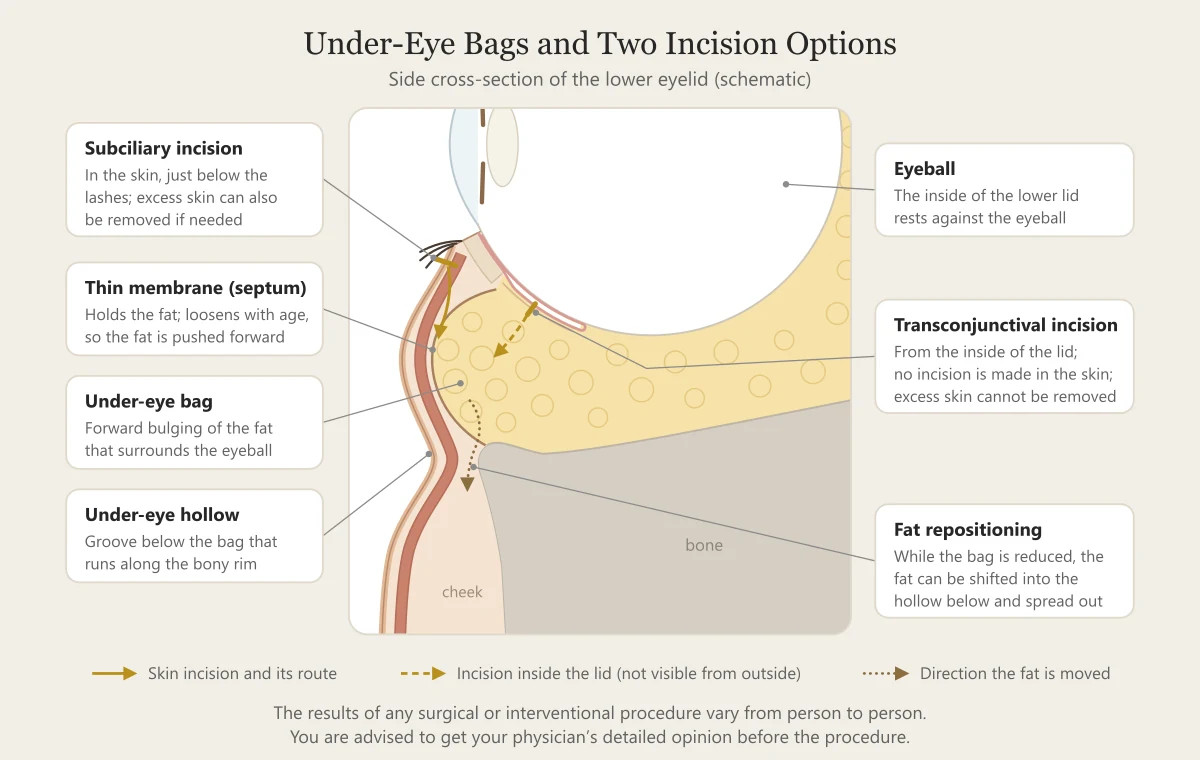 The results of any surgical or interventional procedure vary from person to person. You are advised to get your physician’s detailed opinion before the procedure.
Why do under-eye bags form?
The eyeball is surrounded by fat that cushions it like a pillow. At the front, this fat is held in place by a thin membrane (the orbital septum) and by the supporting tissues of the lower eyelid. With age, the membrane and the supporting tissues slacken, and the fat is pushed forward, creating a bulge in the lower eyelid. Because the fat of the lower eyelid sits in three separate compartments (inner, middle and outer), a bag can appear as a single swelling or as two or three bulges side by side. A family tendency plays an important part when bags become prominent at a young age; sun damage and smoking also speed up skin ageing and can make the bags look more prominent.
Not all puffiness under the eyes is a fat bag. Fluid retention caused by a salty diet, lack of sleep, alcohol, allergies or sinusitis produces swelling that is worse in the morning and goes down during the day; surgery does not correct this, and the cause needs to be addressed first. A fat bag, on the other hand, hardly changes during the day and often becomes even more prominent when you look up. If the swelling has appeared over a short time, affects only one eye, or comes with redness, pain or changes in vision, a medical cause, including thyroid disease, needs to be investigated.
Eye bags or tear troughs?
A tired look under the eyes is often the sum of several different changes. The bag is fat that bulges forward. The tear trough (under-eye hollow) is the groove just below the bag, running along the bony rim of the eye socket; it deepens as the cheek tissue descends with age and the area loses volume. When the bulge of the bag combines with the shadow of the hollow below it, the area under the eyes can look both puffy and dark. Each of these calls for a different approach:
| Appearance | Cause | Approach that may be considered |
|---|---|---|
| Under-eye bag | Fat bulging forward (herniated fat) | Surgery to remove or reposition the fat |
| Tear trough (under-eye hollow) | Loss of volume along the bony rim, descent of the cheek tissue | If there is also a bag, moving the fat into the hollow during surgery; if the hollow is on its own and mild, filler in suitable people |
| Dark circles | Naturally darker skin colour, or blood vessels showing through thin skin | Surgery does not change this colour; only darkness caused by shadow may lessen |
| Fine wrinkles and loose skin | Changes in skin quality | Removing excess skin in measured amounts can reduce looseness and wrinkles to some extent; the texture of the skin does not change |
In some people who have no prominent bag and whose main problem is the hollow, filler placed in the hollow can soften the transition from the lower eyelid to the cheek. Filler does not shrink a fat bag, however, and when it is placed below a prominent bag it can make the area look puffier. The effect of filler fades over time, and in the thin skin under the eyes it carries its own risks, such as swelling, irregularities, discolouration and, rarely, blockage of a blood vessel.
Who is lower eyelid surgery suitable for?
Good candidates for eye bag surgery are usually people who have prominent fat bags that do not change during the day and whose general health does not rule out surgery. If the bags run in the family, surgery may also be considered at a younger age. The aim is a rested-looking under-eye area, not a change in the shape of the eye or in the structure of the skin.
When surgery alone is not enough
- Skin quality: Removing excess skin can reduce looseness and wrinkles to some extent, but the texture of thin, sun-damaged skin does not change, and some fine lines may remain. Because removing more skin than needed can pull the eyelid down, skin is removed from the lower eyelid in measured amounts.
- Sagging cheeks: When the cheek tissue descends, the transition from the lower eyelid to the cheek becomes longer and the hollow deepens. Lower eyelid surgery aimed only at the bag does not lift the cheek; in people whose cheeks and midface sag markedly, planning it together with a deep plane facelift may be considered.
- Swelling over the cheekbones: Puffiness that collects below the tear trough, over the cheekbone, does not come from the eyelid fat, and lower eyelid surgery usually does not correct it.
- Dry eyes, thyroid disease and a lax eyelid: These are assessed separately before surgery. If the lower eyelid is lax, steps to support it are added to the operation; in some cases surgery may not be recommended.
If the upper eyelids also sag, both areas can be treated in the same session. The differences between upper and lower eyelid surgery, and how the two are planned together, are explained on the eyelid surgery (blepharoplasty) page.
Transconjunctival approach or incision below the lashes
In eye bag surgery, the fat can be reached in two ways. The choice depends on whether there is excess skin as well as a bag, and on how firm the lower eyelid is.
Transconjunctival approach (from inside the eyelid)
The incision is made in the thin membrane (conjunctiva) that lines the inner surface of the lower eyelid, facing the eye, and the fat is reached directly from there. Because there is no cut in the skin, there is no incision line visible from the outside; and because the skin and muscle layer that supports the eyelid is left untouched, the edge of the eyelid is generally considered less likely to be pulled down with this method. It suits people whose skin is firm and whose problem is mainly the fat bag. Excess skin cannot be removed this way: if there is a slight excess, removing a thin strip of skin just below the lashes can be planned in the same session, in which case a fine scar remains along the lash line.
Incision below the lashes (subciliary approach, through the skin)
The incision is placed in the line just below the lashes and, if needed, extended a short way at the outer corner into a natural line. Because excess skin as well as fat can be removed through this route, it is preferred for people who have a marked excess of skin as well as a bag. The scar is hidden along the lash line; it may look pink for the first few weeks and, in most patients, fades and becomes inconspicuous within 3–6 months.
Supporting the lower eyelid
At the consultation, the lower eyelid is gently pulled down and released to see how quickly it returns to its place, and pulled forward to see how far it moves away from the eye. If the eyelid is lax, its edge can be supported by tightening the ligament at the outer corner and anchoring it to the bone (canthopexy); if the laxity is marked, additional steps such as shortening this ligament may be needed. This support aims to help prevent the eyelid from being pulled down, especially in operations done through an incision below the lashes.
| Topic | Transconjunctival approach | Incision below the lashes |
|---|---|---|
| Scar on the skin | No cut in the skin; if a strip of skin is also removed, a fine scar remains below the lashes | A fine scar hidden along the lash line |
| Excess skin | Cannot be removed this way; if needed, a thin strip of skin can be removed from just below the lashes | Can be removed in measured amounts |
Removing or repositioning the fat
What is done with the fat that forms the bag is one of the main decisions that shape the result. Removing more fat than necessary can, over time, make the area under the eyes look hollow and tired; this is why the fat is either removed in measured amounts or repositioned by moving it over the bony rim into the hollow below.
- Fat removal: If the bag is prominent and the hollow beneath it is mild, the excess fat is removed in measured amounts.
- Fat repositioning: If there is a marked hollow beneath the bag, the fat is moved from its compartment into the hollow and secured there. The aim is to reduce the bulge, fill the hollow and make the transition from the lower eyelid to the cheek look smoother.
Each fat compartment is assessed separately: fat may be removed from one compartment while the fat of another is moved into the hollow. Both approaches can be carried out through the transconjunctival route or through an incision below the lashes. In the first weeks, the area where the fat has been repositioned may feel slightly firm or uneven; this mostly softens with time.
How is lower eyelid surgery performed?
- Consultation and planning: The examination assesses whether the puffiness comes from fat or from fluid retention, how deep the hollow is, any excess skin, how firm the lower eyelid is, dry eye and the position of the eyeball relative to the cheekbone; the technique is chosen on the basis of this examination.
- Preparation: Medicines such as aspirin that can increase bleeding, herbal teas and supplements are stopped with your doctor’s knowledge; smoking and alcohol should be stopped at least 2 weeks before surgery.
- Anaesthesia: The operation is usually done under local anaesthesia with light sedation; when it is combined with another procedure, or when considered necessary, general anaesthesia may be preferred. Operations are performed in a fully equipped hospital licensed by the Turkish Ministry of Health, with an anaesthesia team present.
- Surgery: The fat compartments are reached through the chosen route; the fat is removed or spread into the hollow and, if needed, excess skin is removed and the eyelid is supported. A skin incision is closed with fine stitches; an incision on the inner surface of the eyelid heals on its own or is closed with dissolving stitches.
- Going home: Most patients go home the same day. Because of the sedation, you should have someone with you on the way home and should not drive that day.
How long the operation takes depends on the technique, on whether the fat is removed or repositioned and on additional steps such as eyelid support. Surgery on the upper and lower eyelids together takes about 1.5–2 hours; for surgery on the lower eyelids alone, you are told the expected duration once the procedure has been planned at the consultation.
Recovery after eye bag surgery
Swelling after lower eyelid surgery may last a little longer than after upper eyelid surgery. The timeline below is a general guide; timings vary with the person and the technique.
- First 48 hours: Bruising, swelling and slight oozing around the eyes; your eyes may feel gritty or water, and the ointment may blur your vision. Regular cold compresses and sleeping with your head raised help to reduce the swelling.
- Days 3–5: The swelling starts to go down and the bruises turn yellow. Use the prescribed drops and ointments regularly.
- Week 1: Any stitches in the skin are usually removed during this week or dissolve on their own. Avoid strenuous exercise, bending forward and straining.
- Days 7–10: Most people with desk jobs can return to work once swelling and bruising have largely settled.
- Week 2: The bruising has mostly gone and you can return to social life. Light eye make-up can be started once the incisions have healed; contact lenses are not recommended for the first two weeks.
- Weeks 4–6: Strenuous exercise and heavy lifting can usually be resumed during this period, with your doctor’s approval.
- Months 3–6: The remaining mild swelling resolves, the incision scar fades and the final appearance emerges.
Severe or worsening pain, rapidly increasing swelling in one eye or reduced vision are not expected; if any of these happens, contact your doctor without delay.
What are the risks of eye bag surgery?
As with any surgical procedure, eye bag surgery has risks. Some are a normal, temporary part of healing; others are uncommon and may need further treatment. Careful patient selection, measured planning and operating in a hospital setting reduce these risks but cannot eliminate them completely.
- Temporary symptoms: Swelling, bruising, dry or watery eyes, a gritty feeling, sensitivity to light and blurred vision; temporary swelling of the membrane that covers the white of the eye (chemosis) can also occur. These usually ease in the first few weeks; dryness can last longer in people who had dry eyes before surgery.
- Change in the position of the lower eyelid: The edge of the eyelid may be pulled down, the white of the eye may become visible below the iris, or the outer corner may become rounder; less often, the edge of the eyelid may turn outwards (ectropion). Mild cases mostly improve with follow-up; corrective surgery is rarely needed. Detecting eyelid laxity at the consultation, removing skin in measured amounts and supporting the eyelid when needed all aim to reduce this risk.
- Difficulty closing the eyes fully: In the first days, swelling may stop the eyes from closing completely; this is mostly temporary, and the eyes are protected with drops and ointments during this time.
- Under- or over-correction, asymmetry and scarring: The bag may not be fully corrected, or the area under the eyes may look hollow if too much fat has been removed; a slight difference between the two eyes, or a scar below the lashes that is more noticeable than expected, may remain. Rarely, a small correction (revision) may be needed.
- Bleeding and infection: Slight oozing is possible in the first few days; heavier bleeding or infection is uncommon and may need further treatment.
- Double vision: One of the muscles that move the eye runs between the fat compartments of the lower eyelid; double vision caused by an effect on this muscle is rare and usually temporary.
- Bleeding that can affect vision: A collection of blood behind the eye is very rare but needs emergency treatment.
- Risks of anaesthesia: The specific risks of sedation or general anaesthesia are discussed separately at the pre-operative assessment.
The risks and the precautions to be taken are discussed in detail at the consultation, and they are also explained to you in writing as part of the informed consent process before surgery.
What determines the cost of eye bag surgery?
The fee depends on the technique (transconjunctival or below the lashes), on whether the fat is removed or repositioned, on additional steps such as eyelid support, on whether the operation is combined with another procedure such as upper eyelid surgery, a brow lift or a facelift, on the type of anaesthesia and on the hospital services. The exact fee is therefore given once your eye area has been assessed at the consultation and the plan that suits you has been made. For patients insured under the Turkish social security system (SGK): eyelid surgery done for purely cosmetic reasons is not covered.
Travelling to Istanbul, Turkey, for eye bag surgery
Before you travel, you can send photos of your eyes on WhatsApp for a preliminary assessment, and you receive the plan in writing; to get started, contact the practice. The examination and the operation plan are made in person in Istanbul, the operation takes place in a fully equipped hospital licensed by the Turkish Ministry of Health, and your surgeon decides when you are fit to fly home. The length of your stay depends on the procedure and is confirmed in your written plan before you book flights. After you return home, follow-up continues with photo reviews on WhatsApp, and your medical records are given to you in English.
Frequently Asked Questions about Eye Bag Surgery
How long does it take to recover from eye bag surgery?
Most people can return to a desk job within 7–10 days and to social life in the second week; the bruising usually fades within this time too. Swelling in the lower eyelids may take a little longer to go down than in the upper eyelids. Strenuous exercise usually has to wait 4–6 weeks, and the final appearance emerges within 3–6 months; timings vary from person to person and with the technique.
Can eye bags come back after surgery?
A bag that has been corrected surgically does not usually come back in the same way; in most patients the result of lower eyelid surgery lasts for many years, and the operation rarely needs to be repeated. Surgery does not stop ageing, however: the skin keeps thinning and the cheek tissue keeps descending. How long the result lasts varies from person to person, depending on skin quality, family traits and factors such as sun exposure and smoking.
Can eye bags go away without surgery?
Morning puffiness caused by fluid retention can ease with less salt, regular sleep, treatment of allergies and cold compresses. A bag formed by fat bulging forward, however, does not go away with creams or exercises. Filler does not shrink the bag either; in some people whose bag is not prominent and whose problem comes mainly from the hollow, it can soften the hollow temporarily. Which approach suits you is decided at the consultation.
Will surgery get rid of the dark circles under my eyes?
Some of the darkness under the eyes comes from the shadow cast by the bag and the hollow beneath it; by reducing this shadow, surgery can help the area under the eyes look brighter. Darkness caused by the skin’s own colour or by blood vessels showing through thin skin, however, is not lightened by surgery. Which of these is the main cause is assessed at the consultation.
What is the right age for lower eyelid surgery?
There is no single right age. Requests for surgery because of age-related bags mostly rise after the age of 35–40; if the bags run in the family, surgery can also be done at a younger age. The decision is based not on age but on the structure of the bag, skin quality, eye health and general health.
What should I be careful about after lower eyelid surgery?
In the first weeks, avoid rubbing your eyes, protect them from dust and wear sunglasses outdoors. When you look at a screen for a long time, taking frequent breaks reduces dryness and eye strain; massage or tape around the eyes should be used only as your doctor advises. Sleeping with your head raised in the first days and using the prescribed drops and ointments without missing a dose also support healing. If you notice reduced vision, severe pain or rapidly increasing swelling in one eye, contact your doctor without delay.
Consultation and appointments
Planning is easier if, at the consultation, you mention the medicines you take, any dry eye, thyroid or allergy problems and any eye operations you have had, including laser treatment to correct your eyesight. It is worth going through these questions together:
- Is the look under my eyes caused by fat bags, a hollow or fluid retention?
- Which technique suits me, and will the fat be removed or repositioned?
- Is my lower eyelid lax, and does it need support?
Results vary from person to person; the purpose of the consultation is to establish whether surgery is the right option for you. Op. Dr. Ayberk Akçay is a specialist in plastic, reconstructive and aesthetic surgery, a Fellow of the European Board of Plastic, Reconstructive and Aesthetic Surgery (EBOPRAS) and a full member of the Turkish Society of Plastic, Reconstructive and Aesthetic Surgeons; his practice is in Teşvikiye, Şişli, Istanbul. To have the area under your eyes assessed, you can book a consultation through the contact page.