Buccal fat removal (bichectomy), known in everyday terms as cheek fat removal, means removing part of the buccal fat pad (Bichat’s fat pad), which lies deep in the cheek, through a small incision inside the mouth. The aim is to reduce the fullness that a prominent fat pad creates in the lower part of the cheek and to make the transition between the cheekbone and the jawline more defined. No incision is made in the skin of the face; the small incision inside the mouth cannot be seen from the outside. Buccal fat removal is not a weight-loss method, and not every round face is caused by this fat pad, so the decision is made only after the source of the fullness in the cheeks has been identified at the examination.
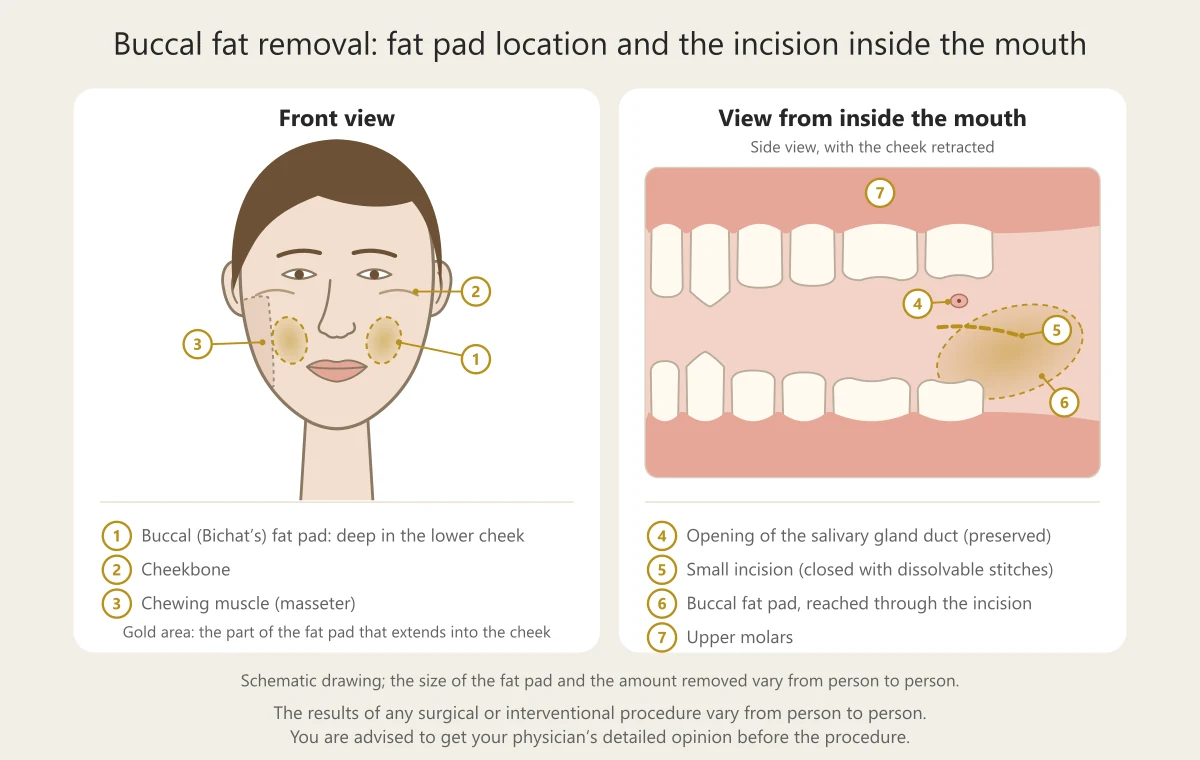 The results of any surgical or interventional procedure vary from person to person. You are advised to get your physician’s detailed opinion before the procedure.
What is buccal fat removal?
The buccal fat pad (Bichat’s fat pad, often simply called “Bichat fat”) is a pad of fatty tissue wrapped in a thin membrane that lies deep in the cheek, between the chewing muscle (masseter) and the cheek muscle that lines the inside of the mouth (buccinator). It is named after the French anatomist Xavier Bichat, who described it at the beginning of the 19th century; the name “bichectomy” comes from Bichat plus the suffix “-ectomy”, meaning removal. It is thought to support the cheek during sucking in infancy and, in adults, to help the chewing and facial expression muscles glide smoothly over one another. The part of the fat pad that extends into the cheek gives fullness to the lower cheek and to the area above and to the side of the corner of the mouth; in some people this part is prominent from birth.
In buccal fat removal, part of the section of the fat pad that extends into the cheek is removed. The goal is to reduce fullness in the area below the cheekbone and give the lower half of the face a slimmer, more balanced contour, not to hollow out the cheeks or create a sunken look. It is a surgical way of slimming the cheeks, but its effect is limited to this fat pad: it does not reduce the fat under the skin, does not change the width of the jawbone or the chewing muscle and does not lift sagging tissues.
What causes fullness in the cheeks?
Different structures can lie behind a face that looks round or full, and several factors are often combined. That is why the first step at the examination is to work out which tissue the fullness comes from:
| Possible cause | Clue at the examination | Approach that may be considered |
|---|---|---|
| A prominent buccal fat pad | The fullness sits below the cheekbone and above and to the side of the corner of the mouth; it does not go away even at a normal weight. | Buccal fat removal |
| General excess weight | There is fat across the whole face and the body; the fullness goes up and down with weight. | First, stabilising your weight; for localised fat deposits on the body, liposuction is considered as a separate procedure. |
| Strong chewing muscles (masseter) | The width is close to the angle of the jaw; a muscle that hardens when you clench your teeth can be felt, and there may be a history of clenching or grinding. | Botulinum toxin injected into the chewing muscle; the effect is temporary and has to be repeated to last. |
| Sagging along the jawline and a double chin | The fullness sits along the edge of the jaw and under the chin; it becomes more noticeable with age. | Double chin liposuction for fat under the chin; a facelift or neck lift for marked sagging. |
| Bone structure | The lower face looks wide even though the soft tissues are thin; the width comes from the jaw and cheekbones. | Buccal fat removal does not change the bone structure; expectations are discussed with this in mind at the examination. |
A swelling on one side of the face that is new, growing or painful is not treated as cosmetic fullness; it may be caused by a problem with a salivary gland, a tooth or a lymph node, so its cause is investigated first.
Can cheeks be slimmed without surgery?
There is no method proven to reduce the deep buccal fat pad without surgery. Non-surgical options help only to a limited extent, depending on the cause of the fullness:
- Losing weight: this can reduce the fat under the skin of the face, whereas the deep fat pad is relatively little affected by changes in weight.
- Fat-dissolving injections: these target the fat under the skin; no effect on the deep fat pad has been shown, and they are no substitute for the surgical procedure.
- Facial exercises and cheek-slimming devices: there is no scientific evidence that they reduce fat in the cheeks.
- Fillers: filler placed on the cheekbones or along the jawline can change the proportions of the face and make the fullness of the cheeks look less noticeable, but it does not reduce fat and its effect is temporary.
If you have had fat-dissolving injections or filler in your cheeks before, you need to mention this at the examination; these treatments can affect the tissues and the surgical plan.
Who is a good candidate for buccal fat removal?
Suitable candidates are usually people in whom the examination shows that the fullness in the cheeks comes mainly from a prominent buccal fat pad. In general, the following are looked for:
- Fullness concentrated in the lower part of the cheek that persists even though weight is normal or stable.
- Cheekbones and an overall facial structure that will stay balanced when volume is reduced.
- Facial growth that is complete.
- No uncontrolled illness, bleeding disorder or clotting disorder that would stand in the way of surgery and anaesthesia.
- For smokers, being able to stop for a while before and after the operation.
- Realistic expectations: the procedure aims to reduce fullness in the lower cheek; it does not copy the look in a photo or on someone else’s face, and results vary from person to person.
Who is buccal fat removal not suitable for?
- People with a naturally slim or narrow face, or with a marked hollow below the cheekbones.
- People whose face has already begun to lose volume with age.
- People planning to lose a lot of weight in the near future, or whose weight changes often.
- People with an untreated infection in the mouth or teeth (this problem is treated first).
- Women who are pregnant or breastfeeding.
- People with conditions such as hemifacial atrophy, which causes progressive tissue loss on one side of the face.
In the first two situations, what is needed is often not less volume but the replacement of lost volume. In that case, methods that work in the opposite direction to buccal fat removal and add volume, such as fillers or fat injections, are discussed.
Will my cheeks look hollow as I get older?
The most important question when deciding is how the face will look years from now. The face naturally loses volume with age: the fat around the cheeks and cheekbones decreases and descends, the bony support weakens and the skin loses its elasticity. If more fat than necessary is removed from a cheek that looks full in youth, then once this natural thinning is added, the cheeks may look hollow years later and the face more tired and older than it really is. Regret after the procedure is also often linked to unsuitable candidate selection or to too much fat being removed.
For this reason, a conservative approach is taken to the amount removed; it is decided not only on the basis of how the face looks today but also with an eye to how it will change over the years. Long-term scientific studies looking at the face ten or twenty years after the procedure are still limited, so it cannot be known for certain in advance how even a measured removal will affect the face over time. The decision should not be rushed, and it should take into account the face as a whole and how it will change in the future.
How is buccal fat removal performed?
- Examination and planning: the source of the fullness in the cheeks, the proportions of the face, the support from the cheekbones, the skin and the difference between the two sides are assessed, and the health of the mouth and teeth is checked. Whether the procedure is suitable and how much will be removed are decided together.
- Preparation before surgery: the necessary blood tests are done. Medicines and herbal supplements with a blood-thinning effect are stopped with your doctor’s knowledge, and you will be asked to stop smoking at least 2 weeks before the operation. Any infection in the teeth or gums is treated first.
- Anaesthesia: the procedure is performed in a fully equipped hospital licensed by the Turkish Ministry of Health. On its own, it is usually done under local anaesthesia, with sedation (a light sleep) if needed; when it is planned together with another operation, general anaesthesia is usually preferred.
- Incision: a small incision is made on the inside of the cheek, at the level of the upper molars. In this area, opposite the upper molars, there is a small bump where the duct of the salivary gland in front of the ear (the parotid gland) opens into the mouth; the incision site is chosen so that this opening is protected.
- Removing the fat: the surgeon passes gently between the fibres of the cheek muscle to reach the fat pad. When light pressure is applied to the outside of the cheek, the fat comes out through the incision, and the planned portion is removed in a controlled way while the surrounding nerve branches and blood vessels are protected. The same is done on the other cheek, and the two sides are compared.
- Closing: the incisions are closed with dissolving stitches.
- Going home: after the procedure on its own under local anaesthesia, most patients go home the same day after a short period of observation. Before you leave, eating, mouth care, medicines and the follow-up schedule are explained to you.
On its own, the operation usually takes between 30 minutes and 1 hour; when it is combined with another procedure, it takes correspondingly longer.
Can it be combined with other facial surgery?
The procedure can be done on its own or, in suitable patients, planned in the same session as another facial operation. From middle age onwards, if fullness in the cheeks and along the jawline comes with sagging, the problem is often not just excess fat; in that case, a deep plane facelift, which repositions the sagging tissues, becomes the main option, and whether part of the buccal fat should be removed in the same operation is decided at the examination. When procedures are combined, the type of anaesthesia, the length of the operation and the recovery timeline are determined by the main operation.
Recovery: when does the swelling go down?
Recovery varies from person to person and with any procedures done at the same time. The table below gives a general outline for the procedure on its own; your personal timetable is given to you when you are discharged.
| Period | What usually happens? | Daily life |
|---|---|---|
| First 2–3 days | Swelling increases over these days and reaches its peak; the face may temporarily look fuller than it did before the operation. There may be slight blood-stained oozing inside the mouth. | Rest; sleep with your head raised on several pillows; cold compresses at intervals as your doctor describes, and the prescribed medicines. |
| First week | Swelling starts to go down; any bruising changes colour and fades. Tenderness inside the mouth continues. | Most people return to desk work and social life within a few days to a week, although the swelling may still be noticeable. Gentle walking is fine. |
| Week 2 | In most patients the swelling has gone down noticeably; the dissolving stitches start to fall out on their own. | As the incision heals, you move back to a normal diet once you are given the go-ahead at your check-up. |
| From week 3 | Slight swelling may persist; the incision inside the mouth has largely healed. | Strenuous exercise, heavy lifting and contact sports are resumed with your doctor’s approval. |
| Months 3–6 | The remaining swelling gradually resolves and the contour of the cheek becomes clearer. | The final appearance is usually assessed during this period. |
Swelling in the first weeks hides the true contour, and because the two sides may heal at different speeds, a slight asymmetry early on is normal. You need to wait for the swelling to resolve before judging the result.
Eating and mouth care
- The first days: choose liquid or soft, lukewarm foods (such as soup, yoghurt and purées); avoid very hot, hard, crunchy, spicy or acidic foods and foods with seeds that could get caught in the incision. Keep mouthfuls small and chew slowly.
- Mouth care: after meals, rinse your mouth gently with the mouthwash your doctor recommends. Brush your teeth with a soft toothbrush without touching the incision.
- Stitches: do not play with the stitches with your tongue or fingers, and do not put strain on the incision.
- Smoking and alcohol: smoking delays healing of the wound inside the mouth and increases the risk of infection, so you should not smoke during recovery. Alcohol is not recommended in the first days either.
- Hot environments: it is advisable to avoid hot environments such as saunas, Turkish baths and sunbeds for a few weeks.
Symptoms to report to your doctor straight away
- Swelling, tightness and pain in the cheek that increase rapidly or become marked on one side (this may be a sign of blood collecting in the cheek).
- Bleeding inside the mouth that does not stop with light pressure.
- Fever; a bad taste or smell in the mouth, or pus coming from the incision.
- Swelling or pain in the cheek that increases when you eat.
- Newly noticed weakness or drooping of the face when you smile or speak.
Swelling that makes it hard to breathe or swallow is an emergency: call 112 (the emergency number in Turkey) or your local emergency number without delay, or go to the nearest emergency department.
Risks and possible complications
Like any surgical procedure, buccal fat removal has risks. Appropriate patient selection, careful planning and following the aftercare instructions reduce these risks but do not eliminate them completely.
- Expected, temporary effects: swelling, bruising, tightness, temporarily restricted mouth opening and temporary numbness around the incision.
- Bleeding and haematoma: blood collecting in the cheek is uncommon; the collected blood may need to be drained.
- Infection: because the incision is inside the mouth, oral hygiene is important; if an infection develops, it may need treatment with medication and, rarely, drainage.
- Asymmetry: a noticeable difference between the two cheeks may remain after the swelling has gone; correcting it may require a further procedure.
- Too little or too much fat removed: a smaller change than expected or, if too much fat is removed, a hollow in the cheek; a hollow can become more noticeable with age.
- Injury to the salivary gland duct: rarely, the duct of the parotid gland can be damaged; this can cause saliva to collect in the cheek or leak, and may need further treatment.
- Injury to branches of the facial nerve: rarely, the branches of the facial nerve that pass through the cheek can be affected, causing weakness in the movements of the upper lip and around the mouth. This is usually temporary but, rarely, it can be permanent.
- Complications related to anaesthesia and the medicines given.
Smoking, uncontrolled chronic illnesses and poor mouth care can make some of these risks more likely. The possible harms and risks are assessed for you individually at the examination and explained openly.
What does the cost of buccal fat removal depend on?
The fee is not the same for every patient and is set at the examination, once your individual plan is clear. The main factors that affect it are:
- Whether the procedure is done on its own or together with another operation, such as a facelift.
- The type of anaesthesia (local anaesthesia, sedation or general anaesthesia) and the length of the procedure.
- Operating theatre and hospital arrangements; for combined procedures, the planned hospital stay.
- Tests before the operation, medicines and follow-up examinations.
For questions about the fee and to book an examination, you can reach us through the contact page; when comparing options, it is a good idea to ask exactly what the fee includes.
Travelling to Istanbul, Turkey, for buccal fat removal
Before you travel, you can send photos of your face on WhatsApp for a preliminary assessment, and the plan is given to you in writing. The examination and the operation plan are made in person in Istanbul, and the procedure takes place in a fully equipped hospital licensed by the Ministry of Health. The length of your stay depends on the procedure and is confirmed in your written plan before you book flights; the surgeon decides when you are fit to fly home. After you return home, follow-up continues with photo reviews on WhatsApp, and your medical records are given to you in English; to get started, please contact us.
Frequently Asked Questions about Buccal Fat Removal
Is buccal fat removal permanent?
The fat tissue that is removed does not grow back. That does not mean the face will stay the same: if you gain weight, the fat under the skin of the face can increase and make the cheeks look full again, and with weight loss and age the face continues to slim. So the appearance changes over the years, and differently from one person to another.
How much fat is removed from each cheek?
The amount is not a fixed number of cc that is the same for everyone. The size of the fat pad varies from person to person, and even between the two cheeks of the same person; the amount is decided according to the structure of the face and what the fat pad is like during the operation. Removing the same amount from both sides does not always give a symmetrical look; the aim is to keep the two halves of the face in balance.
At what age can buccal fat removal be done?
As a cosmetic procedure, it is planned for adults; 18 is generally accepted as the lower age limit. Because fullness in the cheeks can decrease somewhat by itself in young adulthood, the decision is not rushed at a young age. There is no fixed upper age limit; the decision depends more on the volume of the face and the condition of the skin than on age.
Is the operation painful, and will it be hard to open my mouth?
The procedure is done under anaesthesia; with local anaesthesia, you may feel a brief sting while the area is numbed, and pressure or pulling during the procedure. In the following days, pain is usually mild to moderate and is controlled with the prescribed medicines. In the first days, opening your mouth fully and chewing may be difficult; this restriction eases considerably as the swelling goes down, usually within the first week.
Will there be a scar inside my mouth?
As it heals, the incision inside the mouth leaves a small scar in the lining of the inner cheek; this scar cannot be seen from the outside, and most people stop noticing it over time. Because the incision is closed with dissolving stitches, there are no stitches to remove. Rarely, the incision heals slowly or a slight firmness can be felt with the tongue; this is assessed at a follow-up examination.
Is buccal fat removal also done for men?
Yes; in men, suitability is assessed using the same criteria. Since a more angular, strong lower face is usually wanted in a male face, the plan is made to preserve this structure. Because width in the lower face can also come from the chewing muscles or the bone structure, this distinction is made carefully at the examination.
Will my face sag after buccal fat removal?
In suitable candidates with elastic skin and enough volume support in the face, removing a limited amount of fat does not usually cause sagging. If the skin has started to lose its elasticity or the cheek tissues have descended, the loss of volume can make existing laxity more visible. At the examination, the elasticity of the skin and the position of the cheek tissues are assessed separately with this in mind.
What happens if the change is too small or too much fat is removed?
If, once the swelling has fully gone, the change is not enough, removing more fat can be discussed as a second stage; it is usual to wait a few months before making this decision. If too much fat has been removed and the cheek looks hollow, however, the removed tissue cannot be put back; the lost volume can only be partly made up with methods such as fillers or injections of your own fat. This difference is the main reason for being conservative from the start.
Do I need to wear a face compression garment after the operation?
Not every patient needs one. In some cases, an elastic face bandage may be recommended for the first days to help reduce swelling; whether you use one, and for how long, is decided by your doctor according to the extent of the procedure. If a bandage has been recommended, it should not be uncomfortably tight, and you should not stop wearing it without asking your doctor.
Consultation and appointments
At the examination, the source of the fullness in your cheeks, your facial structure and your expectations are assessed together, and whether the procedure is right for you, along with any other options, is discussed. It can be useful to ask these questions at the consultation:
- Does the fullness in my cheeks come from buccal fat, or from the chewing muscle, the fat under the skin or my bone structure?
- Is my facial structure suitable for buccal fat removal, and how do you see the risk of volume loss over the years?
- How much fat do you plan to remove, and is there a difference between my two cheeks?
- What type of anaesthesia will be used, and will I be able to go home the same day?
- What should I eat in the first days, and when can I go back to work and sport?
Results vary from person to person; the purpose of the examination is to establish whether this procedure is the right option for you. Op. Dr. Ayberk Akçay is a plastic, reconstructive and aesthetic surgeon, a Fellow of the European Board of Plastic, Reconstructive and Aesthetic Surgery (EBOPRAS) and a full member of the Turkish Society of Plastic, Reconstructive and Aesthetic Surgeons; his practice is in Teşvikiye, Şişli, Istanbul. You can read about his training and memberships, and to book an examination, please get in touch through the contact page. If you are travelling from outside Istanbul, it is advisable to plan your trip with the first follow-up examination in mind.