
Scar treatment is the general term for the surgical and non-surgical methods that aim not to erase a scar but to turn it into one that draws less attention and causes fewer problems. The scar from a wound that has reached the deeper layer of the skin does not go away completely; however, most scars become thinner, softer and paler on their own during the maturation period, which usually lasts 6 months to 1 year. If a scar is still wide, sunken, raised, running in an unfavourable direction or restricting movement once it has matured, scar revision (surgery to improve a scar) is considered: the old scar is removed and the skin is closed again under less tension, changing the direction of the scar if necessary. For thick (hypertrophic) scars and keloids, on the other hand, silicone, pressure and injections of medication into the scar are often the first step.
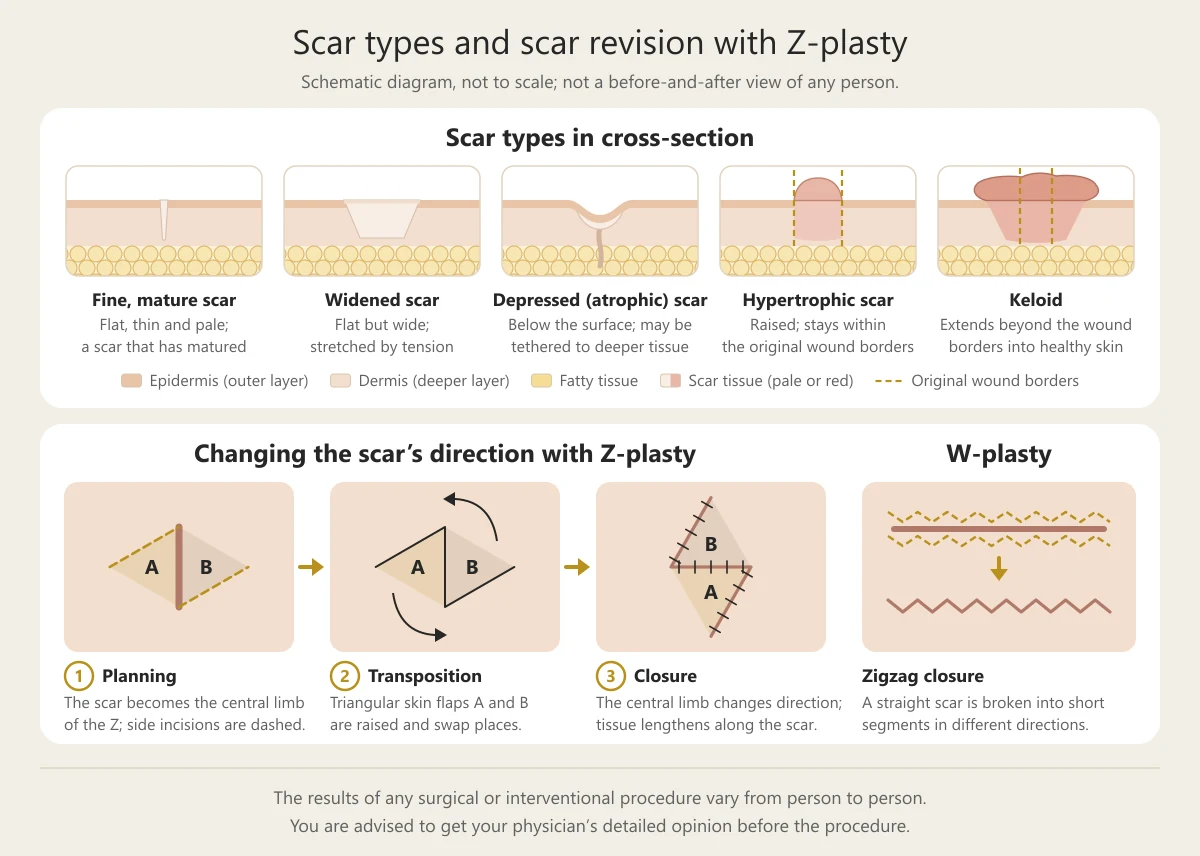 The results of any surgical or interventional procedure vary from person to person. You are advised to get your physician’s detailed opinion before the procedure.
What Is Scar Treatment, and Which Scars Is It For?
When a wound reaches the deeper layer of the skin (the dermis), the skin closes it with repair tissue made of connective tissue. This scar tissue is different from the skin around it: it contains no hair follicles or sweat glands, it is less elastic, and its colour may stay lighter or darker.
Depending on the type of scar, treatment ranges from non-surgical methods to surgery. Surgical correction is usually considered for the following scars:
- Scars that have widened or stayed sunken, or in which the stitch marks are prominent.
- Scars that are stuck to the tissue beneath and are pulled inwards when you move.
- Scars that run against the skin’s natural lines, or that distort features of the face such as the lip border, the eyebrow or the eyelid.
- Raised scars that have not responded well enough to non-surgical treatment, and selected keloids.
- Tight scars (contractures) that restrict movement in areas such as a joint, the neck or the hand.
No method makes a scar disappear; like any procedure that cuts the skin, a revision also leaves a new scar. The aim is to replace the old scar with one that is finer, flatter, closer in colour to the surrounding skin, or no longer restricts movement. How close you can come to this aim depends on the type of scar, where it is and your skin type.
Types of Scar: Which Approach for Which Scar?
The first step in choosing the right method is to identify the type of scar; the same person can have more than one type of scar at the same time.
| Type of scar | What does it look like? | Approach usually considered |
|---|---|---|
| New scar that is still maturing | Pinkish-red, slightly raised and firm in the first months; itching is normal. | Waiting; once the wound has closed, silicone and sun protection. |
| Widened (stretched) scar | Flat and pale but wide; mostly seen in areas under high tension. | Once it has matured, removing the scar and closing it again in layers. |
| Depressed (atrophic) or tethered scar | Sits below the surface of the skin; may be pulled inwards with movement. | Subcision, fat injection or filler; for some scars, removing the scar and closing it again. |
| Raised (hypertrophic) scar | Red, raised and firm; stays within the borders of the original wound. | Silicone and pressure; if needed, steroid (cortisone) injections into the scar; if it does not improve enough, surgical correction months later. |
| Keloid | Grows beyond the borders of the original wound into healthy skin; does not regress on its own. | Injections, silicone and pressure; surgery is planned only in combination with these treatments. |
| Contracture (tight scar) | The shrinking scar pulls on the skin; it can restrict movement or distort the shape of the eyelid or lip. | Surgical release of the contracture; Z-plasty, a skin graft or a flap. |
| Colour difference | The scar is flat but looks red, darker or white compared with the surrounding skin. | Sun protection and time; for persistent redness, laser planned together with a dermatologist. It is difficult to bring colour back to a white scar. |
Stretch marks (striae) are a different change, caused by the skin being stretched quickly, and are not treated with scar revision; treatment for widespread acne scarring on the face is also usually planned together with a dermatologist.
Is It a Hypertrophic Scar or a Keloid?
Both types of scar are raised; what tells them apart is whether the raised area stays within the borders of the original wound. A hypertrophic scar usually starts to thicken in the weeks after the wound has closed, does not spread beyond these borders and may regress to some extent over the months. A keloid, by contrast, sometimes becomes noticeable only months later, grows into the healthy skin around it and does not shrink on its own. Keloids are more common in people with a family history of keloids and in people with darker skin; the front of the chest, the shoulders, the upper back and the earlobes are where they often appear. In someone who is prone to them, even a spot or an ear piercing can trigger a keloid.
Not Everything That Looks Like a Scar Is a Scar
A raised area that keeps growing, bleeds, does not heal or changes in shape or colour may be a different skin condition; a sore that opens in an old burn scar and does not close also needs to be examined. In such cases, a diagnosis is made before any treatment; if necessary, a small piece of tissue is taken and sent for pathological examination (a biopsy).
When Should a Scar Be Treated? Waiting for It to Mature, and the Exceptions
For a revision done to improve appearance, the usual approach is to wait for the scar to mature; this often takes at least 6 months to 1 year after the injury or operation, and can take longer in children and with burn scars. Many scars that look red and raised early on improve markedly on their own during this time, whereas an operation on a scar that has not yet matured often does not give a better result. During this period, silicone, sun protection and, if needed, massage support the maturing process. In the following situations, however, assessment and treatment are planned earlier:
- A contracture that restricts movement: a tight scar that limits the movement of a joint, the hand or the neck can be released before the scar has matured.
- A scar that pulls on the eyelid or lip: a scar that stops the eye from closing fully, for example, is treated early to protect the eye.
- Scars that are starting to thicken, and keloids: treatment started early with silicone, pressure and, if needed, injections can limit the thickening.
- Wound problems: a scar that stays open, keeps breaking down or discharges fluid is examined without waiting for it to mature.
Who Should Wait?
- Smokers: smoking impairs wound healing; you will be asked to stop for a period before and after the procedure.
- People with uncontrolled diabetes, or with active inflammation or acne in the area: these problems are treated first.
- Pregnant and breastfeeding women: a revision done purely for appearance is usually postponed until after this period.
- People with a history of keloids: this does not rule out the procedure; the additional treatments needed after surgery are planned from the outset.
- People taking blood thinners: the medicine is reviewed together with the doctor who prescribed it; do not stop it on your own.
Non-Surgical Scar Treatments and Supportive Methods
These methods are used to prevent a new scar from thickening and to treat raised scars and keloids; they are also part of the treatment after surgery. None of them erases a scar, and all of them take time and regular use.
Silicone Gel and Silicone Sheets
Silicone is a frequently recommended method of scar care, and its effect has been examined in many studies; by forming a thin layer over the scar that reduces moisture loss, it is thought to limit how raised the scar becomes and to soften it. It is started once the wound has fully closed, usually after the stitches have been removed; it is not used on an open or weeping wound. Silicone sheets or tape are usually worn for more than 12 hours a day and cleaned every day; gel, by contrast, is applied twice a day in a thin layer and is more practical on exposed areas such as the face. Its effect can usually be judged only after 3–6 months of regular use; if the skin becomes irritated, use is paused.
Pressure Therapy and Massage
Constant, gentle pressure on a scar can limit how raised the scar tissue becomes: custom-made pressure garments are used for large burn scars, and pressure earrings after a keloid has been removed from the earlobe. Pressure can only work if it is applied for months, every day and for most of the day. Once the wound has closed, circular massage pressing into the scar with a moisturising cream can also help soften it, if your doctor recommends it.
Steroid (Cortisone) Injections into the Scar
A treatment often used for raised scars and keloids is to inject a medicine from the corticosteroid (cortisone) group directly into the scar tissue with a fine needle. The medicine suppresses excess production of connective tissue and can reduce how raised and firm the scar is, as well as itching. The injections are usually repeated several times, 4–6 weeks apart, depending on how the scar responds. Possible side effects are thinning or denting of the skin, lightening of its colour and fine thread veins becoming visible; this is why the dose and interval are adjusted at each session according to the state of the scar. For stubborn keloids, other medicines can also be injected into the scar.
Laser and Other Skin-Surface Treatments
For some scars, surface treatments such as laser, microneedling, dermabrasion and chemical peels can also be planned together with a dermatologist, either in addition to surgery or on their own. These methods often need several sessions and can carry a risk of colour changes in darker skin. For small keloids, freezing treatment (cryotherapy), again planned together with a dermatologist, is another option; it can cause permanent lightening, especially in darker skin.
How Is Scar Revision Done?
At the examination, the cause and age of the scar, its size, colour and firmness, whether it is stuck to the tissue beneath, its direction and the tension in the area are assessed; you are asked whether it itches, hurts or restricts your movement. A history of keloids, previous treatments, the medicines you take and whether you smoke all directly affect the plan; if photographs are needed, they are taken only with your consent. The outcome may be a recommendation for a single method, or a plan that combines surgery with non-surgical treatments.
Most small and medium-sized scars are corrected under local anaesthesia while you are awake; for large contractures, procedures that need a skin graft or a flap, and in children, sedation or general anaesthesia may be needed. Correcting a single small scar usually takes between 30 minutes and 1 hour; it takes longer when a detailed closure is needed or several scars are treated.
Removing the Scar and Closing the Wound in Layers
In the basic method, the old scar is removed as an ellipse with pointed ends. If needed, the edges are released from the tissue beneath to reduce tension; the deeper layers are brought together with dissolvable stitches, and the skin is closed with very fine stitches or with stitches that run beneath the skin. The support of the deeper layers aims to reduce the tendency of the new scar to widen again; where possible, the new incision is placed parallel to the skin’s natural lines. In surgical mole removal, too, the mole is removed as an ellipse on the same principle. Scars too wide to be removed in one go can be narrowed in several stages, months apart, or the healthy skin around them can first be expanded with a tissue expander that is gradually inflated over a period of weeks.
Z-Plasty, W-Plasty and Broken-Line Closure
A long, straight scar catches the eye easily, while a scar that runs against the natural lines tends to widen and pull because of the tension on it. For these scars, techniques that change the direction of the scar or break up the straight line are used:
- Z-plasty: a side incision is drawn from each end of the scar, in opposite directions, so that the scar becomes the central limb of a letter Z; the two triangular skin flaps this creates swap places. The central limb changes direction, coming closer to the natural lines, and the tissue lengthens along the line of the scar; this is why Z-plasty is also often used for scars that cause tightness.
- W-plasty: the scar is cut out with small zigzags so that its two edges interlock; once closed, it leaves a line made up of short segments running in different directions. It is used mainly for straight scars on the face.
- Broken-line (geometric) closure: an irregular line made up of a series of shapes such as triangles, squares and semicircles; because it reflects light differently, it can be less noticeable than a straight line.
These techniques can increase the total length of the scar; the aim is for the scar to draw less attention and to heal under less tension.
Depressed and Tethered Scars: Subcision, Fat and Filler
A depressed scar is often pulled down because it is stuck to the tissue beneath it. In subcision, a fine needle or cannula is passed under the skin through a small entry point, and the bands pulling the scar down are released; there may be bruising and swelling for a few days afterwards. If there is also a loss of volume, your own fat can be transferred into the scar: a small amount of fat is taken, usually from the abdomen or thigh, with fine cannulas similar to those used in liposuction, then prepared and injected in thin layers. Because some of the fat is absorbed in the first months, a second session may be needed. For some soft depressed scars, hyaluronic acid filler is a temporary option; for narrow, deep scars with sharp edges, removing the scar and closing it again may be more appropriate.
Surgery for Thick Scars and Keloids: Why Is It Not Done on Its Own?
For thick (hypertrophic) scars, surgery is usually considered when there has not been enough improvement despite non-surgical treatment that has often gone on for months; the scar is closed again in a way that reduces tension, and silicone and, if needed, injections are then continued. Keloids are a different matter: a keloid removed with surgery alone has a high chance of coming back, and a recurring keloid can be larger than before. This is why keloid surgery is planned as part of a complete treatment, together with injections into the scar, which are usually started during the procedure or around the time the stitches are removed and repeated weeks apart, and with silicone and pressure; follow-up continues for a long time. The removed tissue may be sent for pathological examination to confirm the diagnosis. For stubborn keloids that have come back several times, radiotherapy shortly after surgery may be considered; whether this treatment is suitable is decided by the radiation oncology department, which also plans the treatment.
Releasing Contractures That Restrict Movement
A contracture usually forms when scar tissue shrinks, often after a burn or extensive tissue loss. In treatment, the tight band is first released by cutting through it or removing it; the area this opens up is then closed with techniques that shift nearby tissue, such as Z-plasty, if there is enough healthy skin around it, or otherwise with a skin graft taken from another part of the body or with a flap (a piece of tissue moved with its blood supply preserved). For the graft to take, the area is kept still for the first few days; a scar is also left where the graft was taken. After a release around a joint, a splint and physiotherapy are an important part of preventing the scar from tightening again; for extensive contractures, treatment may be planned in several stages.
Facial Scars, Body Scars and Caesarean Scars: What to Consider
Because facial skin has a good blood supply, incisions on the face usually heal well, and the stitches are removed sooner. Where possible, the new incision is placed in natural lines such as the hairline, the edge of the eyebrow or the nose-to-mouth line (nasolabial fold); because even a slight misalignment at the lip border or the eyelid margin catches the eye, lining these up precisely is central to the plan.
The back, the shoulders, the front of the chest and the upper arms are areas where scars are prone to widening and thickening. In some people, the scars of operations with long incisions, such as breast reduction surgery or a tummy tuck, can also widen; these scars, too, are usually corrected after waiting for them to mature.
In some women, a caesarean section scar widens, thickens, or is pulled inwards so that a fold of skin and fat forms above it. If there is no marked sagging, the scar alone can be removed and closed again in layers; if there is also marked excess skin on the abdomen, the old scar can often be removed together with the skin taken away during a tummy tuck (abdominoplasty), or incorporated into the new scar line. In either case, recovery after childbirth must be complete first.
Recovery After Scar Revision
The table below gives a general outline for a stitched scar revision under local anaesthesia; for procedures using a skin graft or a flap, the timeline is longer and is given to you individually.
| Period | What usually happens | Recommendations |
|---|---|---|
| Day of the procedure and the first 2–3 days | The numbness wears off within a few hours; there may be mild pain, swelling and bruising. | Keep the dressing clean and dry; pain usually settles with simple painkillers. After a small revision, most people return to desk work the same day or the next day. |
| First week | The edges of the incision knit together; mild redness along the stitch line is normal. | Avoid movements that stretch the incision; do not pick off scabs. |
| Stitch removal | On the face, usually on days 5–7; on the trunk, arms and legs, usually on days 10–14; a little later over a joint. If dissolvable stitches were used, no stitches need to be removed. | The incision line does not reach full strength for several more weeks; tape to support the line may be recommended. |
| Weeks 2–6 | The wound has closed; the scar is pink and slightly firm. | Start silicone with your doctor’s approval; do not expose the scar to direct sunlight. |
| Months 2–3 | It is common for the scar to look redder and firmer than in the first weeks, and to itch; this is a normal stage of maturing. | Continue with silicone; if the scar is thickening, come for a check-up early. |
| 6 months to 1 year | The scar matures; in most people, it becomes thinner and softer, and its colour gets closer to that of the surrounding skin. | The final appearance, and whether any further correction is needed, are usually assessed during this period. |
- Showering: the dressing is usually kept dry for the first 24–48 hours; after that, you can shower as your doctor instructs.
- Exercise: sports that stretch the incision and weight training are usually postponed for a few weeks, even after the stitches are out.
- Sun: until the scar has matured, which usually means throughout the first year, protect it with sunscreen, clothing or tape; sun exposure can permanently darken a healing scar.
- Pools, the sea, Turkish baths and saunas: wait until the stitches are out and the wound has fully closed.
Symptoms to Report to Your Doctor Straight Away
- Increasing redness, warmth, swelling or pain around the incision; pus-like discharge or a fever.
- Bleeding that does not stop with pressure, or a tense swelling that grows quickly.
- The stitch line opening; a graft or flap that turns dark or purplish, or looks cold and pale.
Risks and Possible Complications
Scar revision is often a minor procedure, but like any surgical procedure it carries risks, and the result varies from person to person:
- The new scar turning out differently than expected: the new scar may not be better than the old one; over time, it may widen or thicken again, or stay a different colour from the surrounding skin. With techniques such as Z-plasty, the scar is longer.
- A thick scar or keloid coming back: despite additional treatments, a raised scar or a keloid may return.
- Wound problems: infection, a collection of blood (haematoma), the stitch line opening or delayed healing; these are more likely in smokers and in areas under high tension.
- Problems specific to grafts and flaps: part of the graft or flap not taking, differences in colour and texture, shrinkage over time, and a scar where the graft was taken.
- Problems related to injections and fat transfer: thinning or colour change of the skin; more of the fat being absorbed than expected, irregularities or small firm lumps.
- Changes in sensation: numbness or tingling around the scar; this usually lessens over the months and is rarely permanent.
- The need for further procedures: more than one stage, or a minor correction later on, may be needed.
Risks related to anaesthesia, and any other possibilities that apply to you, are discussed separately before the procedure, at the examination and as part of the informed consent process.
What Determines the Cost of Scar Revision?
The fee is set once the type of scar and the treatment plan have been established at the examination. The main factors are:
- The type, length and number of scars, and where they are.
- The method to be used: removing and closing the scar, Z-plasty or W-plasty, subcision, fat transfer, a skin graft or a flap.
- The type of anaesthesia (local anaesthesia, sedation or general anaesthesia) and how long the procedure takes.
- The number of repeat sessions, such as injections, and whether the plan is carried out in stages.
- Follow-up examinations, stitch removal and, if needed, pathological examination.
Travelling to Istanbul, Turkey, for Scar Revision
Before you travel, you can send photos of your scar on WhatsApp for a preliminary assessment, and the plan is given to you in writing. The examination and the treatment plan are made in person in Istanbul; surgical procedures take place in a fully equipped hospital licensed by the Ministry of Health, and the doctor decides when you are fit to fly home. The length of your stay depends on the procedure and is confirmed in your written plan before you book flights. After you return home, follow-up continues with photo reviews on WhatsApp, and your medical records are given to you in English; to get started, contact the practice.
Frequently Asked Questions about Scars and Scar Revision
Which specialist should I see about a scar?
Surgical scar correction, contracture release and procedures such as skin grafts and flaps fall within the field of plastic, reconstructive and aesthetic surgery. Widespread acne scarring, colour changes over large areas and surface treatments such as laser are planned together with a dermatologist; for keloids, it is also common for the two specialties to work together.
Can laser treatment make a scar go away?
Laser does not erase a scar; in suitable scars, it aims to bring the colour or surface texture a little closer to that of the surrounding skin. For scars with a rough surface or slightly depressed scars, fractional lasers can be considered together with a dermatologist. For a scar that is wide, runs in an unfavourable direction or is stuck to the tissue beneath, laser alone is usually not enough; for these scars, surgical correction and surface treatments can complement each other.
Do scar creams work?
No cream can erase a scar or flatten a raised one; apart from gels containing silicone, the evidence on the effect of scar creams is limited and conflicting. Regular moisturising can reduce the dryness and itching of a maturing scar. Herbal oils or home-made mixtures should not be applied to an open wound, and acidic remedies such as lemon or vinegar can burn the skin and leave permanent marks.
Do steroid injections into a scar hurt?
Although the needle is very fine, you feel a prick and a brief ache as the medicine goes into the firm scar tissue; in hard scars such as keloids, this can be more noticeable. To reduce the discomfort, a numbing cream or cold can be applied beforehand. There may be mild tenderness for a few days after the injection; most people go back to their daily activities straight away.
How is an earlobe keloid treated?
Earlobe keloids usually develop after an ear piercing. Small keloids can be shrunk with injections into the scar; larger ones are removed surgically, after which injections and pressure earrings, worn regularly for a long time, are planned to reduce the chance of the keloid coming back. Because piercing the same ear or the other ear again can trigger a new keloid, this decision should first be discussed at the examination.
What can I do to stop a new surgical scar from thickening?
While the wound is healing, the first steps are not to strain the incision line, not to pick off scabs, and to report signs of infection such as redness or discharge early. Once the wound has closed, using silicone regularly as recommended and staying away from smoking can reduce the likelihood of a thick scar developing. If you have developed thick scars or keloids in the past, mentioning this before surgery allows preventive treatments to be planned from the start.
When will the pink colour of my scar fade?
The pinkish-red colour of a new scar comes from the new blood vessels that form in the scar during healing, and it fades as the scar matures. This usually takes months; in most people, the colour lightens markedly towards the end of the first year, while in darker skin the scar may look darker than the surrounding skin for a while. Protecting the scar from the sun while it matures helps prevent its colour from darkening permanently; for redness that lasts longer than a year, a laser that targets blood vessels can be considered together with a dermatologist.
When is scar revision done in children?
In children, scars can stay red and raised for longer and take longer to mature, so a correction done purely for appearance is often postponed. Because the size and position of a scar can change as the child grows, the timing is planned according to the child’s age and where the scar is. A tight scar that restricts the movement of a joint, however, is not left to wait, because it can affect growth; in children, these procedures are usually done under general anaesthesia.
Can an old scar still be improved?
Yes; a scar that has finished maturing can be revised even if many years have passed. Because the colour and height of an old scar are no longer expected to change on their own, the problem is usually its width, a depression, its direction or its attachment to the tissue beneath; depending on these features, surgical correction or surface treatments planned together with a dermatologist can be considered. A new sore or growth appearing in a scar that has not changed for years, however, should be examined before any treatment.
Is scar treatment covered by insurance?
For patients insured under the Turkish social security system (SGK), scar treatments aimed purely at improving appearance are not covered. For a functional problem that restricts movement, such as a burn contracture, cover depends on the official criteria and on medical necessity being documented, and is assessed at SGK-contracted institutions. Private practice services and private doctors’ fees are not covered by SGK; with private health insurance, cover depends on the terms of your policy.
Consultation and Appointments
If you have photos that show how your scar has changed over time, bring them to the examination together with a list of the medicines you take; this makes the assessment easier. It can be useful to ask the following questions at the consultation:
- What type of scar do I have, and do I need to wait for it to mature?
- Which method do you recommend: a non-surgical treatment, surgery, or a plan that combines both?
- Where will the new scar be, how long will it be, and in which direction will it run?
- What is my risk of a keloid or a thick scar, and which additional treatments are planned after surgery?
- How many sessions or stages might be needed, and when can I return to work and sport?
- What happens if the scar thickens again or does not heal as I expect?
- Does the fee include follow-up visits, stitch removal and any injection sessions?
Results vary from person to person; the purpose of the examination is to agree together on a realistic goal for your scar and the right way to reach it. Op. Dr. Ayberk Akçay is a plastic, reconstructive and aesthetic surgeon, a Fellow of the European Board of Plastic, Reconstructive and Aesthetic Surgery (EBOPRAS) and a full member of the Turkish Society of Plastic, Reconstructive and Aesthetic Surgeons; his practice is in Teşvikiye, Şişli, Istanbul. To book an appointment at the practice in Istanbul, use the contact and appointments page.