
Gynecomastia is fullness of the chest in men caused by enlargement of the breast gland tissue; it can affect one side or both. Commonly known as male breast enlargement, the condition is benign, but a chest that shows under a T-shirt can be a source of discomfort in many situations, from choosing clothes to playing sport. In gynecomastia surgery (male breast reduction), the excess glandular tissue and fat are removed, together with excess skin where necessary, to create a flatter chest contour.
What is gynecomastia?
In medical terms, gynecomastia is a benign growth of the glandular tissue in the male breast. This tissue lies just behind the nipple; when examined by hand, it feels like a firm, rubbery disc, and it can be tender when it first develops. Not all chest fullness comes from glandular tissue: in men who are overweight in particular, fat stored on the chest creates a similar appearance. This is called false gynecomastia (pseudogynecomastia or lipomastia). In many men, both tissues have increased together.
True and false gynecomastia (pseudogynecomastia): what is the difference?
| Feature | True gynecomastia | False gynecomastia (lipomastia) |
|---|---|---|
| Enlarged tissue | Breast gland tissue | Fatty tissue |
| How it feels on examination | Firm, disc-shaped tissue behind the nipple | Soft fullness spread across the chest; no distinct firm area |
| Weight loss and exercise | The glandular tissue does not shrink noticeably | The fullness may decrease |
| Common causes | Puberty, hormonal changes, some medicines, anabolic steroids | Excess weight |
| Surgical approach | Removal of the glandular tissue through a small incision, often together with liposuction | Liposuction is often enough |
Which tissue predominates is established at the examination, with a breast ultrasound if needed. The distinction matters: if only liposuction is performed and the glandular tissue is left in place, the bulge behind the nipple may remain.
Grades (stages) of gynecomastia
Gynecomastia is graded according to the amount of enlargement and whether there is excess skin. One commonly used classification is as follows:
- Grade 1: Mild enlargement, with no excess skin.
- Grade 2a: Moderate enlargement, with no excess skin.
- Grade 2b: Moderate enlargement with slight excess skin.
- Grade 3: Marked enlargement, with excess skin that gives the appearance of a sagging breast.
At higher grades, the excess skin may also need to be dealt with, which affects the surgical plan and the length of the scars.
What causes breast enlargement in men?
The male body also contains a small amount of the hormone oestrogen. When the balance between oestrogen and testosterone shifts in favour of oestrogen, the breast gland tissue grows. The main factors that affect this balance are:
- Puberty: Temporary breast enlargement is common in boys going through puberty; it sometimes starts as a tender swelling and in most cases goes away on its own within two years. Tissue that persists after puberty is complete, however, does not usually disappear by itself.
- Excess weight: Fatty tissue converts some testosterone into oestrogen, so excess weight can contribute both to fat building up on the chest and to growth of the glandular tissue.
- Some medicines: Some medicines used for prostate conditions and for hair loss, some heart, blood pressure and stomach medicines, and some psychiatric medicines can cause breast enlargement. Do not stop taking a medicine on your own; if a change is needed, it is decided together with the doctor who prescribed it.
- Anabolic steroids and some supplements: Anabolic steroids used in gyms are a frequently overlooked cause; even after they are stopped, firm tissue that has been there for a long time often remains. Some supplements containing plant oestrogens have also been linked to breast enlargement.
- Ageing: In later life, testosterone levels gradually fall, the proportion of body fat rises and fullness of the chest becomes more common.
- Hormonal and other health problems: Testosterone deficiency, an overactive thyroid (hyperthyroidism), liver and kidney disease and, rarely, tumours of the testicles or of other hormone-producing glands can cause gynecomastia.
Alcohol and some recreational drugs have also been linked to gynecomastia; in some men, no clear cause can be found.
Which signs need a medical assessment first?
Breast cancer is rare in men, and gynecomastia is not considered a condition that turns into cancer; however, the risk of male breast cancer is higher in some genetic conditions, such as Klinefelter syndrome. Not every swelling of the chest is gynecomastia; in the following situations, a medical assessment is needed before any cosmetic plan is made:
- Breast tissue that began before puberty, or that has appeared within a short time or is growing quickly outside the years of puberty.
- A firm lump on one side that sits off to the side of the nipple rather than directly behind it, or that is fixed to the skin or to the tissue beneath.
- Discharge from the nipple (especially blood-stained discharge), or a nipple that has turned inwards or has a sore.
- Puckering, thickening or redness of the skin of the breast; a swelling that can be felt in the armpit.
- Pain and tenderness that do not go away or keep getting worse.
- Swelling or hardness of the testicles, or a marked difference in size between them.
In these situations, an examination that includes the testicles is carried out; blood tests (hormone levels and thyroid, liver and kidney function), a breast ultrasound or mammogram depending on age and findings, and a testicular ultrasound if needed may be requested. If a lump is suspicious, a tissue sample is taken (biopsy). Depending on the findings, you are referred to the relevant specialty, such as endocrinology, general surgery or urology. Surgery is planned once this assessment is complete and, if there is an underlying cause, once its treatment has been arranged.
When is surgery considered?
Surgery becomes an option when the cause of the breast enlargement has been assessed and the enlargement has not gone away on its own. It is usually considered in these situations:
- Enlargement that persists after puberty is complete, or that appeared in adulthood and has not changed for some time.
- Feeling restricted or self-conscious in daily life, during sport, at the pool or on the beach because the chest shows under clothing.
- Chest fullness that has not reduced despite weight loss and regular exercise.
Suitable candidates are usually men whose weight is stable, whose general health does not rule out surgery and anaesthesia, and who have realistic expectations. If you use anabolic steroids, you are asked to stop them before surgery; if you smoke, you are asked to stop for a while before and after the operation. In teenagers, the tissue is usually monitored for a while because it may go away on its own; cases that have not changed for a long time and seriously affect daily life are assessed individually. Under the age of 18, surgery requires the consent of a parent or legal guardian.
Can gynecomastia go away without surgery?
The answer depends on the cause of the enlargement and on which tissue predominates:
- Weight loss: In mainly fatty (false) gynecomastia, losing weight can reduce the fullness noticeably; glandular tissue, however, does not shrink with weight loss.
- Exercise: Working the chest muscles helps the overall look of the chest, but it does not burn fat locally and does not dissolve glandular tissue.
- Removing the cause: Changing or stopping a medicine or substance that is causing the enlargement, on the advice of the relevant doctor, can reverse enlargement that has only recently begun.
- Medication: This is not routinely recommended; in some recent, painful cases, it may be considered by the relevant specialist. It is not expected to work on firm tissue that has been present for a long time.
Creams and supplements sold with the claim that they reduce the chest have not been shown scientifically to work. Compression vests that flatten the chest hide it temporarily but do not reduce the tissue.
Examination and assessment before surgery
At the examination, the cause of the enlargement and the structure of your chest are assessed first: you are asked when it started, which medicines, supplements and steroids you use, and how your weight has changed; the proportion of glandular tissue to fat, the grade, any excess skin, the position of the nipples and any difference between the two sides are examined. Hormone tests and a breast ultrasound are requested if needed. If surgery is planned, blood tests and an anaesthetic assessment are carried out, and medicines and supplements that thin the blood are stopped under your doctor’s supervision.
How is gynecomastia surgery performed?
The aim of the operation is to remove the excess tissue and create a flat, masculine chest contour that blends with the surrounding area. In this respect, it differs from breast reduction surgery in women: in women, the volume of the breast is reduced and its shape is rebuilt, whereas in men the aim is to remove the appearance of a breast. An overview of breast operations for women is on the breast surgery page. The method is chosen according to the type of tissue and the grade; in most patients, the two methods described below, liposuction and removal of the glandular tissue, are used together.
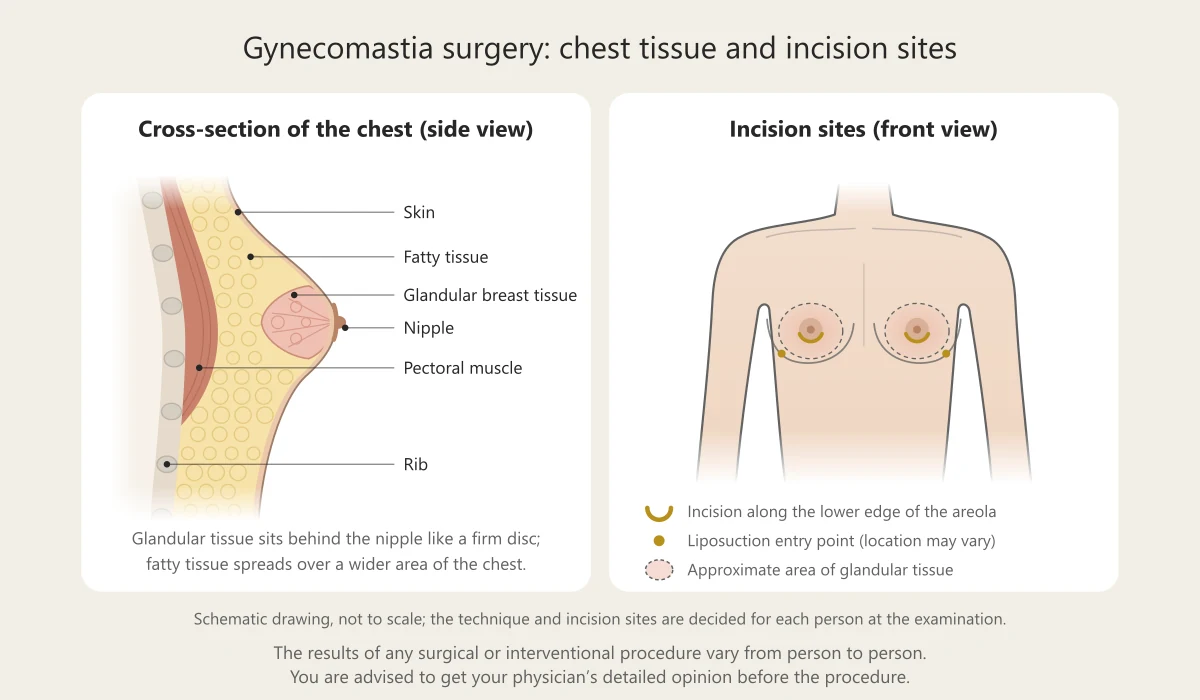 The results of any surgical or interventional procedure vary from person to person. You are advised to get your physician’s detailed opinion before the procedure.
Liposuction for fatty tissue, with ultrasound assistance
Fatty tissue on the chest is removed with thin cannulas inserted through openings a few millimetres long. Because fat in the male chest can be denser and more fibrous, ultrasound-assisted liposuction may be preferred in suitable patients; with this method, the fatty tissue is loosened with ultrasonic energy before it is removed. Liposuction also helps to smooth the transitions towards the sides of the chest and the armpits. Firm glandular tissue, however, cannot always be removed adequately with liposuction; in that case, it has to be removed separately.
In suitable patients, liposuction of the waist and abdomen can be planned in the same session as the chest. The details are explained on the liposuction page, and defining the outline of the abdominal muscles is covered on the abdominal etching (six-pack surgery) page.
Removing the breast gland tissue
The glandular tissue is removed through a small, half-moon-shaped incision placed at the lower edge of the darker area around the nipple (the areola), along the line where the darker and lighter skin meet. A thin layer of tissue is deliberately left just beneath the nipple: removing all of the tissue could make the nipple sink inwards or leave a hollow around it.
Advanced cases with excess skin
In advanced grades with marked enlargement and sagging, the skin may not adapt well enough to the new contour once the tissue has been removed. In that case, the excess skin is also removed and, if necessary, the nipple and areola are moved to a more suitable position; the scars are longer. Because in some patients the skin can tighten more than expected after the first operation, skin removal may be left for a second stage.
The day of surgery
The operation is performed in a fully equipped hospital licensed by the Ministry of Health, with an anaesthesia team in attendance. The type of anaesthesia (general anaesthesia, or local anaesthesia with sedation) is chosen according to the extent of the procedure. The markings are drawn while you are standing. Depending on the method, the operation usually takes 1 to 3 hours; it can take longer when skin needs to be removed. If needed, a thin drain is placed. At the end of the procedure, while you are still in the operating theatre, a compression vest is put on. Depending on the extent of the procedure, patients go home the same day or after one night of observation.
Recovery after gynecomastia surgery
Recovery varies with the method and the person: it is usually shorter for patients who have liposuction only, and longer for those who have skin removed. The timeline below is a general guide; your personal timeline is given to you when you leave hospital.
- First 2–3 days: Tightness, swelling and tenderness are expected; pain is usually controlled with prescribed medication. The compression vest that wraps around the chest (gynecomastia vest) is worn day and night for the first weeks. Short walks start on the day of surgery or the day after; movements that strain the arms and heavy lifting are avoided.
- Week 1: The bruising starts to fade. Most patients can return to desk work towards the end of this week; after skin removal or more extensive procedures, it may take a little longer.
- Weeks 2–3: Most of the bruising disappears and the swelling goes down noticeably; daily activities are increased gradually.
- Weeks 4–6: The compression vest is usually phased out during this period, following the schedule set by your doctor. Chest exercises, weight training and heavy lifting are resumed gradually with your doctor’s approval; for contact sports, wait for the assessment at your follow-up visit.
- Months 3–6: Any remaining swelling and firmness resolve and the skin settles onto the new contour; the final appearance usually emerges during this period.
It is advisable to stay away from hot environments such as saunas, Turkish baths (hammams) and sunbeds for a few weeks, and to go into a pool or the sea only once the wounds have fully closed. Because smoking delays wound healing, you should also avoid it for a while after surgery.
Symptoms to report to your doctor straight away
- Rapidly increasing swelling, tightness and pain on one side (this may be a sign of blood collecting in the chest).
- A high fever; increasing redness, warmth or a foul-smelling discharge at the incision.
- Darkening or bluish discolouration of the nipple or the skin around it.
- Painful swelling in one leg.
If you develop sudden shortness of breath, chest pain that starts suddenly and feels different from the pain at the surgical site, or palpitations, go to an emergency department without delay.
Will gynecomastia surgery leave scars?
Every operation that involves an incision leaves a scar; where the scars lie and how long they are depend on the method used. Liposuction entry points are a few millimetres long and are placed, as far as possible, in less visible spots such as the chest crease or the armpit. Because the incision for the glandular tissue lies on the colour border of the areola, it tends to become less noticeable over time; in advanced cases where skin is removed, the scars are longer.
Scars usually take 6 months to 1 year to mature, and their final appearance depends on your skin type, how the wound heals and how it is cared for; some people develop a thick (hypertrophic) scar or a keloid. Once the wound has closed, using the silicone gel or tapes your doctor recommends, protecting the scar from the sun and not smoking are the basic steps of scar care.
Risks and possible complications
Like any operation, this one has risks; careful planning and operating in a hospital setting reduce them but do not eliminate them completely:
- Collection of blood or fluid: A collection of blood (haematoma) or fluid (seroma) in the chest is one of the more common problems with this operation; draining the blood or fluid, and sometimes a further operation, may be needed.
- Contour irregularities and asymmetry: A remaining bulge if too little tissue is removed, a dip beneath the nipple if too much is removed, a wavy surface or a difference between the two sides may occur; in some cases, a corrective procedure may be needed.
- Changes in nipple sensation: There may be numbness or, conversely, increased sensitivity in and around the nipple; in most patients this improves within months, but in some it may not recover completely.
- Problems with the blood supply to the nipple: This is uncommon; it is more likely in advanced cases in which skin is removed and the nipple is moved.
- Infection, wound-healing and scar problems: Infection at the incision site, delayed healing, or a noticeable or thick scar.
- Loose skin: If the skin is not elastic enough, looseness may become more noticeable once the tissue has been removed.
- Heat-related skin damage: This can occur, rarely, with methods that use energy, such as ultrasound-assisted liposuction.
- Regrowth: Glandular tissue that has been removed does not grow back; however, if the cause of the enlargement continues, the remaining glandular tissue can grow again, and fat can build up on the chest again with weight gain.
- General surgical risks: Rare but serious risks that apply to any operation, such as those related to anaesthesia, blood clots in the leg veins and a clot travelling to the lungs.
What does the cost of gynecomastia surgery depend on?
The fee depends on the method (liposuction only, removal of the glandular tissue or skin removal), whether one side or both are operated on, whether a technology such as ultrasound assistance is used, the type of anaesthesia, the length of the hospital stay, the tests before surgery and supplies such as the compression vest. If fat is also removed from other areas at the same time as the chest, this is reflected in the fee too. For this reason, the fee is set once your individual plan has been confirmed at the examination.
Is gynecomastia surgery covered by SGK in Turkey?
This section concerns patients insured under the Turkish social security system (SGK). SGK does not cover operations carried out only to change appearance; whether gynecomastia surgery can be covered depends on the official criteria and on documentation of medical necessity, and this also applies to operations in public hospitals. How reimbursement and additional charges are applied varies between SGK-contracted institutions, and services at the practice and private doctors’ fees are not covered by SGK. With private health insurance, cover depends on your policy. Please confirm the current conditions with SGK, your insurer and the institution concerned before planning surgery.
Travelling to Istanbul, Turkey, for gynecomastia surgery
Before you travel, you can contact the practice and send photos on WhatsApp for a preliminary assessment; your plan is then given to you in writing. In Istanbul, you are examined in person and the operation is planned with you; operations take place in a fully equipped hospital licensed by the Ministry of Health. The length of your stay depends on the procedure and is confirmed in your written plan before you book flights, and your doctor decides when you are fit to fly home. After you return home, follow-up continues with photo reviews on WhatsApp, and your medical records are given to you in English.
Frequently Asked Questions about Gynecomastia
Does breast enlargement during puberty go away on its own?
In most cases, yes: breast enlargement during puberty usually goes away on its own within two years, and the breasts may be tender or slightly painful in the meantime. Enlargement that began before puberty, is very marked, persists after puberty is complete or takes the form of a firm lump on one side, however, needs to be assessed by the relevant specialty, such as paediatric endocrinology. Surgery is not usually considered at this stage.
Can breast enlargement in men affect only one side?
Yes. Gynecomastia usually affects both sides, but it can appear on one side only, or there can be a marked difference in size between the two sides. One-sided enlargement is also benign in most cases; even so, if a firm, irregular lump or a lump that is fixed to the skin can be felt, its cause is investigated first. If surgery is planned, the difference between the two sides is taken into account separately when deciding how much tissue to remove.
Can gynecomastia turn into cancer?
Gynecomastia is a benign growth and is not considered to turn into cancer over time. However, men can also develop breast cancer, although rarely, and its first signs can be mistaken for gynecomastia. Signs that suggest cancer include a firm, irregular lump on one side that cannot be moved, a nipple that turns inwards or has a blood-stained discharge, puckering of the skin and a swelling in the armpit. If any of these is present, it is investigated with a mammogram or ultrasound, chosen according to age and findings, and with a biopsy if needed.
Which doctor should I see about breast enlargement in men?
If the enlargement is new, growing quickly, on one side only or painful, its cause needs to be investigated first. This assessment can be done by your family doctor, an endocrinologist or a general surgeon; for boys going through puberty, paediatric endocrinology is the right specialty. For surgical treatment of gynecomastia whose cause has been assessed and which has not gone away on its own, you can see a specialist in plastic, reconstructive and aesthetic surgery. If needed, the plastic surgeon also asks for the opinion of the relevant specialties.
How long does male breast reduction surgery take, and can it be done under local anaesthesia?
Depending on the method, the operation usually takes 1–3 hours; it can take longer in advanced grades where excess skin is also removed. Local anaesthesia with sedation may be chosen for limited procedures, and general anaesthesia for more extensive ones; the decision is made together with the anaesthesia team, taking your general health into account.
Can gynecomastia surgery be done without an incision, using a “closed” method?
There is no gynecomastia operation that is done without any incision at all; liposuction, too, is performed through openings a few millimetres long. If the enlargement is mostly fatty tissue (false gynecomastia), these small openings are often enough; this is usually what is meant by the “closed method”. If there is firm glandular tissue behind the nipple, a small incision at the lower edge of the areola is also needed. Which of these you need is established at the examination, with an ultrasound if necessary; an operation that leaves no scar cannot be promised.
When can I exercise again after the operation?
Gentle walking is recommended from the first days. Exercises that work the chest muscles, such as bench presses and push-ups, and weight training usually start after 4–6 weeks, with light weights, once your doctor gives the go-ahead. Contact and combat sports in which the chest may take a blow may need a longer wait; the timing is decided at a follow-up visit. Pushing yourself too early increases the risk of bleeding, fluid collection and prolonged swelling.
How long do I need to wear the compression vest?
The compression vest worn after surgery (gynecomastia vest) is usually needed for 4 to 6 weeks. In the first weeks, it is taken off only for short periods, such as to shower; after that, you wear it less, following the schedule set at your check-ups. The vest helps to reduce swelling and fluid collection and helps the skin to adhere smoothly to the tissue beneath. The period may be longer depending on the method used and how your healing progresses; stopping earlier than recommended can prolong the swelling and lead to contour irregularities.
Can gynecomastia come back after surgery?
Glandular tissue removed during the operation does not come back. Even so, the thin layer of tissue deliberately left beneath the nipple can grow again if the cause of the enlargement has not been removed, and with significant weight gain, fat can also build up on the chest again. Anabolic steroids, medicines that cause breast enlargement and an untreated hormonal problem make this more likely. This is why it is important to have the cause assessed before surgery and to keep your weight stable afterwards.
Consultation and appointments
It makes the assessment easier if you bring a list of the medicines and supplements you take and the results of any tests you have already had. Asking these questions at the examination helps to clarify the plan that suits you:
- Is the enlargement of my chest caused by glandular tissue or by fat? Do I need any tests before surgery?
- Which method will be used? Where will the incisions and scars be, and will skin need to be removed?
- What type of anaesthesia will be used, and will I need to stay in hospital?
- How long will I wear the compression vest, and when can I go back to work and sport?
- Will the removed tissue be sent for pathological examination?
- Do I have any condition that makes it more likely for the enlargement to come back?
- What does the fee include?
Results vary from person to person; the purpose of the examination is to establish whether surgery is the right option for you. Op. Dr. Ayberk Akçay is a specialist in plastic, reconstructive and aesthetic surgery, a Fellow of the European Board of Plastic, Reconstructive and Aesthetic Surgery (EBOPRAS) and a full member of the Turkish Society of Plastic, Reconstructive and Aesthetic Surgeons; his practice is in Teşvikiye, Şişli, Istanbul. To book an examination, please get in touch through the contact page.