
Nose filler is a non-surgical, temporary treatment in which a small amount of hyaluronic acid filler is injected into the nose. It is used to camouflage a small hump on the bridge of the nose, to fill small dips and asymmetries, or to make the tip look slightly more lifted; it is also popularly known as a non-surgical nose job or liquid rhinoplasty. Filler adds volume to the nose: it does not make the nose smaller or narrower, it does not remove a large hump, and it does not improve breathing. Its effect fades over time, and the filler can be dissolved if necessary.
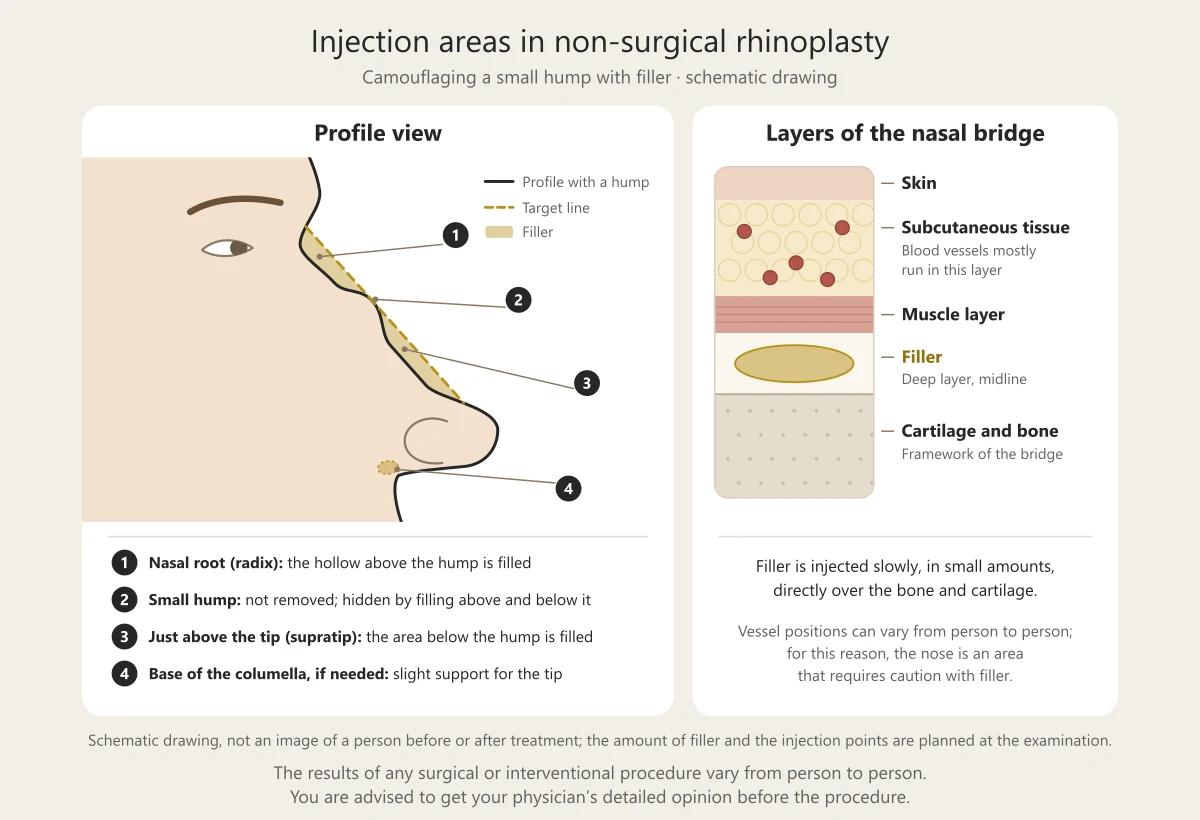 The results of any surgical or interventional procedure vary from person to person. You are advised to get your physician’s detailed opinion before the procedure.
This page explains what filler can and cannot change in the nose, how it differs from nose surgery, what needs extra care in a nose that has already been operated on, how the treatment is done, what to look out for afterwards, and the risks. Results vary from person to person; whether the treatment is suitable for you is assessed at a face-to-face examination.
What Is Nose Filler?
Hyaluronic acid is a water-binding molecule found naturally in the skin and connective tissue. For use as a filler, hyaluronic acid is cross-linked into a gel so that it stays in the tissue for longer, and the body gradually breaks it down over time. An important property is that it can be dissolved with an enzyme called hyaluronidase, which is why dissolvable hyaluronic acid fillers are preferred for the nose.
The principle is not to take anything away but to fill in areas that look deficient. If there is a small hump on the bridge, filler is placed at the root of the nose just above the hump (the radix) and in the area below the hump, just above the tip (the supratip). This brings the areas above and below the hump closer to its level, so that the bridge can look like a straighter line in profile; the hump itself stays where it is. The bone and cartilage are not touched and no incision is made: the change comes only from the added volume.
What Can Nose Filler Change, and What Can’t It?
What can be achieved depends on the structure of your nose and on how much volume can safely be added to it. In a nose that is suitable for filler, the following can usually be aimed for:
- Making a small hump look less noticeable in profile
- Filling a deep nasal root, the hollow where the area between the eyebrows meets the nose
- Softening small dips, steps or irregularities on the bridge
- Making a slight crookedness less noticeable by filling in the sunken side
- Making a slightly drooping tip look a little more lifted for a while
What filler cannot do:
- It does not make the nose smaller or narrower: it does not slim down wide nasal bones or a wide, rounded tip; because it adds volume, it actually makes the nose slightly bigger.
- It cannot hide a large hump: the amount of filler needed to mask a prominent hump makes the nose look longer and larger in profile.
- It does not improve breathing: problems such as a deviated septum, enlarged turbinates or the sides of the nostrils collapsing inwards when you breathe in are not treated with filler.
- It does not correct a bend in the bone and cartilage: the crookedness of the nasal framework stays as it is; filler only balances the outward appearance to a limited extent.
Too much filler also spoils the result: filler injected in excess, or added layer upon layer at short intervals, can widen the bridge and make the nose look larger than it is and “overfilled”. This is why smaller amounts are used in the nose than in many other areas of the face; the goal is to keep the nose in harmony with the face.
Balance in profile is not always about the nose alone; a receding chin can also make the nose look bigger than it is. In such cases, filler treatments for other areas of the face can also be discussed.
Can Filler Hide a Hump on the Nose?
If the hump is small, yes, but the hump is hidden, not removed. From the front, the nose does not look any narrower; from the side, the bridge looks straighter but also somewhat fuller. If the hump is large, the nose is long or the tip droops noticeably, filler cannot create this balance; an operation in which the hump is corrected by removing bone and cartilage is then more appropriate. Which of these groups your hump falls into is determined at the examination, by looking at the nose from the front and from the side.
Can Filler Lift the Nose Tip?
For a slightly drooping tip, a small amount of filler placed where the columella (the strip of tissue between the nostrils) meets the upper lip and, if needed, around the tip can support the tip and help it look a little more lifted for a while. The skin at the tip stretches less, and the amount of filler the tissue can take is limited; the tip and the sides of the nostrils are also areas where filler-related circulation problems are reported more often. For this reason, filler is used at the tip with caution and in small amounts. A tip that is very droopy, long or wide cannot be corrected with filler; in these cases, nose tip surgery (tip rhinoplasty), in which the tip cartilages are reshaped, is considered.
Nose Filler or Rhinoplasty: What Is the Difference?
The two methods address different problems. The main differences can be summarised as follows:
| Feature | Nose filler | Rhinoplasty (nose surgery) |
|---|---|---|
| How does it work? | Camouflages irregularities by adding volume at specific points | Reshapes the bone and cartilage, reducing or supporting them where needed |
| Does it make the nose smaller or narrower? | No | Aims to make it smaller and narrower where needed |
| Large hump, marked crookedness | Not suitable | Aims to correct them |
| Breathing problems | Does not correct them | Problems such as a deviated septum can be addressed in the same operation |
| Anaesthesia | Numbing cream; most fillers also contain a local anaesthetic | Usually general anaesthesia |
| Duration | Usually 15–30 minutes | Usually 2–4 hours; often one night in hospital for observation |
| Return to daily life | Usually the same day | The splint usually comes off on days 5–7; most people return to desk work after 10–14 days |
| How long the effect lasts | Temporary; fades over time | The effect does not wear off on its own after a certain time; the nose continues to change with age |
| Can it be reversed? | Hyaluronic acid filler can be dissolved with an enzyme | Changes can only be corrected with another operation |
| Main risks | Swelling, bruising, asymmetry; uncommon but serious: a blocked blood vessel and skin damage; very rarely, loss of vision | Risks related to anaesthesia, bleeding, infection, asymmetry, difficulty breathing, the need for a further correction |
If you are bothered by the size of your nose, a prominent hump, a wide tip or difficulty breathing, the option is usually surgery; the techniques and the process are explained on the rhinoplasty (nose job) page. For people who do not want surgery, cannot have it at the moment, or only want to hide a small irregularity, filler can be considered. The look achieved with filler is not a preview of the nose after surgery: surgery often achieves its result by making the nose smaller or reshaping its structure.
Can I Have Nose Filler After Rhinoplasty?
In some patients, a small irregularity, a slight dip or a step left after rhinoplasty can be camouflaged with filler. Healing must be complete first: the swelling that persists for months after surgery hides the true shape of the nose, and an irregularity seen during this period may lessen as the swelling goes down. The nose usually takes 6 months to 1 year to reach its final shape, and longer with thick skin; the timing of filler is decided with this period and the surgeon’s examination in mind.
Filler in a nose that has had surgery calls for more care than in a nose that has never been operated on:
- Scar tissue: the scar tissue that forms after surgery makes the tissue layers stick together and reduces their elasticity; the filler has to fit into a tighter space, and pressure in the tissue builds up more easily.
- Altered blood vessels: surgery may have changed the blood supply of the nose and made the position of the vessels less predictable. This increases the risk of filler entering a vessel or compressing it from outside.
- Grafts and previous treatments: cartilage grafts, other materials used in the past or previous fillers affect the plan; bringing your operation notes and details of previous treatments to the examination makes the assessment easier.
For this reason, even smaller amounts are used in a nose that has been operated on, and not every irregularity is suitable for filler. For structural problems such as a marked dip, loss of support at the tip or difficulty breathing, the option is usually revision rhinoplasty.
Who Is Nose Filler Suitable For, and Who Should Wait?
Suitable candidates are generally adults in good general health who have a small hump, a dip, an asymmetry or a slightly drooping tip, and who accept that the result is temporary and may need repeating over time. People who are wary of surgery or cannot have it at the moment also belong to this group. Realistic expectations are key: filler does not redesign the nose; it balances the profile of your existing nose to a limited extent.
In the following situations, the treatment is postponed or needs a detailed assessment:
- Pregnancy and breastfeeding
- Active infection or inflammation at or near the treatment area (such as an acne flare-up or a cold sore); a passing illness such as a cold, flu or sinusitis
- Recent nose surgery or another procedure on the nose (until healing is complete)
- A known allergy to the filler or to the anaesthetic it contains
- A bleeding or clotting disorder, taking blood-thinning medication, an autoimmune disease that is flaring up, or treatments that suppress the immune system
- A permanent substance such as silicone, or a substance of unknown content, injected into the nose in the past
- A problem that needs to be addressed with surgery, such as the size of the nose, marked crookedness or difficulty breathing
Do not stop any medication on your own; if you take a blood thinner, this is assessed together with the doctor who prescribed it.
How Is Nose Filler Done?
- Examination and planning: the nose is examined from the front, from the side and from below; skin thickness, the size of the hump, the support of the tip and the proportions of the nose in relation to the face are assessed. You are asked about any previous surgery, fillers or other procedures. Which points need filler, and roughly how much, is discussed together with your expectations; photographs are taken for comparison.
- Preparation: you are asked in advance about the medicines and supplements you take; if any of them can increase the risk of bruising, what to do about them is planned together. On the day of the treatment, any make-up is removed.
- Numbing and cleansing: if needed, a numbing cream is applied to the area and left to take effect; if cream was used, it is wiped off. Just before the injection, the skin is cleaned with an antiseptic solution.
- Injection: the filler is injected slowly and in small amounts at the planned points, with a fine needle or a blunt-tipped cannula. On the bridge, the filler is placed beneath the superficial layers in which the blood vessels mostly run, directly over the bone and cartilage and in the midline. The profile is checked after each step, and no filler is added where it is not needed.
- Checks and observation: the colour of the skin and the circulation are monitored during and after the treatment; you are asked to say straight away if the pain increases or you notice any change in your vision. After a short period of observation, you go home the same day.
The treatment itself usually takes 15–30 minutes; if numbing cream is used, the time it needs to take effect is added to this. The change is visible immediately, but mild swelling in the first days can make the nose look slightly fuller. The final look is usually assessed after about two weeks, once the swelling has gone down; if needed, a small touch-up is planned at this check-up.
The treatment should be performed by a doctor, under sterile conditions and in a setting where the enzyme that dissolves the filler is at hand. A doctor who knows the anatomy and the blood vessels of the nose, and who can recognise a circulation problem early and act on it at once, is a fundamental part of the safety of this treatment.
After Nose Filler: What to Expect and What to Avoid
Most people return to their daily activities the same day. The advice below is a general guide; advice specific to you is given after the treatment.
| Period | What to expect | What to watch |
|---|---|---|
| First day | Mild swelling, redness and tenderness; small marks at the injection points | Do not press on or rub the nose; do not apply make-up to the treated area and do not drink alcohol |
| First 24–48 hours | The swelling starts to go down; there may be bruising | No strenuous exercise; at night, sleep on your back with your head slightly raised, not face down |
| First week | Most of the swelling settles | Stay away from saunas, Turkish baths, sunbeds and very hot environments; do not massage the nose unless your doctor advises it |
| First 1–2 weeks | Any bruising fades | Do not rest heavy-framed glasses on the bridge; wear contact lenses or a light frame if needed; avoid sports in which the nose could take a knock |
Warning Signs: When to Contact Your Doctor Straight Away
The following symptoms are uncommon, but because they can point to a circulation problem or an infection, the doctor who performed the treatment should be informed without delay:
- Pain that keeps increasing or is more severe than expected
- Whitening (blanching) of the skin on the nose, the tip, the cheek or the forehead, followed by a purplish, grey or net-like mottled discolouration; skin that feels cold
- Small blisters, pimple-like spots or crusting appearing over the following days
- Increasing redness, warmth and swelling, or a fever
Blurred or double vision, loss of vision, eye pain, weakness in the face, an arm or a leg, and difficulty speaking are signs of an emergency: call the emergency services (112 in Turkey) or go to the nearest emergency department without delay, and also inform the doctor who performed the treatment.
How Long Does Nose Filler Last?
The effect of filler is not permanent; the body breaks hyaluronic acid down over time. How long the effect lasts depends on the product used, the amount, the area treated and the person’s tissue; in the nose, it usually lasts between a few months and a year, and longer in some people. Because the nose is one of the less mobile areas of the face, the effect can last longer than in areas that move a lot, such as the lips.
When the effect starts to fade, this does not mean that more filler is needed straight away. Whether to have another treatment is decided after the current state of your nose has been assessed at an examination. Even when the visible effect has faded, some filler may remain in the tissue; this is why repeat treatments often need less filler than the first one.
Can Nose Filler Be Dissolved?
Yes. Hyaluronic acid filler can be dissolved by injecting the enzyme hyaluronidase into the area where the filler sits. Dissolving is done as a planned treatment when the result does not meet expectations, or when an asymmetry or a lump that can be felt develops, and as an emergency when a blocked blood vessel is suspected. The enzyme usually dissolves the filler within hours to a few days; sometimes more than one treatment is needed. There may be brief redness and swelling at the injection site and, rarely, an allergic reaction. The enzyme dissolves only hyaluronic acid; other types of filler and permanent fillers cannot be dissolved this way. Massage, heat or home remedies do not dissolve filler.
Risks and Possible Side Effects
Being non-surgical does not mean that nose filler carries no risk. Most side effects are mild and temporary:
- Common effects: swelling, redness, tenderness, bruising and small marks at the injection points.
- Asymmetry and irregularity: the filler spreading differently than expected, or small lumps that can be felt here and there; these can often be corrected with a small touch-up or by dissolving the filler.
- Discolouration under the skin: filler that sits close to the surface can show through thin skin as a bluish shadow.
- Infection and delayed reactions: uncommonly, an infection, or inflamed swellings and firm lumps (nodules) that appear weeks or months later, can occur; these may need treatment.
- Allergic reaction: this is rare.
Blocked Blood Vessels (Vascular Occlusion): An Uncommon but Serious Risk
The most serious risk of filler is impaired circulation, caused by the filler entering a blood vessel or compressing it from outside. In this respect, the nose is one of the higher-risk areas of the face: the vessels that supply the nose are fine and close to the surface, and they are connected to each other and to the vessels around the eyes. Where the circulation of the skin is impaired, sores, tissue loss (necrosis) and a permanent scar can develop. Very rarely, permanent loss of vision has been reported, caused by filler reaching the vessels that supply the eye; extremely rarely, a problem affecting the blood supply to the brain (stroke) has also been reported.
The precautions taken during the treatment are aimed at reducing this risk; when the signs are noticed early and treated immediately with the enzyme, the likelihood of lasting skin damage is reduced. Even so, no precaution removes the risk completely. The risks that apply to you are discussed in detail at the examination.
What Determines the Cost of Nose Filler?
The fee is not the same for everyone; it is set after the examination, once your personal plan is clear. The main factors are:
- The amount of filler to be used and the properties of the product
- Whether one area is treated or several points, such as the root of the nose, the bridge and the tip
- Whether another area that affects the profile, such as the chin, is planned in the same session as the nose
- Whether additional assessment is needed for a nose that has had surgery or filler before
- Whether the follow-up examination and, if needed, a small touch-up are included in the plan
For patients insured under the Turkish social security system (SGK), cosmetic treatments are not covered. For information on fees and appointments, get in touch through the contact page.
Travelling to Istanbul, Turkey, for Nose Filler
Nose filler is an in-office treatment, carried out at the practice in Teşvikiye, Şişli, Istanbul, after an in-person examination; before you travel, you can send photos of your nose on WhatsApp for a preliminary assessment and receive the plan in writing. After you return home, follow-up continues with photo reviews on WhatsApp, and your medical records are given to you in English; to plan your visit, contact the practice.
Frequently Asked Questions about Non-Surgical Rhinoplasty
Does nose filler hurt?
Most people describe the treatment as needle pricks with a mild feeling of pressure and tightness; numbing cream and the local anaesthetic that most fillers contain reduce this discomfort. The tip of the nose is more sensitive than the root. Afterwards, there may be mild tenderness for a few days that you notice mainly when you touch the area. How much discomfort people feel varies from person to person.
Can I have rhinoplasty later if I’ve had nose filler?
Yes, a nose that has had filler can be operated on. Because filler can change the appearance of the nose and the thickness of its soft tissues, the surgeon may recommend waiting for the filler to fade on its own before surgery, or having it dissolved with the enzyme; the timing depends on how much filler there is and when it was injected. Telling your surgeon when your nose was treated, with which product and with how much filler makes planning easier. If a permanent substance such as silicone has been injected, the plan and the extent of the operation may change.
Is the filler used in the nose the same as lip filler?
Both usually contain hyaluronic acid, but the same product is generally not used. In the lips, softer products that adapt to movement are preferred, whereas in the nose, firmer products are used that can hold the shape in which they are placed. The product is chosen according to the area to be treated, the thickness of the skin and the change being aimed for.
Can permanent filler be used in the nose?
Permanent substances, or substances the body does not break down, such as silicone, are not recommended for the nose. Even years later, they can cause hardening, deformity, chronic inflammation (granulomas) and infection; when problems arise, they can usually be removed only with surgery, together with the surrounding tissue, and often only partly. For people who want a longer-lasting change to the nose, the option is rhinoplasty surgery, in which the bone and cartilage framework of the nose is reshaped.
Can filler fix a nose tip that drops when I smile?
The main reason the tip moves down when you smile is a small muscle that runs from the upper lip to the base of the columella; filler does not stop this muscle from moving. A small amount of filler that supports the tip can help it look slightly more lifted at rest, but the drop when smiling often persists. In some people, relaxing this muscle with botulinum toxin is a temporary option, while surgery that strengthens the support of the tip and, if needed, releases the muscle aims for a longer-lasting result. The right option is chosen after the tip has been examined both at rest and while smiling.
Will my nose look worse than before when the filler wears off?
As the effect fades, the nose gradually returns to how it looked before the treatment; when filler injected in moderate amounts breaks down, the nose is not expected to look worse than before. If the way your nose looks bothers you while the filler is fading, dissolving the remaining filler or having a new treatment is considered together at an examination.
Can men have nose filler too?
Yes. In men, the aim is usually a strong bridge that is straight or has a slight hump, and a tip that is not too upturned; for this reason, over-lifting the tip is avoided when filler is used there. Because men’s skin is often thicker, small irregularities show less; the plan is made according to the thickness of the skin. As with women, suitability is assessed at the examination.
How old do you have to be to have nose filler?
Cosmetic nose filler is planned for adults whose facial development is complete, usually after the age of 18. There is no set upper age limit; in older people, the deciding factors are the condition of the skin, general health and the medicines they take. With young candidates, what exactly bothers them about their nose, and whether a procedure is really needed, is first discussed in detail.
Can I have nose filler if I wear glasses every day?
Yes. Once you have followed the advice for the first period, you can usually carry on wearing glasses. If the nose pads or the bridge of your glasses constantly press on the area to be treated, mention this at the examination; the injection points and the amount can be planned accordingly, and a lighter frame may be recommended if needed.
Consultation and Appointments
At the examination, you discuss whether the change you would like in your nose is better addressed with filler or with surgery. Asking the following questions at the consultation can make your decision easier:
- Is the problem with my nose small enough to be camouflaged with filler, or would surgery be more suitable?
- Where will the filler be injected, and roughly how much will be used? How will my nose look from the side and from the front?
- What type of filler will be used, and can it be dissolved if necessary?
- How does my previous surgery or filler affect the risk?
- How can I reach you if I notice an unexpected symptom after the treatment?
- When is the follow-up appointment, and what can be done when the effect fades?
Results vary from person to person; the purpose of the examination is to make clear whether this treatment is the right option for you. Op. Dr. Ayberk Akçay is a plastic, reconstructive and aesthetic surgeon, a Fellow of the European Board of Plastic, Reconstructive and Aesthetic Surgery (EBOPRAS) and a full member of the Turkish Society of Plastic, Reconstructive and Aesthetic Surgeons; his practice is in Teşvikiye, Şişli, Istanbul. To book an examination in Istanbul, get in touch through the contact page.